Opinion
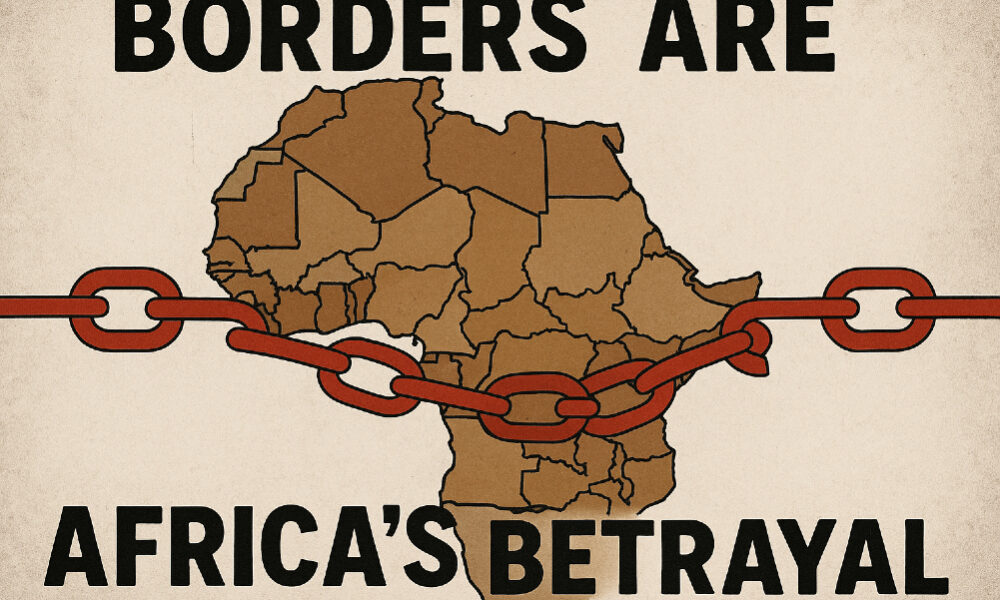
Borders Are Africa’s Betrayal – It’s Time to Unshackle the Continent


By Farhia Noor
I am African. And I ask a simple, urgent question: How long will we remain strangers in our own homeland?
When colonial powers retreated from Africa, they left behind more than extractive economies and political instability – they left borders. Not natural frontiers, but artificial lines drawn in boardrooms in Berlin, London, and Paris – designed not to unite, but to divide; not to empower, but to control.
These borders turned brothers into foreigners, split families, and severed trade routes that had flourished for centuries.
More than six decades after independence, these colonial cages remain intact – not enforced by foreign troops, but by African leaders who now guard them with visas, checkpoints, and bureaucracy.
In 2018, the African Union (AU) made a bold promise: the Protocol on Free Movement of Persons. A vision of a borderless Africa.
A continent where any African could live, work, study, and trade freely from Cape to Cairo, from Dakar to Djibouti. It was a step toward reclaiming our sovereignty, our unity, our destiny.
Yet, as of 2025, only four out of 55 African Union member states have ratified the protocol. Four.
That is not progress. That is betrayal.
At every AU summit, leaders recite the mantra of Agenda 2063 and Pan-Africanism – grand visions of integration, prosperity, and self-reliance. But behind the podium, they stamp visas on African passports like gatekeepers of a colonial prison.
Their speeches celebrate unity. Their policies enforce division.
Let’s confront the shame:
- A European passport grants visa-free access to over 30 African countries.
- An African passport? Often denied entry even to neighboring nations.
So I ask: Who truly owns Africa? The people who were born here, or the outsiders who move more freely across our soil than we do?
The Colonial Borders We Still Obey
Today’s borders do not protect us. They control us.
They are tools of exclusion – designed to keep Africans poor, fragmented, and dependent. They strangle small traders carrying goods across regions. They block students seeking education beyond their birth nations. They humiliate professionals denied the right to work where opportunity exists.
And while African youth face visa denials and bureaucratic hurdles, foreign investors, consultants, and diplomats move with ease – often backed by the very governments that preach African self-determination.
This is not sovereignty. It is subjugation in a new form.
Every delay in ratifying the Free Movement Protocol entrenches a system that privileges outsiders over Africans. Every visa requirement between African nations is a monument to colonial logic – still standing, still enforced, still justified in the name of “security” or “national interest,” while the real cost is paid by ordinary people trying to build better lives.
These borders were never ours. And yet, we are the ones policing them.
Empty Rhetoric, Broken Promises
Unity is not a flag. It is not a slogan. It is not a ceremonial handshake at a summit.
True unity is the freedom of an Ethiopian student to study in Ghana. A Senegalese entrepreneur to launch a business in Kenya.
A Congolese artist to tour the continent without begging for permission.
Until that freedom becomes reality, every “Pan-African” speech is hollow. Every pledge to integration is a lie.
Our leaders speak of a single African market, of digital transformation, of industrialization. But how can we build a common market when our people cannot move freely within it?
How can we foster innovation when talent is trapped by borders?
Agenda 2063 promised a “continent integrated, prosperous, and peaceful.” But integration without mobility is a fantasy.
Prosperity without access is a myth. Peace without unity is fragile.
The AU must stop measuring progress by photo-ops and start measuring it by passports – how many African citizens can travel, work, and live freely across the continent without permission.
The Youth Are Already Building the Future
But hope is not lost.
Africa’s youth are already building the bridges our leaders refuse to construct. Through cross-border trade, digital innovation, music, fashion, and grassroots solidarity, young Africans are dismantling barriers one connection at a time.
From Afrobeats uniting playlists across nations to informal traders moving goods through unofficial routes, the people are voting with their feet – and their dreams.
They understand an ancient African proverb: “When brothers fight, strangers inherit the land.” As long as we remain divided by colonial borders, others will profit from our fragmentation.
The truth is clear:
- Every delay in ratifying the Free Movement Protocol is a betrayal of 1.4 billion Africans.
- Every leader who prioritizes border control over continental unity is defending colonial relics, not African futures.
- Every empty speech about integration without action is a disservice to the next generation.
Africa stands at a crossroads. We can remain chained by borders drawn by empires long gone – or we can build bridges that honor our shared identity, our common destiny.
The choice is ours. Borders are chains. Bridges are freedom. And Africa must choose.
Farhia Noor is a seasoned business consultant based in Dar es Salaam, Tanzania. With a proven track record in developing enterprises and executing turnkey projects across both government and private sectors, she brings deep expertise to the table. Farhia is also a committed advocate for community-led development and is passionate about advancing sustainable, intra-African growth.