Opinion
Beyond Tractors: Why Africa’s Agriculture Needs Artificial Intelligence Now
The continent’s farmers are already working harder than anywhere on earth. What artificial intelligence offers is not a replacement for that effort – it is a force multiplier for it.


By Jean Claude Niyomugabo
The skeptics have a familiar script. Africa, they say, needs tractors before algorithms. Fertilizer before forecasting. The “basics” before anything as abstract as artificial intelligence.
It is a reasonable-sounding argument, delivered with the quiet confidence of those who have never watched a smallholder farmer lose an entire season’s harvest to a pest outbreak that a sensor, deployed in time, could have detected in its earliest stages.
Walk through any farming community on the continent at dawn and the rebuttal writes itself. These farmers are already awake. They are already in the fields – digging, planting, and scanning the horizon for the cloud formations that might mean relief or ruin.
They carry, in their calloused hands and accumulated knowledge, the immense responsibility of feeding entire nations. The deficit they face is not one of effort or discipline. It is a deficit of access: access to timely data, to precision tools, and to the kind of fast, evidence-based decision-making that farmers in wealthier countries have quietly taken for granted for decades.
From Guesswork To Guided Decision
The question is no longer whether Africa needs artificial intelligence in agriculture. The question is whether the continent will shape how that technology is built – or inherit a version designed for someone else.
Artificial intelligence in agriculture is not a proposal to retire the hoe. It is a proposal to tell the farmer exactly where to dig.
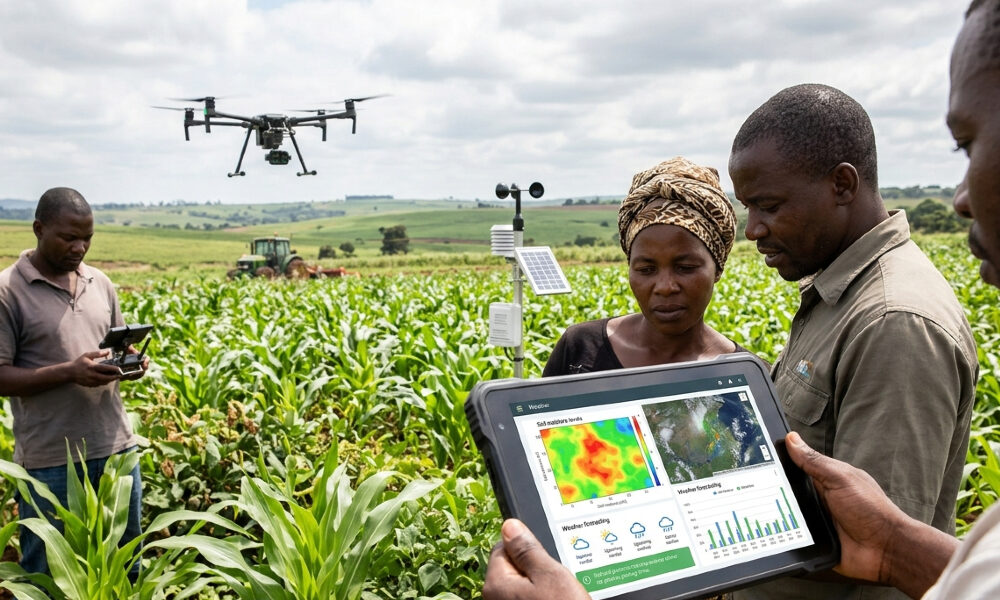
Modern AI systems can analyze satellite imagery, soil composition data, and historical weather patterns to predict with meaningful accuracy when the rains will arrive – not as a guess, but as a probability. They can identify the early signatures of crop disease or pest infestation before any damage becomes visible to the human eye.
They can recommend the precise combination of inputs – the right seed variety, the right quantity of fertilizer, applied at the right moment – that maximizes yield while minimizing waste and soil degradation. In short, they convert information, which has always existed somewhere in the world, into locally actionable intelligence.
The demographic arithmetic alone demands that this conversation be taken seriously. Africa’s population is projected to reach 2.5 billion by 2050. That figure is not merely a statistic for development economists to cite at conferences; it is a concrete, compounding pressure on arable land, on food systems that are already strained, and on the livelihoods of hundreds of millions of people.
More mouths will need to be fed on land that is becoming less predictable as the climate shifts. The margin for error is narrowing, not widening.
Without a serious commitment to agricultural innovation, the continent will continue to import at scale commodities it has every ecological capacity to produce itself – a dependency that serves no one except those who profit from it.
A Multiplier, Not a Miracle
None of this is an argument for technological utopianism. Artificial intelligence is not a miracle solution, and treating it as such would be a disservice to the farmers who need practical tools, not marketing language.
What AI represents, deployed thoughtfully and built with the specific conditions of African agriculture in mind, is a multiplier. It amplifies the impact of existing effort.
It reduces the kind of catastrophic risk that keeps smallholder farmers trapped in cycles of subsistence. It creates efficiency in domains where uncertainty has long been the only constant.
There is also a generational dimension that deserves acknowledgment. African agriculture suffers from a persistent image problem among young people on the continent, who increasingly associate farming with hardship and stagnation rather than with entrepreneurship and innovation.
Integrating AI, remote sensing, and data analytics into agricultural practice does not merely improve yields – it reframes the sector entirely. It positions farming as a domain of skill, technology, and opportunity. That reframing may prove to be as important as any marginal improvement in crop output.
The question, then, is not whether Africa needs artificial intelligence. That question has already been answered by the pressures of population growth, climate volatility, and global food market dynamics.
The question is whether Africa will be an active architect of how this technology is designed and deployed – whether it will build systems calibrated to local soils, local languages, local constraints, and local ambitions – or whether it will, once again, receive a version of the future shaped by others, for others, and wonder why it does not quite fit.
The continent does not need more well-intentioned lectures about prerequisites. It needs investment in digital infrastructure, in locally trained agronomists who understand both the technology and the terrain, and in policy frameworks that give farmers genuine access to the tools that are already transforming agriculture elsewhere. It needs precision, not pity. It needs more tools, and fewer reasons to wait.
Jean Claude Niyomugabo is an entrepreneur and digital communication specialist with a strong passion for Africa’s development. He is dedicated to harnessing the power of social media to drive positive change and enhance livelihoods. With diverse interests and a strategic approach to digital engagement, he strives to create meaningful impact through innovation and connectivity.