Opinion
Beyond the Mines: Southern Africa’s Industrial Awakening
The region has the minerals, the markets, and the moment. What it does next will decide whether it merely supplies the world’s factories – or becomes one.


By Dishant Shah
For decades, Southern Africa’s role in the global economy has been simple, almost old-fashioned: dig it up, ship it out. Copper from Zambia, diamonds from Botswana, platinum from South Africa, gas from Mozambique – the region has long been a pantry for other people’s factories. That story is starting to change, and quietly, it may be changing faster than most investors realize.
While East Africa builds the ports and railways that move goods, West Africa cultivates consumer markets a billion people deep, and North Africa assembles cars and components for European supply chains, Southern Africa has been doing something less visible but arguably more consequential: assembling the raw ingredients of industrialization itself. The question is no longer whether the region can industrialize. It is how fast it can move before the world’s attention – and capital – shifts elsewhere.
South Africa: The Anchor, Not the Whole Story
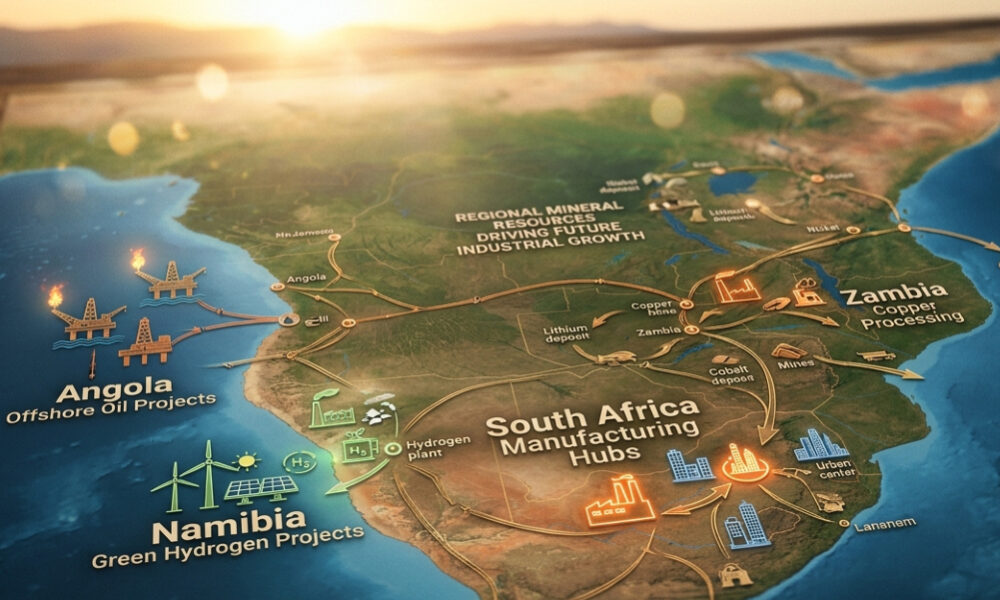
South Africa remains the region’s undisputed industrial heavyweight. It manufactures automobiles, chemicals, machinery, steel, mining equipment, and processed food, and it runs financial markets sophisticated enough to rival those of much larger economies.
Neighboring countries still lean heavily on South African factories for the industrial inputs they cannot yet produce themselves.
But treating South Africa as the whole of Southern Africa’s industrial story is like judging an orchestra by its loudest instrument. The real momentum is building in the countries around it.
The Rise of the Industrial Satellites
Botswana is using diamond revenue to fund beneficiation and downstream industries, rather than simply exporting rough stones.
Namibia is positioning itself as a future hub for green hydrogen and critical minerals – a bet that could pay off handsomely as global energy markets retool.
Zambia is pushing to process more of its copper at home instead of shipping raw ore to smelters abroad, climbing the value chain one refinery at a time.
Zimbabwe sits on lithium, platinum, and chrome reserves rich enough to anchor battery and metal-processing industries – if political and policy stability finally catches up with its geology.
Mozambique is parlaying enormous natural gas discoveries into investment in fertilizer, petrochemicals, and energy-intensive manufacturing.
And even the region’s smallest economies, Eswatini and Lesotho, have carved out export-oriented textile and apparel sectors by making smart use of preferential trade agreements.
None of this is happening in a vacuum. It is happening because the underlying resource base makes it almost inevitable.
A Resource Base the World Cannot Ignore
Southern Africa holds staggering reserves of copper, platinum, manganese, lithium, chrome, cobalt, uranium, rare earths, coal, natural gas, and diamonds – precisely the inputs the global economy needs for electric vehicles, renewable energy, and advanced electronics. Resources have never been the region’s problem. The problem has always been conversion: turning what is in the ground into factories, skilled jobs, exportable technology, and durable wealth.
That conversion requires more than mineral wealth. It requires affordable electricity, modern ports, efficient rail networks, a skilled workforce, predictable regulation, and access to capital.
On every one of those fronts, Southern Africa is making progress – but unevenly. Power shortages, aging infrastructure, logistics bottlenecks, and policy uncertainty continue to slow investment in several countries, and no amount of mineral wealth can fully compensate for a port that cannot move containers or a grid that cannot keep the lights on.
Why the Tailwinds Matter More Than the Headwinds
Despite those very real obstacles, the long-term trends are unusually favorable. Global supply chains are diversifying away from single-source dependence, particularly in critical minerals.
Demand for battery-grade materials is accelerating as the energy transition gathers pace. Manufacturers worldwide are actively scouting new production bases to de-risk their operations. And the African Continental Free Trade Area now offers exporters a regional market larger and more integrated than at any point in the continent’s history.
Put those forces together, and Southern Africa starts to look less like a collection of mineral exporters and more like an industrial region waiting for its moment to arrive.
The Decade That Decides
For investors, exporters, equipment manufacturers, and industrial suppliers, Southern Africa may represent one of the continent’s most consequential long-term opportunities – precisely because it remains underestimated. The next ten years will likely determine which version of the region’s future prevails: one where it continues supplying raw materials to factories elsewhere, or one where it becomes a manufacturing power in its own right, processing, building, and exporting finished goods to the rest of the Global South.
The minerals are already there. The market access is already there. What remains is execution.
Dishant Shah is a partner at Legion Exim, a company specializing in facilitating the export of high-quality engineering products directly sourced from manufacturers in India to Africa. His areas of expertise include new business development and business management.