Opinion
Beyond Concrete: Why Africa Needs Industrial Sovereignty to Grow Tenfold
Africa is pouring concrete as though it were a development strategy. It is only the launchpad, and Uganda’s tenfold growth ambition shows why the difference matters.


By Apollo Buregyeya
Uganda Airlines flies a fine Bombardier. Fly it faster and it is still a Bombardier. Bolt on a third engine and it becomes a Bombardier with a problem. A rocket is not a faster aircraft. It is a different machine, with different fuel, different guidance and a different crew.
Uganda’s Tenfold Growth Strategy, a plan to multiply the size of its economy, is a rocket mission. Across Africa, where governments from Dakar to Dar es Salaam have set similarly bold targets, the temptation is to fly the Bombardier harder.
Flying harder is easy to recognize. It means counting kilometers of tarmac, megawatts installed, industrial parks opened and ribbons cut. These are good numbers, and necessary ones. But necessary is not sufficient, and the continent’s history explains why.
The Railway That Points To the Sea
The Uganda Railway reached Lake Victoria in 1901 as an imperial project. It was built to carry the interior’s resources to the coast and to pull imperial trade inland. It was excellent engineering. It was also never designed to leave Africans with the capacity to build railways, or with an industrial economy of their own.
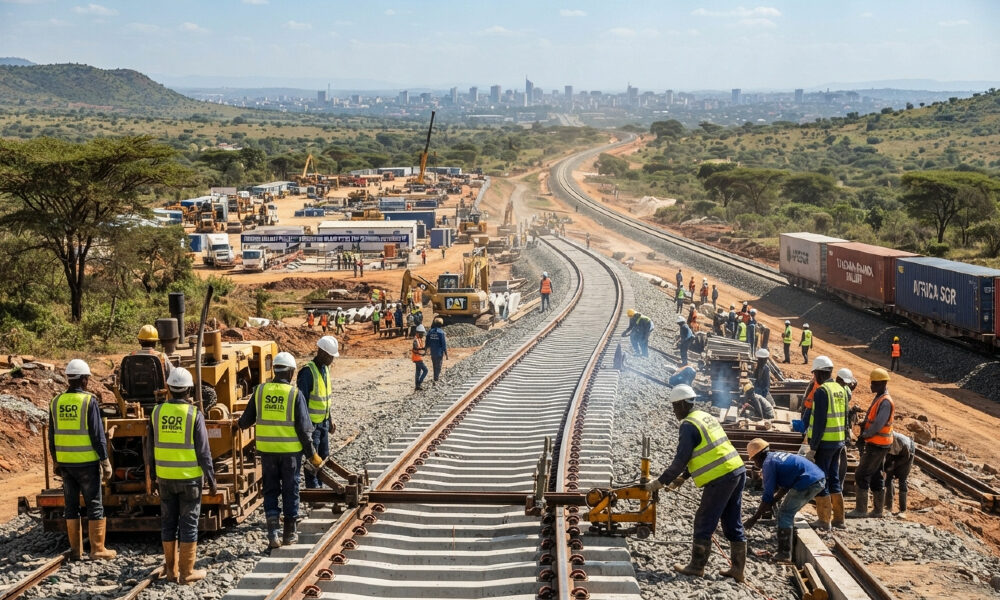
The same pattern runs across the continent. Colonial lines in West, Central and Southern Africa were laid from mines and plantations to ports, rarely from one African market to another. Today, Uganda is borrowing heavily to build a standard gauge railway that once again points toward the coast, while a line linking Africans to one another, running from Butembo to Bujumbura via Kasese and Kabale, waits its turn.
Infrastructure is never neutral. It always works for somebody’s economy.
None of this is an argument against airports, roads, power plants or industrial parks. Africa’s infrastructure deficit is real, and it throttles everything from farm incomes to factory costs. It is an argument against inheriting the colonial purpose of infrastructure: moving raw materials out, bringing finished goods in, and leaving design, manufacturing, maintenance and finance somewhere else.
So the right question is not how much we have built. It is what we can do now that we could not do before.
Three Questions For Every Project
Does an airport create African engineering, maintenance, catering, furniture, logistics, digital-services and aviation-support businesses? Does a road connect farmers to processors, factories to markets and local producers to exporters? Does an industrial park nurture local suppliers, technicians, fabricators and technology firms, or does it merely offer serviced land for imported machinery and imported inputs?
At a recent Doing Business Forum in Uganda, the answers were sobering. About 30 percent of work permits, the forum heard, go to the construction sector. Indigenous contractors receive roughly 15 percent of the work while supplying about 40 percent of the labor. Fewer than one builder in ten has formal training. And in 2024, Uganda imported about $232 million worth of iron and steel.
The irony writes itself. A country is importing the industrial skeleton with which it hopes to become industrial. It is building a great deal. It is not yet building itself.
What a War Footing Looks Like
Skeptics will say industrial policy is a fashion, and that Africa’s record with it is mixed. They are right about the record, and the lesson is not to abandon the effort but to take it seriously.
China’s 2015 industrial strategy, Made in China 2025, did not hedge. It treated manufacturing as a condition of national strength and a survival imperative, then attached targets to it. Whatever one makes of its methods, the seriousness was unmistakable. Africans may fairly borrow the lens and ask whether their own growth strategies are a war footing or merely another good story, like the ones the continent has heard before.
Africa now has a tailwind its predecessors lacked. The African Continental Free Trade Area, if implemented in earnest, offers the single market that colonial infrastructure was designed to prevent. But a free-trade area with nothing competitive to trade is a customs form, not a strategy.
The Full Rocket
Consider the whole machine. In Uganda’s plan, the engines are agro-industrialization, tourism, minerals plus oil and gas, and science, technology and innovation. Infrastructure is the launchpad. Industry is the propulsion. Skills and institutions are the guidance system. Finance is the fuel, and too much of it currently flows into land plots, rental property and Treasury bills. Nobody has ever harvested a factory from a Treasury bill.
Construction, in this picture, is both the assembly hall and the university. Every major project should leave behind trained technicians, capable local suppliers, working quality systems, equipment-maintenance capacity and firms able to deliver the next project at a higher level. That is what local content rules, apprenticeship requirements and procurement reform are for. Without enforcement they are slogans. With it, they are how a continent turns contracts into capabilities.
The Only Test That Matters
Before celebrating any completed project, ask one question: when the foreign contractor leaves, what can Africans now make, repair or run that they could not before?
If the answer is “the ribbon,” then the continent will keep flying very good Bombardiers: economy class, in an economy designed by somebody else.
Apollo Buregyeya, Ph.D., is a civil engineer and entrepreneur focused on developing sustainable African industries that leverage local mineral resources to improve living standards. He is the founder and CEO of Eco Concrete Ltd, a construction company specializing in innovative solutions tailored to the African environment. Committed to resource ownership and appropriate technology for value creation, he also teaches at Makerere University in Kampala, Uganda.