Owusu on Africa
Benin’s Olive Branch: A Sensible Thaw in the Fractured Sahel
A presidential inauguration becomes a quiet but consequential act of regional diplomacy.


By Fidel Amakye Owusu
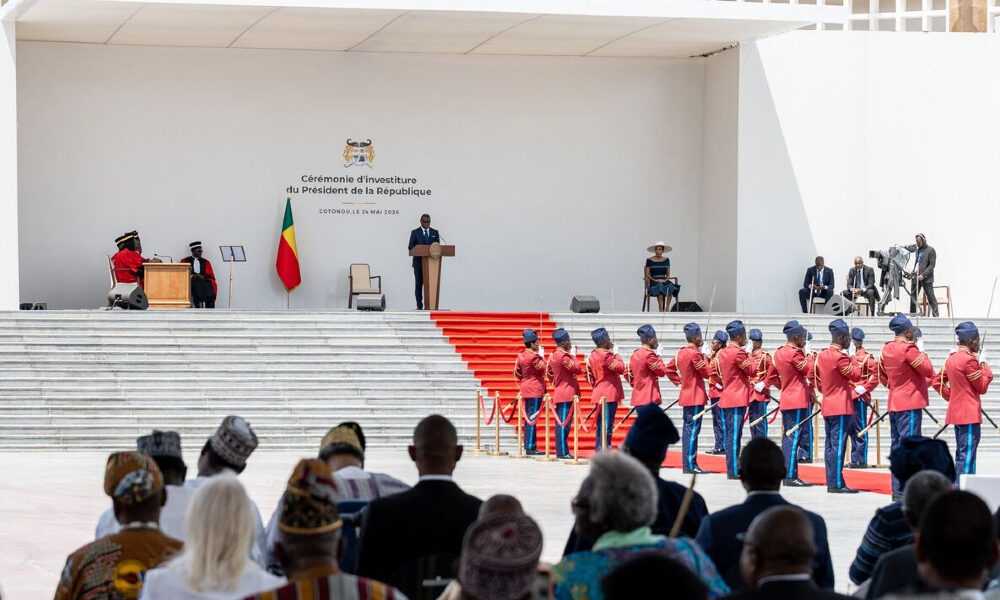
West Africa’s fractured geopolitical landscape showed a rare flicker of promise last week, as Benin’s newly inaugurated president extended an olive branch to the military-led governments of the Alliance of Sahel States – a gesture that, however symbolic, carries outsized strategic significance for a region battered by terrorism and political rupture.
The new president – formerly the finance minister in the outgoing government – used the occasion of his inauguration to signal a clear break from the tensions that have defined Benin’s relationship with its landlocked northern neighbor, Niger, since the latter’s military coup. By extending invitations to representatives of the Alliance of Sahel States (AES), a bloc comprising Niger, Mali, and Burkina Faso, the incoming leader made his intentions unmistakable: Cotonou is open for dialogue.
The response from the AES was equally telling. Niger dispatched a prime minister; Burkina Faso sent its foreign minister. These were not courtesy appearances. In the careful choreography of African diplomacy, the seniority of a delegation speaks volumes – and the message here was one of reciprocal seriousness.
A Rift With Real Consequences
To appreciate the significance of this diplomatic overture, one must understand how sharply relations had deteriorated. Following the July 2023 coup in Niamey, the Economic Community of West African States (ECOWAS) threatened military intervention to restore Niger’s deposed civilian president – a position Benin, as a member state in good standing, was compelled to support.
For two countries that had maintained warm relations for decades, the crisis forced an abrupt and painful realignment. Niger and Benin found themselves on opposite sides of a widening fault line.
The fallout was not merely diplomatic. The oil pipeline connecting Niger’s southeastern oil fields to Benin’s Atlantic coast – a vital artery for both economies – became a casualty of the breakdown in trust. Its functioning was disrupted at precisely the moment regional infrastructure most needed to demonstrate its value.
More alarming still was the security vacuum created by the estrangement. Counter-terrorism cooperation between Benin and Niger, already strained by the broader ECOWAS crisis, effectively collapsed.
Islamic State-affiliated groups seized on the opportunity, intensifying attacks on both sides of the porous border and exploiting the absence of coordinated intelligence-sharing and joint operations. The border, once a relatively manageable frontier, became a gateway for extremist activity.
The Larger Context: ECOWAS in Crisis
The deterioration of Benin-Niger relations is, in many ways, a microcosm of a broader institutional crisis gripping West Africa. For the first time in its fifty-year history, ECOWAS – established in 1975 as the region’s premier vehicle for economic integration and collective security – has experienced the formal withdrawal of three of its members.
Mali, Burkina Faso, and Niger exited the bloc in a coordinated move, forming the AES as an alternative framework anchored in military solidarity and anti-Western sentiment.
The schism has raised fundamental questions about ECOWAS’s relevance and cohesion. Its threat of military force against Niger was never acted upon, and its subsequent isolation of the Sahelian juntas arguably deepened regional instability rather than resolving it.
The departing states have repositioned themselves geopolitically – turning away from France and Western partners and toward Russia – complicating the security calculus for coastal states like Benin and Togo that remain formally aligned with the West.
Pragmatism Over Principle?
Benin’s outreach to the AES states invites a pointed question: is this pragmatic statesmanship or a quiet capitulation to the new regional order? The answer is almost certainly the former – and the more defensible one.
Whatever the moral complexities of engaging with governments that came to power through unconstitutional means, the security arithmetic is unambiguous. Terrorism does not respect diplomatic protocols.
The extremist groups operating in the tri-border areas of the Sahel are indifferent to ECOWAS membership cards; they exploit every seam of political dysfunction with lethal precision. A Benin that refuses to engage with its Sahelian neighbors on security grounds accomplishes little beyond ensuring that those seams remain wide open.
The oil pipeline calculus reinforces the case. Niger’s energy revenues depend in significant part on export access through Benin. Benin, in turn, has an economic interest in positioning itself as the indispensable gateway to the landlocked Sahel.
Normalizing relations is not just strategically sound – it is economically rational for both parties.
Cautious Optimism
None of this is to suggest that the road ahead is smooth. The structural tensions that produced the ECOWAS schism have not disappeared.
Niger, Mali, and Burkina Faso remain under military governance with no firm timetable for the restoration of civilian rule. Their alignment with Russia’s Wagner Group successor forces continues to unsettle Western partners.
And the terrorist threat – from both Islamic State and al-Qaeda affiliates – shows no sign of abating.
Yet there is something instructive in the fact that both sides showed up. The AES governments have proved willing, at least in this instance, to set aside the rhetorical absolutism that has characterized their posture toward ECOWAS-aligned states.
Benin’s new president has demonstrated that he understands the difference between solidarity with an institution and hostility to a neighbor.
If this inauguration marks the beginning of a genuine, sustained diplomatic re-engagement – one that restores intelligence-sharing, revives the pipeline agreement, and lays the groundwork for coordinated counter-terrorism operations – it will matter far more than the ceremony that occasioned it. In the Sahel, where the cost of political dysfunction is measured in lives, even modest progress deserves careful attention.
Fidel Amakye Owusu is an International Relations and Security Analyst. He is an Associate at the Conflict Research Consortium for Africa and has previously hosted an International Affairs program with the Ghana Broadcasting Corporation (GBC). He is passionate about Diplomacy and realizing Africa’s global potential and how the continent should be viewed as part of the global collective.