Opinion
Before Africa Builds, It Must Learn From West Africa’s Fuel Market
A regional fuel benchmark won’t fix West Africa’s energy market. Understanding the market it already has might.


By Farhia Noor
In 1953, a young agronomist named Amílcar Cabral set out across Portuguese Guinea with a clipboard, not a manifesto. For nearly two years, he and his colleagues surveyed the land: what grew where, how villages organized labor, why some districts thrived while others starved. Cabral would go on to become one of Africa’s most consequential anti-colonial thinkers, a man whose name is now synonymous with liberation. But before he tried to change Guinea-Bissau, he tried to understand it. He counted crops. He mapped soil. He listened to farmers explain, in their own terms, why the system worked the way it did.
That sequence – understand, then transform – is not a historical footnote. It is a discipline that much of African policymaking still gets backward. And nowhere is the cost of skipping it more visible today than in West Africa’s rapidly evolving fuel market.
The Region Doesn’t Lack Pieces. It Lacks Connections.
As African refining capacity expands and reshapes the continent’s physical supply of fuel, West Africa is edging toward something ambitious: a regional pricing benchmark and trading hub that could finally give the region control over how its own fuel is priced, rather than importing a number set somewhere else. It is a worthy goal. It is also, for now, premature.
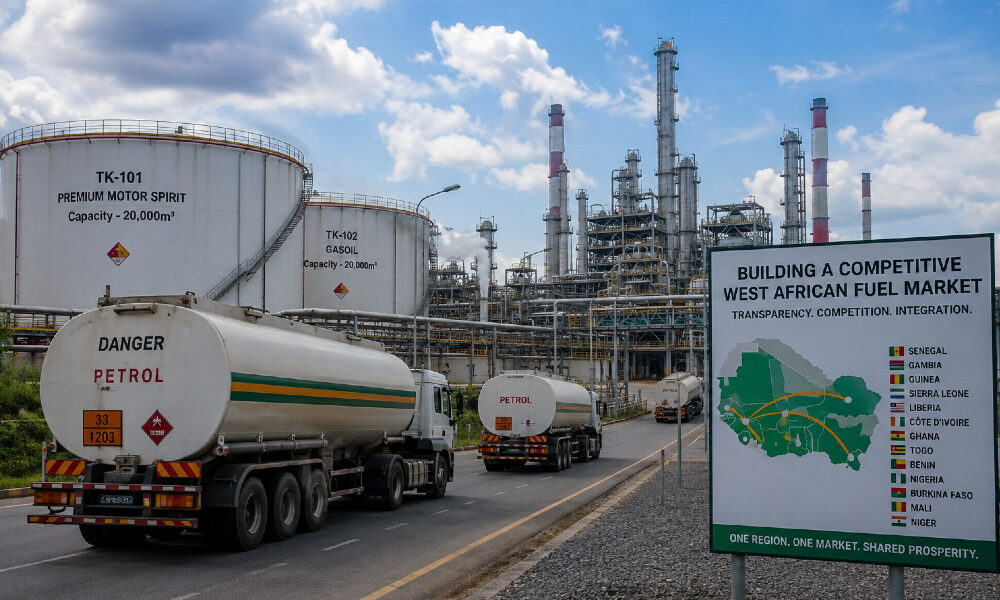
A country-by-country mapping of the region’s energy infrastructure reveals a striking pattern: the raw materials for a credible, competitive fuel market already exist. Nigeria has the scale to anchor supply. Lomé has the trading infrastructure to deepen liquidity. Ghana has the storage capacity, quality-control systems, and inland distribution networks to move fuel efficiently once it lands. Abidjan and Dakar add refining depth and resilience on the western flank. Cotonou offers transit capability that shortens the distance between port and pump. And the landlocked trio of Burkina Faso, Mali, and Niger present the hardest and most instructive test of all: what does reliable inland fuel supply actually require, when geography itself works against you?
None of these countries needs to replicate what its neighbors already do well. West Africa does not need eight versions of the same refinery, the same storage terminal, or the same trading desk. It needs these complementary national capabilities to function as a single, interoperable market – one where a liter of fuel can move from a Nigerian refinery to a market in Ouagadougou with predictable cost, verifiable quality, and minimal friction at every border it crosses.
A benchmark price is meaningless if the market underneath it isn’t trustworthy. You cannot price what you cannot see, verify, or move efficiently. Build the market first. The benchmark will follow, because it will finally have something real to measure.
Five Places to Start
Getting there does not require a grand unified infrastructure project. It requires disciplined, sequenced action.
First, build regional market intelligence. Right now, no single body has comparable, real-time visibility into production, imports, inventories, trade flows, and bottlenecks across the region. You cannot manage what you cannot measure, and West Africa is currently trying to manage a market it can only partially see.
Second, map the true cost of every corridor. The price of fuel at the pump is never just the reference price. It is the reference price plus port handling, storage, financing costs, border friction, and transport – stacked, corridor by corridor. Mapping that stack honestly shows exactly where unnecessary cost is entering the system, and where it isn’t.
Third, make quality systems interoperable. Regional standards are only as good as the trust between the national systems that enforce them. A quality certification issued in Accra needs to mean something in Bamako. That requires mutual recognition, not just parallel rulebooks.
Fourth, protect competition and price integrity. A strong African refinery is an enormous asset – but it should anchor supply without becoming the market. Credibility depends on multiple buyers, multiple sellers, multiple locations, and transactions that can actually be observed. A market with one dominant voice is not a market; it’s a monopoly wearing a market’s clothing.
Fifth, build from the bottleneck backward. If storage is the constraint, finance storage. If ports are the constraint, fix ports. If borders are the constraint, fix the border. This sounds obvious, yet the temptation to build prestige infrastructure – a flagship terminal, a signature pipeline – often overrides the far less glamorous work of fixing the actual chokepoint. Symbolic construction photographs well. It rarely solves the problem.
The Real Leadership Question
The question West African leaders have been asking – who sets Africa’s fuel price? – is the wrong one, or at least the premature one. The better question is what system makes an African price credible, competitive, and deliverable in the first place. A benchmark without an underlying market is just a number with no market discipline behind it.
And this is where Cabral’s example becomes more than a historical parallel – it becomes a governing principle. His insistence on surveying the land before attempting to transform it reflects a truth that applies well beyond agriculture or energy: policy built on an inaccurate picture of reality can be perfectly designed for a country that does not exist.
Consider how easily this gap opens. A government may know its GDP figures cold, yet not know why a specific district cannot produce. It may track unemployment precisely, yet have no idea what capabilities the unemployed already possess. It may report agricultural output every quarter, yet not understand what actually prevents farmers from reaching markets. It may count how many businesses are registered, yet not know where value quietly disappears between production and ownership. It may celebrate school enrollment numbers, yet have no clear sense of what those years of education become once a student leaves the classroom.
Data is not the same thing as understanding. And reading a report about how a system behaves is not the same thing as knowing how it actually behaves, on the ground, when no one is measuring it.
This does not mean every president needs to personally conduct a land survey, the way Cabral once did. Modern states have statistics offices, universities, ministries, local authorities, and digital systems built precisely for this purpose. The leadership responsibility is narrower but no less demanding: build a state that can see itself clearly, and then act on what it sees – even when the picture is inconvenient.
That last part matters most. Ideology creates its own kind of blindness. When leaders grow attached to what they believe should be true, evidence that contradicts the preferred narrative starts to look like a nuisance rather than information. That is precisely the moment a government begins losing its grip on reality – not through a lack of data, but through an unwillingness to look at the data it already has.
Understand Before You Transform
The lesson from Cabral was never about liberation-era politics, and it isn’t a template to transplant onto modern African governance wholesale. It is something simpler and more durable: understand reality before trying to transform it. Listen before prescribing. Map before allocating. Measure before claiming success. Learn before leading.
West Africa’s fuel-market ambitions and its broader governance challenges are, in the end, the same story told twice. Africa’s constraint has rarely been a shortage of ideas – the region has no scarcity of bold plans, flagship projects, or ambitious benchmarks. The deeper and more persistent problem is the distance between the idea and the reality it is meant to change.
So the question worth sitting with is not how quickly West Africa can announce a fuel-pricing benchmark. It is whether the region has first built a market – and a system of governance – that actually understands itself well enough to make that benchmark mean something.
Farhia Noor is a seasoned business consultant based in Dar es Salaam, Tanzania. With a proven track record in developing enterprises and executing turnkey projects across both government and private sectors, she brings deep expertise to the table. Farhia is also a committed advocate for community-led development and is passionate about advancing sustainable, intra-African growth.