News
Beatriz Gomes Dias, could become the first woman of African descent to head Portuguese capital
The outcome of Lisbon’s 2021 local elections, could thrust Dias into leadership role
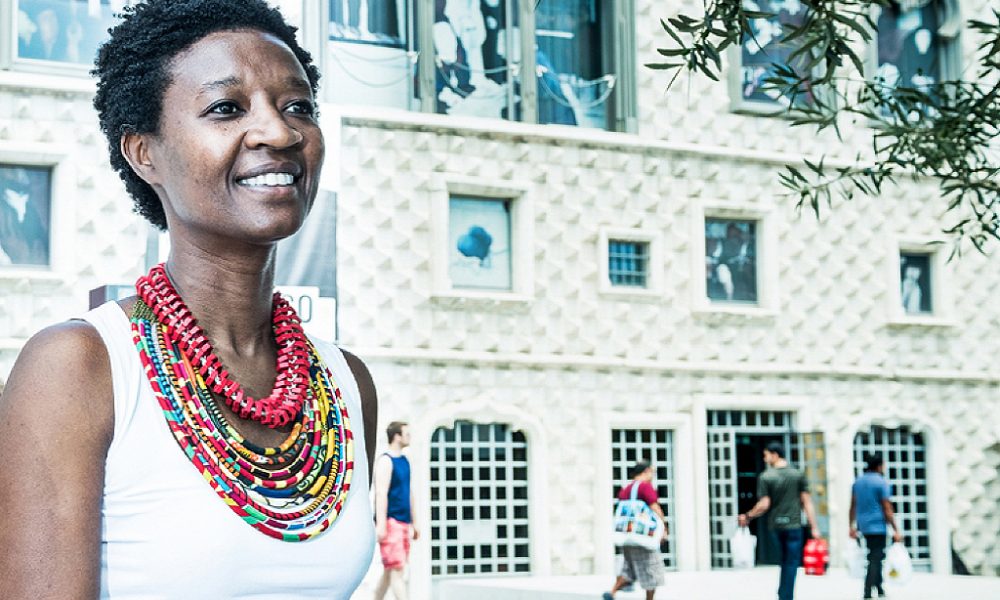
By Alexsyane Silva; translated by Liam Anderson
Come Lisbon’s 2021 local elections, which are expected to take place in late September and early October, schoolteacher Beatriz Gomes Dias could become the first woman of African descent to head the Portuguese capital, once her coalition wins a majority in the city council.
Elected as a member of Portugal’s parliament for the Left Bloc in 2019, Dias is 1 of just 3 black women in the current parliament, though she has served as a Lisbon city representative since 2018. In March 2021, she agreed to be part of the Left Bloc’s list of candidates for the city’s local elections.
Dias, who was born in Dakar, Senegal in 1971, is of Guinean descent and has lived in Lisbon since she was 4. She graduated with a degree in Biology from Coimbra University and holds a Master’s Degree in Science Communications from the Faculty of Social and Human Sciences at the New University of Lisbon. She works as a secondary school teacher and an anti-racist activist.
She is a member of the organization SOS Racism and the founder of Djass (Association of People of African Descent), which led the charge, back in 2017, to build the city’s Memorial in Honur of Enslaved People.
Dias said at the announcement of her candidacy:
I believe it is possible to build another Lisbon. A more liveable city, more inclusive, more cooperative, less unequal and with more memory. A Lisbon with the courage and determination to face the social crisis we are experiencing, the climate emergency, racism and all forms of discrimination. A city that is not serving the interests of the few, but that is truly the city of everybody.
Many netizens, among them Marlene dos Santos, declared their support for Dias:
Young people would undoubtedly be very well represented if she were elected. The serious climate crisis, racism and xenophobia are, without a shadow of a doubt, serious problems for the near future (unfortunately), which young people will have to face.
Génio Eugénio was of the same opinion, commenting on one of the candidate’s posts:
Beatriz, when I look at you with great pride, it makes me say to all the children that ‘no matter where you come from, believe that your dreams will always be worthy’. Thank you for making us feel represented.
Racist attacks
Dias has been the target of racist attacks, including death threats, since her 2019 election.
In August 2020, she – along with 2 other female politicians, Mariana Mortágua and Joacine Katar Moreira (who is also black) – received an anonymous email giving them “a 48-hour deadline” to “resign from their political functions and leave Portuguese territory”. If they failed to do so in order to “guarantee the security of the Portuguese people”, the email threatened, their families would be harmed.
The email was also sent to individuals linked to social and left-wing movements, including Mamadou Ba, director of the association SOS Racismo; Vasco Santos of the Alternative Socialist Movement (MAS); Jonathan Costa and Rita Osório of the Anti-Fascist United Front; trade unionist Danilo Moreira; and Melissa Rodrigues of the Porto Anti-Racist Centre.
President Marcelo Rebelo de Sousa condemned the threats made against the three politicians and the activists:
A racist act with criminal aspects against politicians is as reprehensible as against any other Portuguese citizen.
The president of the Assembly of the Republic, Ferro Rodrigues, also spoke about the case to the news outlet Agência Lusa, stressing the gravity of the intimidation attempt:
The attempt to intimidate members of parliament and political activists is sufficiently serious that, as President of the Assembly of the Republic, I cannot (and would not want to) fail to condemn it, and I also express my full support for those affected.
In a March 26 podcast, Dias spoke about the racist messages she has been receiving on social media since being elected:
I fight the hate speech directed at me by proposing public policies against the exclusion and discrimination of black people. We are the heirs of the liberation fighters, towards a collective cause.
Around the same time, Facebook user Ricardo Santos acknowledged that Portugal has not yet moved on from its history of racism:
Portugal has not yet truly reconciled itself with its own history. This episode and so many others thoroughly demonstrate that as long as the country is not able to broach both the great epics of the discoveries and the horrors related to colonization and slavery at the same time, it will be difficult, if not impossible, to avoid these primitive racisms.
Apart from Dias, the only other black female members of the Portuguese parliament are fellow Portuguese-Guinean Joacine Katar Moreira, and Romualda Fernandes, who was born in Guinea-Bissau.
In the midst of the October 2019 elections, Moreira said that the election of the female members of parliament “should not only be seen as an achievement, but as a fundamental tool” in contributing “to the strengthening of democracy and the republican ideals of liberty, equality and fraternity.”
This article is republished from GlobalVoices under a Creative Commons license. Read the original article.