Business
Barbados economic growth projected to be less than 1 percent in 2014 – Governor Worrell
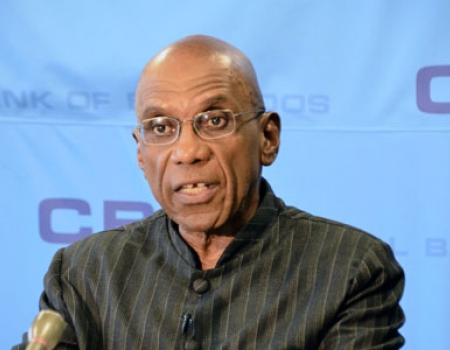
Bank of Barbados Governor, Delisle Worrell. PHOTO/FP/p>
DeLisle Worrell, the Governor of the Central Bank of Barbados, has said that tourism-related investment will impart some stimulus to the economy this financial year, however, this effect will be largely eroded by the fiscal contraction, and the forecast is for growth of less than 1 percent.
In an opinion article commenting on the current status of the Barbados economy, Worrell said the recent economic performance has been commendable given the unprecedented recession in the markets for the island-nation’s tourism and traded services.
He said the Bank of Barbados protects the value of the local currency by intervening as necessary on the interbank market.
“Up until April 2013, Barbados’ foreign exchange reserves were the equivalent of 19 weeks of imports. By September, reserves had declined to a little over 13 weeks. In response, the Freundel Stuart administration took action to introduce a major budget correction in mid-August.”
According to Worrell, the measures included expenditure cuts equivalent to about 3 percent of gross domestic product (GDP), plus additional taxes of about 2 percent.
Worrell said in December, additional measures, including job cuts in the public sector, were introduced to reinforce the effect of the August adjustments.
“Projections are for a deficit equivalent to 5 percent of GDP for fiscal year 2014/15, when the budget cuts will have full effect. Tourism-related investment will impart some stimulus to the economy in 2014, but this effect will be largely eroded by the fiscal contraction, and the forecast is for growth of less than 1 percent,” he said.
“Fiscal consolidation continues into the medium term, and the ratio of net public sector debt to GDP is expected to peak at about 67 percent of GDP in 2015, and decline thereafter. The ratio of external debt service to earnings of foreign exchange is projected at 8 percent for 2014, and to remain at about 10 percent for the foreseeable future,” he added.
Last month, the Stuart administration announced the plan to cut public service jobs in a bid to save BDS$143 million (US$71.5 million).
It said it would also institute a “strict program of attrition” across the central public service, filling posts only where it is absolutely unavoidable, over the next 5 years, ending 2018-2019.
“This attrition is expected to reduce central government employment levels from approximately 16 970 to 14, 612 jobs – a projected loss of 2 358 posts; and savings of BDS$121 million (US$60.5 million).
Over the current 19-month adjustment period public sector employment will be reduced by an additional 501 jobs with a projected savings of BDS$26 million (US$13 million),” said Economic Affairs and Finance Minister Chris Sinckler.
The National Union of Public Workers (NUPW), which represents the majority of the 28,000 public servants, has accused the government of already retrenching workers through technical maneuvers.
The government said it intends to trim the service by 3,000 jobs starting from January 15.
Worrell said the current economic recession in Barbados, which hit its lowest point in 2009, is the fourth since the mid-1970s. He said previous recessions in 1981-82 and 1991-93 were deeper and more prolonged, even though the challenges faced then were nowhere as daunting.
“Economic growth in Barbados is driven by the sectors that earn foreign currency. Small countries like Barbados specialize in the export of a few categories of goods and services that are produced profitably at prevailing international prices. The foreign exchange earned is used to fuel economic growth, which requires a range of consumer and producer goods for which there are no domestic substitutes.”
The Central Bank of Barbados estimates the potential savings from additional import substitution at less than 2 percent of imports.
Barbados’s economic growth is led by private investment in tourism, international business and financial services, and agro- processing all net foreign exchange earners, and green energy, where there is potential for savings on fuel imports.
Barbados brings a number of competitive strengths to the international market. The country’s social and political institutions are stable, the labor force skilled and educated, the physical infrastructure good, and there are strong institutions for information-sharing, discussion and democratic decision-making. -(CMC)