Opinion
Atoms, Diamonds, and the Architecture of African Development
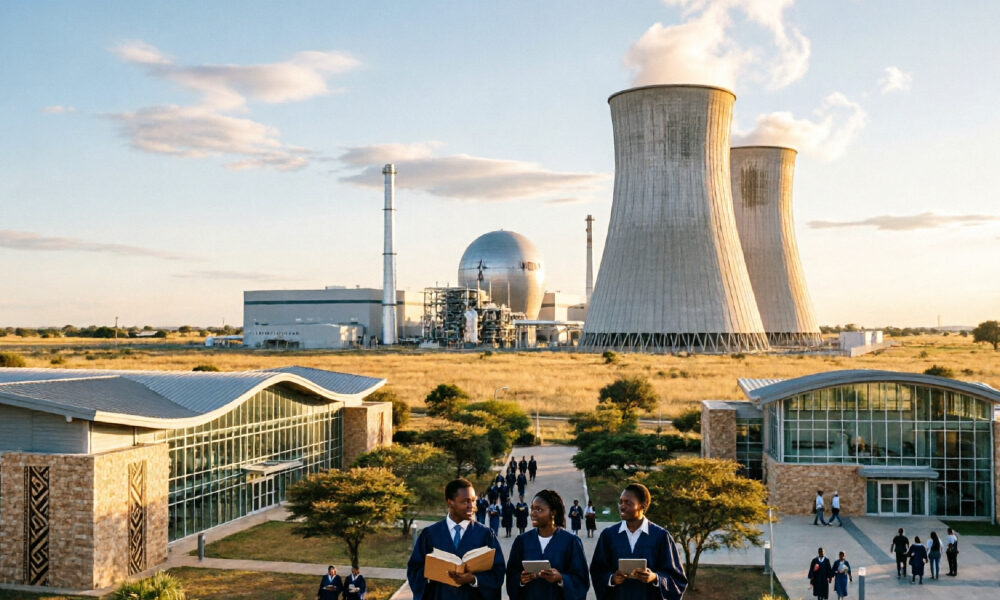
Egypt, Kenya, South Africa and Burkina Faso are pushing Africa’s nuclear ambitions forward for the first time in decades. But Botswana’s 60-year experiment with diamond wealth suggests the harder challenge isn’t building infrastructure – it’s building institutions that outlast it.

By Gregory September
For 40 years, a single power station has carried the nuclear ambitions of an entire continent. Koeberg, on South Africa’s Atlantic coast, has been Africa’s only commercial nuclear plant since 1984. One reactor complex, for a continent of 1.5 billion people. Around 600 million of them still have no access to electricity at all.
The numbers make the imbalance hard to miss. In 2025, Africa generated roughly 7.8 terawatt-hours of nuclear electricity. France alone produced 373 TWh – nearly 50 times as much, from a country with a fraction of Africa’s population. The United States generated about 782 TWh. This is not simply a gap in electricity output. It is a gap in industrial capacity: the engineering talent, regulatory maturity, and financing architecture that nuclear power demands and that, historically, most African states have not had the chance to build.
That may finally be changing.
Four Signals of a Shift
Four developments, taken together, suggest Africa’s nuclear story is entering a genuinely new chapter rather than simply maintaining its old one.
- Egypt is constructing El Dabaa, a four-reactor nuclear power plant that would represent the continent’s first major nuclear buildout in a generation.
- Kenya has invited reactor vendors to bid on a planned nuclear program of its own.
- South Africa, home to that lone aging plant, is reviving elements of its small modular reactor ambitionsAn Older Lesson, From an Unlikely Sourcea bet on a newer, more flexible nuclear technology rather than a repeat of Koeberg’s model.
- And Burkina Faso, one of the continent’s least electrified states, has approved a civil nuclear agreement with Russia, its transitional legislature unanimously adopting a bill that lays the groundwork for reactor construction, technology transfer, workforce training, waste management, and the use of nuclear techniques in healthcare and agriculture.
Burkina Faso’s entry is the most striking of the four, precisely because it is starting from the furthest back. Just 34.2 percent of the country had access to electricity in 2024. Unlike Egypt’s turnkey plant or Kenya’s competitive vendor process, Burkina Faso’s path runs through a single bilateral partner, Russia, and through an unusually deliberate effort to build the legal scaffolding first: an IAEA-backed legislative workshop in Ouagadougou has already brought together the country’s foreign ministry, its fledgling Atomic Energy Agency, its radiation-safety regulator, and half a dozen other ministries to work through the treaties, safeguards, and liability frameworks that any nuclear program eventually has to answer to. Several Burkinabe officials are already training in Russia. Whether that legal groundwork is matched, years from now, by financing, engineering capacity, and political continuity is a separate and much harder question.
For decades, the African nuclear conversation was really about preservation: keeping one plant running safely into its old age. The conversation now on the table is about creation – multiple countries, multiple reactors, multiple decades-long commitments, and, in Burkina Faso’s case, a nuclear ambition arriving well before the institutions to support it are fully formed.
That is a fundamentally different kind of question. Operating an existing plant is a technical challenge. Financing, building, regulating, and sustaining a nuclear program from scratch, across the 60-year lifespan these projects typically demand, is an institutional one. It requires stable regulatory bodies that survive changes in government, financing structures that can absorb enormous upfront costs, and a domestic technical workforce trained over years, not months. Power generation is the visible output. The institutions behind it are the actual infrastructure.
An Older Lesson, From an Unlikely Source
Africa has, in fact, run this experiment before – just not with reactors.
Since independence in 1966, Botswana has quietly built one of the more effective public education systems on the continent, funded almost entirely by diamonds. The math is striking: diamonds account for roughly a quarter of the country’s GDP, about 80 percent of its exports, and a third of government revenue. Rather than letting that windfall leak away, as resource-rich states so often do, Botswana funneled a substantial share of it into public services.
The result is free basic education, from pre-primary through secondary school, alongside university sponsorships for a large share of students. School enrollment has climbed dramatically since independence. And the broader economic story tracks alongside it: Botswana moved from one of the poorest countries in the world to an upper-middle-income, politically stable state – a trajectory almost no other resource-dependent economy on the continent has matched.
The lesson is not really about diamonds, or about education specifically. It is about what happens when a state treats a resource windfall as a decades-long investment rather than a short-term prize. Three principles made that possible.
First, capturing and ring-fencing resource rents. Botswana’s central advantage was governance: comparatively low corruption and a deliberate policy choice to save and invest mineral revenue rather than let it be siphoned off. Most resource-rich countries never clear this bar – not because the resources are lacking, but because the institutions to protect them are.
Second, sustained investment in human capital. Botswana consistently directed diamond revenue toward education, health, and infrastructure over multiple political cycles, rather than treating it as a pool of discretionary spending for whoever happened to be in power.
Third, political stability and policy continuity. Decades of relatively predictable governance allowed the country to plan on a timescale that actually matches the problems it was trying to solve. That kind of continuity is, by some distance, the hardest of the three principles to replicate quickly.
That third principle is also where Burkina Faso’s nuclear bet looks most exposed. The agreement with Russia was approved not by an elected parliament but by a transitional legislative assembly, installed after a military government took power. A 60-year reactor commitment assumes a government – or at least a state – that will still be answerable for it in 2085. Botswana’s advantage was never really its diamonds; it was six uninterrupted decades of the same basic governing bargain. Nuclear power, even more than diamonds, is unforgiving of the alternative.
The Same Question, Four Times Over
Set the nuclear stories next to the education story and a single thread runs through both: infrastructure of any kind – reactors or classrooms – is only as durable as the institutions built to sustain it.
A reactor is not simply switched on. It requires regulators who understand the technology, financing structures that survive election cycles, and a workforce trained over years. A school system is not simply funded. It requires governments willing to keep investing in it decades after the political credit for building it has faded. Botswana managed the second. Whether Egypt, Kenya, South Africa, and Burkina Faso can manage the first – not just building reactors, but building the regulatory and financial scaffolding around them – is the real test now underway.
The four countries are not really running the same experiment, either. Egypt and Kenya are pursuing conventional buildouts backed by established regulatory processes and international financing. South Africa is trying to extend four decades of operating experience into a newer, smaller reactor technology. Burkina Faso is doing something riskier: importing both the reactors and the institutions to govern them at the same time, through a single partner, under a government still defining its own legal foundations. That is not necessarily a mistake – institution-building sometimes has to happen alongside construction, not before it – but it is a materially different bet than the one Egypt or Kenya is making.
The optimistic reading is that more African governments are beginning to recognize this distinction and plan accordingly. The skeptical reading is that ambitious announcements are cheap, and multi-decade institutional commitments are not. Both readings are probably true at once, and which one dominates will likely vary sharply by country.
What is clear is that the question Africa’s nuclear moment poses is not really about electricity at all. It is about whether the continent is starting to build the kind of long-horizon institutions that complex infrastructure – of any kind – actually requires.
Which African country do you think is best positioned to become the continent’s next nuclear success story? The answer may say as much about institutions as it does about engineering.
Gregory September is a South African academic, author, and geopolitical analyst with extensive experience in government and Parliament. He is the founder and CEO of SAUP (Sustainability Awareness and Upliftment Projects NPC), which focuses on sustainability education and community development. He previously served as Head of Research and Development for the Parliament of South Africa. His work centers on sustainability, African geopolitics, and economic development, and he regularly contributes to analysis of global political and economic affairs.