Opinion
ATI is best-positioned to change the way you do business with Africa: An Interview with Manuel Moses
Introduction
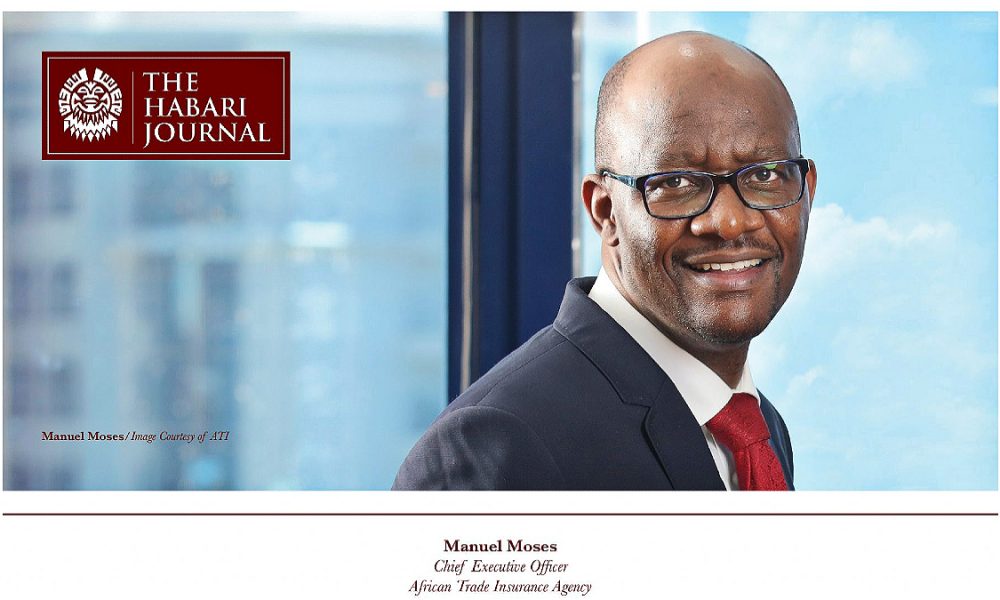
Manuel is well-known and well-regarded in the financial sector in Africa and abroad. He is easy going, ambitious and unforgettable. His former boss at the then PTA Bank, Dr. Gondwe says he’s a straight shooter and speaks proudly of him. The team he worked with at International Finance Corporation (IFC) treat him like family. The new chief executive of the African Trade Insurance Agency (ATI) officially took over Africa’s multilateral trade & investment insurer in December 2020, and the shareholders, his colleagues and staff are elated that someone with Manuel’s solid reputation, personality and good humor is sitting in the Boss’ office at the Kenya Re Towers in Nairobi. This interview is on Zoom. He sports a blazer, open shirt and half an hour before a major meeting. But this chat is not rushed. He smiles easily and gives in-depth answers.
___________________________
Dennis Matanda [DM]: Such a pleasure to meet you, Mr. Moses. So, how does one of the good guys end up in the big bad world of finance?
Manuel Moses [MM]: Well … Very nice to meet you too, Dennis [He laughs out loud]! And please call me Manuel.
DM: It is quite fitting; after all, Chubb joined recently as the first American investor, and a few months later, in the height of COVID-19, the Spanish Export Credit Agency also joined.
MM: You’re quite right about our recent success with the Spanish Export Credit Agency, and I am glad you mentioned Chubb. But as you’re aware, membership processes are lengthy and therefore, I really must give credit to my predecessors, acting CEOs John Lentaigne, and Toavina Ramamonjiarisoa.
DM: Congratulations to you and ATI. I also noted that you did not make a comment on COVID.
MM: There’s COVID, but much more to say on the African Continental Free Trade Area (AfCFTA).
DM: Interesting you should say that. How does ATI help Africans and in this case, Americans grow intra-Africa trade while increasing Africa’s share of global business via the AfCFTA?
MM: ATI was designed, created and mandated to facilitate the growth of trade and investment in Africa. And I think I should
address COVID, a topic you seem to like! [He smiles] When you juxtapose AfCFTA and COVID, you will note that one is a planned scenario [AfCFTA] while the other [COVID] was most likely given the probabilistic forecasting treatment. Unlike financial services firms all over the world, ATI is at a vantage point because we optimally balance planned scenarios & eventualities such as foreign exchange shortages or border closures on a daily basis. So, where global trade must continue to flow even in the midst of a pandemic, ATI is one of the entities that underwrites the flow; suppliers can receive payments where importers cannot make payments for any reason whatsoever. With African countries importing more from outside the continent than from within, trade credit insurance is really helpful to suppliers from around the world, in the U.S., in Africa and elsewhere. On the investment side, our political risk insurance products works to assure FDI between host governments & investors.
DM: But don’t these trade and investment products present Africa as a risky place to do business?
MM: Let me ask you a simple question, my good friend, Dennis. Why does China take over ten percent of the world’s political risk insurance polices?
DM: Is it because they attract the most business & FDI?
MM: Well … Yes and No. Some think that political risk is a concern about specific or certain transactions, and others think that banks will not lend to projects without risk mitigation. Overall, purchasing a political risk policy is the essence of pro-activity. Just as you would buy an insurance policy to cover your home or car, you buy political and credit risk insurance policies to simply have skin in the global game. Out of interest, the Berne Union, a global association provides around US$ 2.5 trn of payment protection to banks, exporters, investors and businesses every single year. I am basically saying that instead of looking at ATI as unique to Africa, one should see risk mitigation is as central to business. We just happen to underwrite opportunities in this part of the world.
DM: If you put it that way, I am almost compelled to ask what ATI’s value proposition is.
MM: Thank you for asking that. Now, I can take off my CEO hat and wear my chief sales officer hat [DM & MM laugh]. Since our establishment in 2001, we remain one of the world’s most specialized or most unique multilateral institutions. As you may know, unlike other frontier markets, the region faces an information asymmetry challenge. Because people don’t know much about us, they assume that we are much riskier to do business with than, say, Kazakhstan or Honduras. As a result, Canada, the U.S., United Kingdom and other FDI sources invested over US$ 16.5 bn in Honduras and US$ 3.1 bn in Kazakhstan in 2019.
Now look at how much the world sent to Africa in 2019. If you divided US$ 45 billion by all 55 African countries, you will get an average of US$ 800 million. In this case, it matters that whereas both Kazakhstan and Namibia have significant uranium deposits, the former attracts FDI in the billions while the latter brought in less than US$ 200 m for the period in question. Of course, we know that investors look at all kinds of metrics before investing in a country. Namibia’s risk profile is lower than Kazakhstan’s. Yes – the latter has better infrastructure but both have the same currency convertibility challenges that affect risk profiles.
But in our estimation, there ought to be some explainer or resolver of such quandaries. ATI is a frontrunner for this; one such agent of balance.
DM: An Agent of Balance? That should be the title of your value Proposition?
MM: There you go!
DM: Talking about this agent thing, what are your other super powers?
MM: Our most important super power is definitely the fact that our shareholders are sovereign nations, regional institutions and private & public sector entities. Thus, we know our Member States and the fabric of this neighborhood very well. Knowing your neighborhood is pivotal to the underwriting process, and that is why global firms like Chubb, Munich Re, Swiss Re and Lloyds of London work with us to cover a plethora of projects in the region. Secondly, even if we are owned by nations, we aren’t a concessional Guarantor. Hence, shareholders and partners can be assured of competitively priced products and an annual dividend.
DM: What do you do when America’s International Development Finance Corporation (DFC) starts to work in your backyard?
MM: You must remember that the Overseas Private Investment Corporation (OPIC) as the DFC’s predecessor also gave eligible investors a host of risk mitigation solutions. But as occurred when ATI and OPIC partnered to finance wind farming in Kenya, we expect that there are mutually beneficial ways for multilaterals like ATI to co-exist with development partners like DFC. Don’t forget those super powers you mentioned; these have capacity to benefit stakeholders and shareholders alike.
DM: This Chief Sales Officer hat suits you.
MM: Thank you, my friend. But we also have to remember that one is only as good a salesperson as their product. We have a solid product here. Let me explain: Since 2001, we’ve insured over US$ 66 bn worth of African transactions. Today, we insure trade and investments that are valued between one to two percent of our Member Countries’ annual GDP. Can you imagine what would happen if all African countries were ATI shareholders?
DM: What would happen?
MM: For starters, we’d have wherewithal to instantly grow the volume of FDI to our region, and intra-African trade under the AfCFTA. Suppose investors did not have to worry about losing their Investments? What about business people on either side of Africa’s many borders? What if they no longer had to worry about being paid and instead focused on supplying goods and services? ATI may be the growth factor.
DM: But if you’re a poignant growth factor, why aren’t all African countries beating a path to your door?
MM: As I mentioned before, ATI is not a concessional guarantor. On top of a long and laborious due diligence process to know national shareholders, our shares are also cost prohibitive. From this perspective, some countries may choose to invest their resources elsewhere. However, as evidence of our incredible value, entities like African Development Bank (AfDB), the European Investment Bank (EIB), and the German Development Bank, KfW provide African countries with grants to obtain ATI membership. The key argument here is that risk management, risk mitigation and the various products we provide are modern international business facilitation tools. It is neither a luxury, nor a privilege to carry a political risk insurance policy. ATI is not a secret ingredient, or a secret agent. We are a known entity in the world of business. Overall, if I was to make a rationale for ATI, it would be this: Suppose China takes over ten percent of the world’s political risk insurance policies and attracts over US$ 136 bn in annual FDI, how much American FDI would pivot to Africa if the U.S. suddenly put an embargo on Chinese textiles?
DM: Is this even a possibility? Should we think like this?
MM: Of course. ATI cannot afford to look at things in singular dimensions. Scenario planning and probabilistic forecasting tell us that Africa must optimally gird for and guard against global trade and investment scenarios. Political risk is global trade and investment’s largest & most unforeseeable risk, and ATI just happens to hold Africa’s most cost effective solution.
DM: What gives you this confidence in Africa?
MM: Aside from the positivity infused by AfCFTA, I am quite optimistic that even if things take more months than we originally thought, we’ll bounce back from COVID like we did after the global financial crisis. Starting with the Biden COVID stimulus package, global business shall have much needed resources infused into frozen value chains. Secondly, Africa’s on going advocacy efforts for increase of the supplementary power of Special Drawing Rights (SDRs) is going to have a positive effect on central banks and capacity to ease liquidity. A granted increase in SDRs should see enhance liquidity on many fronts. But most of all, we must continue to talk of Africa’s population growth rate, the fact that we still have the world’s highest return on investment, and that despite momentary setbacks, our continent is still trending towards liberal democracy. As we make progress towards Agenda 2063, smart investors should look to leverage ATI’s institutional value as a vehicle to add their capital to the continent.
DM: Manuel, I know that you have to go, and thank you for taking the time to chat. My last question is: What does the future hold for ATI?
MM: There is a quote that applies directly to ATI and this region: It’s amazing how a little tomorrow can make up for a whole lot of yesterday. By saying this, I know that the efforts of our founders are going to pay off significant dividends. Our aspiration is that we shall play a role in ensuring that the future remains bright for our demographic dividend, employment, and significant growth in intra-African trade and FDI from traditional and non-traditional sources.
To play a bigger role on the continent, we are expanding beyond our COMESA origins. Alongside nations within eastern and southern Africa, Member Countries include west African nations such as Benin, Cote d’Ivoire, Ghana, Niger, Nigeria and Togo. We are also working hard to bring into the fold Angola, Central African Republic, Gabon, Liberia, Mozambique, Sierra Leone and Sudan, amongst others.
By the way, this response also applies to your earlier question about our value and why African nations were not beating a path to our door. From our standpoint, it is our responsibility to make the case to African nations. Interestingly, although countries as disparate as Mauritania and South Africa are not Member Countries, they benefit from our coverage. Last but not least, I am really proud to say that ATI will welcome a number of Member Countries: Burkina Faso, Cameroon, Chad, Egypt, and Senegal are in advanced stages of ATI Membership. Simply put, we are working tirelessly to ensure that we are the facilitator we were created to be.
About Manuel Moses
Manuel Moses commenced his role as ATI’s Chief Executive Officer on December 1, 2020. He has over 25 years of experience in finance, banking, insurance and investment at the international level. Prior to joining ATI, Manuel worked at IFC for 15 years, where he most recently held the post of Country Manager for East Africa. He was responsible for IFC’s activities in the sub-region and managed a large and diverse team of experts. Manuel has also held Senior-level positions at Eastern and Southern African Trade and Development Bank (TDB), the Commercial Bank of Zimbabwe and the Zimbabwe Development Bank. He holds an MBA in Finance from the University of Leicester in the UK and a BSc in Civil Engineering from the University of Zimbabwe. He is also an associate member of UK Chartered Institute of Management Accountants.