Owusu on Africa
Arms Proliferation: The Hidden Engine of Africa’s Instability


By Fidel Amakye Owusu
A century ago, Europe’s descent into the First World War was hastened not by a single spark – but by a continent already primed for conflagration. Long before Archduke Franz Ferdinand’s assassination, Britain and Germany had locked themselves in a feverish arms race, stockpiling the very weapons that would soon drown the world in blood.
History has repeated this pattern: from the rearmament preceding World War II to the nuclear brinkmanship of the Cold War, the accumulation of arms has consistently preceded – and amplified – catastrophe.
Today, Africa finds itself at a similar inflection point – not as a passive bystander, but as a theatre where arms proliferation is actively undermining peace, development, and governance.
Despite its vast economic potential and hard-won democratic strides, the continent is increasingly besieged by domestic insurgencies, cross-border tensions, and surging terrorist activity. From the Sahel to the Horn of Africa and through the volatile heart of Central Africa, conflict is no longer the exception – it is becoming the norm.
And at the core of nearly every flare-up lies a common, corrosive enabler: the unchecked flow of small arms and light weapons, both licit and illicit.
The Global Pipeline Fueling Local Conflicts
Much of this arsenal traces its origins far beyond Africa’s borders. During the Cold War, superpowers funneled weapons to proxy regimes and rebel factions alike, indifferent to the long-term consequences.
Decades later, those same stockpiles – combined with new inflows from contemporary arms exporters – continue to circulate through informal networks, corrupt customs checkpoints, and porous borders.
The result? A thriving black market that equips everyone from jihadist cells in the Sahel to militia groups in the Great Lakes region.
Compounding the problem is the resurgence of great-power competition. As geopolitical rivals vie for influence, arms exports to African states are often driven more by strategic interest than by adherence to international norms or human rights considerations.
This transactional approach not only bypasses accountability but also emboldens state actors to reject diplomatic solutions in favor of military posturing.
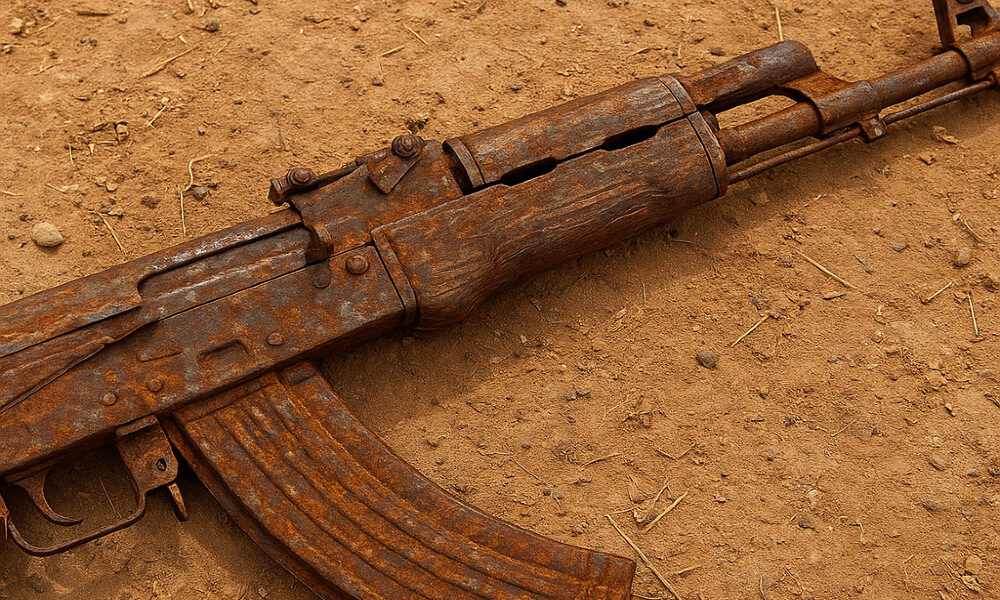
From Kalashnikovs to Collapse: The Human Cost of Weaponized Insecurity
Yet the gravest threat may lie not in state arsenals, but in the hands of non-state actors. Small arms – cheap, portable, and devastatingly effective – are the weapons of choice for insurgents, traffickers, and terrorists.
Their proliferation fuels cycles of violence that displace millions, cripple economies, and erode state authority. In environments where a single rifle can shift the balance of local power, security becomes a commodity, not a public good.
Addressing this crisis requires more than rhetoric. While Africa cannot – and should not – be expected to solve a problem largely fueled by external actors, it can lead the charge in demanding global responsibility.
The United Nations must move beyond symbolic protocols and enforce stricter, verifiable controls on arms transfers to conflict-prone regions. Simultaneously, African states should accelerate the adoption of digital border surveillance, biometric tracking, and AI-driven cargo screening to reduce human-enabled smuggling at ports and checkpoints.
But technology alone is insufficient. What is needed is a paradigm shift – one that treats arms proliferation not as a secondary concern, but as a primary driver of instability.
Just as climate change is now recognized as a “threat multiplier,” so too must the uncontrolled spread of weapons be seen as a foundational risk to Africa’s peace, prosperity, and sovereignty.
The lesson of the 20th century remains stark: when arms accumulate, war follows. Africa’s 21st-century promise hinges on ensuring that history does not repeat itself – not with cannons, but with Kalashnikovs.
Fidel Amakye Owusu is an International Relations and Security Analyst. He is an Associate at the Conflict Research Consortium for Africa and has previously hosted an International Affairs program with the Ghana Broadcasting Corporation (GBC). He is passionate about Diplomacy and realizing Africa’s global potential and how the continent should be viewed as part of the global collective.