Opinion
All aboard the Luanda express
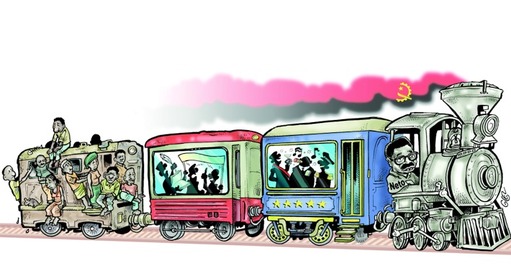
Leaders never miss an opportunity to remind us of the positive changes since the end of the civil war in 2002. Take a ride on the train to hear Angolans’ differing views. For a country that has been wracked by war for more than four decades, first the nationalist campaign against the colonial rulers and then a civil war fueled by the geopolitics of the Cold War, the coming of peace has indeed changed our reality.
Our people travel around the country without difficulty. And to help them, there are three main railway lines. The most important of these lines is the Caminho de Ferro de Benguela, which is being restored with Chinese investment and labor. Once completed, the Benguela line will link Angola to the mineral-rich Katanga Province in southeastern Democratic Republic of Congo and the Copperbelt of Zambia.
This long-awaited railway line should symbolize a new era of economic and political cooperation. But our shiny new trains have also come to symbolize a wider predicament. Angola itself is like an express train – but on a far longer journey than any of us could have imagined. Our national train’s destination was described by the leaders who led the struggle against the colonialists.
Agostinho Neto, Jonas Savimbi and Holden Roberto – in spite of how they led their troops and political cadres – all spoke of a country that would be wealthy, democratic and with a firm commitment to social and economic justice. Our political leaders often repeat these ideals as if we all need reminding of where we are meant to be travelling. And, as the train clatters down the tracks, it seems that we are travelling in very different conditions.
The select few
There is the first-class carriage where President José Eduardo dos Santos, who has been in power since 1979, remains at the centre of a powerful network of patronage. Dos Santos believes that Angola should have an indigenous entrepreneurial class that is able to compete on a global scale.
A select few travel in the luxuriously appointed first-class compartments, where Cristal champagne and dainty smoked-salmon hors d’oeuvres are served up on starched white tablecloths.The passengers stay close to the ruling Movimento Popular de Libertação de Angola (MPLA); they seize the opportunity to make serious fortunes. The business and political elite belong to the same club.
Then as we walk down the corridor, it gets rowdier and the compartments are more crowded. We come to standard class, where we find the middle classes and professionals in an increasingly critical mood. Their arguments are fuelled by grilled fish, a smattering of spicy gindungo and bottles of cold beer.
Holding court in one well-used standard compartment we find the opposition parties. Their top officials are middle-class and middle-aged. They are led by the biggest pretender to power, the União Nacional para a Independência Total de Angola (UNITA). Since Savimbi’s death in 2002, UNITA has been plagued by internal divisions – resulting in the defection of Abel Chivukuvuku.
Chivukuvuku, a charismatic orator, led the Convergência Ampla de Salvação de Angola-Coligação Eleitoral in last year’s parliamentary elections and got eight deputies elected to parliament. UNITA doubled its take to 32 deputies. UNITA and other historic parties have tried to challenge the government in the courts. They have won the odd victory.
In the last elections, they forced electoral commission president Suzana Inglês to resign after they demonstrated the legal flaws in her appointment. A few carriages down, still in standard class, the political arguments get louder and more determined. Here we find impatient young activists who vent their frustration through street protests. That unsettles the first-class carriage. From there, the presidency has ordered a clampdown on such demonstrations.
Virtual free speech
But it cannot shut down the dissidents. Young Angolans talk freely on social media, questioning why their reality is often at odds with the ideals proclaimed by the politicians. Seventeen-year-old activist Nito Alves has become a cause célèbre after the police detained him in September for trying to print T-shirts with slogans critical of Dos Santos.
Our standard-class activists, however, are confined to the large cities. The interior is firmly under the control of the provincial governors, appointed by Dos Santos. According to the constitution, there should be local elections, but officials tell us the conditions are not right. And finally we come to the third class compartments, where the noise is intense.
There is no water in the taps, and the electricity flashes on and off. The menu is that great Angolan staple, funje, eaten with beans stewed in palm oil, washed down with a soda. This is where the vast majority of Angolans are. The Voice of America has a popular phone-in program. Unusually for a program in Angola, you hear the grievances of people in the interior as well as those in the cities.
People complain about pensions that have not been paid for years, corrupt officials in hospitals and underpaid teachers. From Cabinda, the northern oil- producing enclave, you hear complaints about marginalization. People in the diamond-rich Lund provinces are asking where the money is going, and the government cracks down hard on any talk of secession.
If those political and business leaders do not pay attention to the rest of the passengers, we will again be late to our destination. Perhaps we will not get there at all. Angola has to modernize and diversify its economy. The first-class passengers must devolve some of their power to the rest of train. We should have an open conversation about politics and the economy.
The ownership of key private companies is still shrouded in secrecy. Activist Rafael Marques de Morais, one of the bolder voices in standard class, has exposed all kinds of conflicts of interest. Discussion, debate and protest on the train are lively. People from different carriages come together to celebrate our proud culture. Our differing musical traditions blare out from the compartments. We join each other in this mobile melée to dance, laugh and even cry.
Some of us dwell on the dreams of the nationalists of the 1950s and 1960s. In October, the Brazilian authorities issued an arrest warrant for General Bento dos Santos, who is accused of trafficking prostitutes. One of our respected columnists, Gustavo Costa, lamented that such a character could belong the MPLA, which had been started by such refined intellectuals as Mario Pinto de Andrade and Viriato da Cruz. Come and take a journey on our Angolan train, you will at least find that the ideals of these intellectuals are very much alive.
Copyright The Africa Report 2014