Zina’s Youth View on Africa
Algeria, Niger, and Nigeria to Shape Africa’s Energy Future?


By Godfred Zina
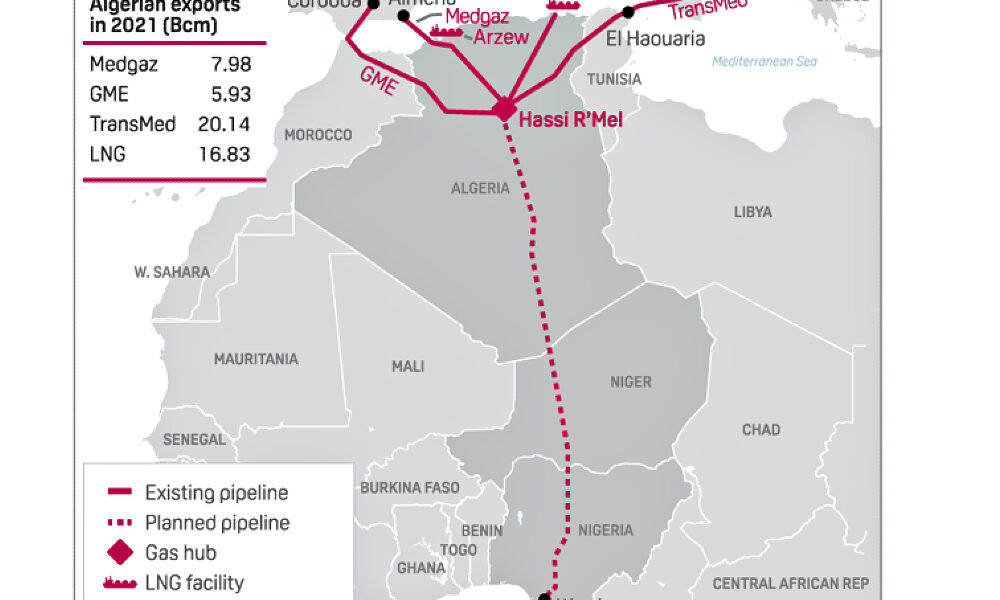
As global demand for natural gas surges and prices continue to rise in the wake of Russia’s invasion of Ukraine in February 2022, Algeria, Nigeria, and Niger have taken a decisive step forward. On February 11, 2025, the three nations signed a renewed agreement to accelerate the long-awaited Trans-Saharan Gas Pipeline (TSGP), a project that could redefine Africa’s role in global energy markets.
A Project Decades in the Making
Once completed, the TSGP is expected to transport billions of cubic meters of natural gas annually from Nigeria to Algeria. From there, the gas will either be funneled into the Transmed pipeline for delivery to Italy or exported globally via liquefied natural gas (LNG) tankers.
Despite its renewed urgency amid shifting geopolitical dynamics, the project is far from new. Originally conceptualized in the 1970s, it has faced repeated delays over the decades.
One of the most pressing concerns is financial: the project’s initial cost estimate of US$10 billion, set in 2009, has remained unchanged, raising serious questions about feasibility given soaring inflation and rising material costs.
Strategic and Economic Implications
The TSGP represents a landmark in Africa-Europe energy cooperation. By strengthening gas supply routes, Algeria, Nigeria, and Niger are positioning themselves as key players in the global energy landscape, offering Europe a more stable and diversified gas supply.
Beyond geopolitics, the pipeline holds immense economic potential for Africa. The project is expected to:
- Boost regional employment by creating thousands of jobs during construction and operations.
- Stimulate economic growth by improving infrastructure and attracting further investments.
- Enhance energy security for both Africa and Europe, reducing reliance on volatile suppliers.
Challenges and Uncertainties
Despite the renewed commitment, progress has been slow. In June 2022, energy ministers from the three nations pledged to fast-track development – yet, nearly three years later, another agreement was required to reaffirm their commitment.
Key concerns remain:
- Outdated Cost Estimates – With inflation and rising material costs, is the $10 billion budget still realistic?
- Geopolitical Risks – Algeria already exports gas to Europe through three pipelines, but one route via Morocco has been inactive since 2021 due to diplomatic tensions. The TSGP could face similar challenges.
- Global Competition – Established gas suppliers such as Russia, the Middle East, and the United States could limit the project’s strategic and economic value.
The Path Forward
For Algeria, Nigeria, and Niger to unlock the full potential of the Trans-Saharan Gas Pipeline, commitment to project timelines and transparent execution will be critical. If successfully implemented, the pipeline could transform Africa’s energy sector, drive regional economic growth, and enhance Europe’s energy security.
However, without decisive action and financial clarity, it risks becoming another stalled megaproject.
The coming months will reveal whether this agreement is a true turning point—or just another chapter in the pipeline’s long and uncertain history.
Godfred Zina is a freelance journalist and an associate with DefSEC Analytics Africa – a consulting agency specializing in the provision of accurate data and assessments on security, politics, investment, trade, and other risks within Africa. He is based in Accra, Ghana.