Opinion
AI in African Agriculture: Evolution, Not Revolution


By Jean Claude Niyomugabo
Every algorithm powering precision agriculture. Every autonomous drone mapping field boundaries. Every self-navigating tractor optimizing fuel consumption. None of them materialized overnight. They represent the culmination of decades of human ingenuity applied systematically to humanity’s oldest endeavor: feeding ourselves.
Understanding this trajectory matters profoundly for Africa, a continent where agriculture employs over 60 percent of the workforce yet accounts for merely 15 percent of gross domestic product – a productivity gap that artificial intelligence could help close, but only if we abandon the mythology surrounding it.
The Architecture of Agricultural Intelligence
Computers possess no innate understanding of soil composition, crop physiology, or meteorological patterns. What they excel at is pattern recognition – identifying what scientists call signals amid the noise of agricultural data.
For years, agronomists and engineers have collaborated to isolate and refine actionable insights: accelerated yield forecasting, optimized planting schedules, enhanced field-level accuracy.
Consider it analogous to systematic training. Trial and error, executed not across growing seasons but within lines of code.
Early agricultural technologists identified outliers worth scaling: the predictive model that detected drought conditions weeks earlier than traditional methods, the system that reduced fertilizer waste by 30 percent, the algorithm that maintained performance across diverse soil types spanning thousands of hectares.
This is machine learning demystified. Behind every incremental improvement lies a adjusted parameter, a expanded dataset, a refined decision rule.
Some modifications are modest – a single variable recalibrated. Others are transformative – entire systems architecturally redesigned.
But they occur continuously, iteratively. This is technological evolution in action.
Africa’s Opportunity in Agricultural Transformation
Modern artificial intelligence has merely accelerated what was already underway. We have learned to train models on massive agricultural datasets, identify patterns invisible from ground level, and improve decision-making without waiting through multiple growing seasons.
No mysticism involved. Simply superior tools applied intelligently.
Generative AI systems represent the next frontier. Rather than purely reactive analytics, these technologies actively generate solutions: optimized irrigation schedules adapted to microclimates, rapid disease detection protocols, precision input applications that minimize waste while maximizing yield.
For Africa, where 70 percent of the population depends directly or indirectly on agriculture, this matters enormously. The continent possesses 60 percent of the world’s uncultivated arable land yet produces far below its potential.
Climate volatility, resource constraints, and knowledge gaps create persistent food insecurity. Technology offers a pathway forward – not a replacement for farmers, but an amplification of their expertise.
Dispelling the Mythology
Some voices across Africa hear “artificial intelligence in agriculture” and recoil, perceiving something unnatural, even dangerous. This reaction ignores historical precedent.
Mechanization revolutionized farming productivity. Hybrid seed varieties transformed yields across continents.
GPS technology enabled precision agriculture that conserves resources while boosting output.
Humans have shaped agriculture since the Neolithic Revolution. What has changed is not the objective but the precision of our tools.
Previous generations planted with fingers crossed, hoping favorable conditions would materialize. Contemporary farmers test hypotheses, train predictive models, and fine-tune strategies with empirical data.
Fewer catastrophic surprises. Reduced losses. Accelerated progress.
Africa’s Agricultural Systems: Already Technological
African food systems are not pristine ecosystems untouched by innovation – they are products of continuous technological adoption, from drought-resistant varieties to mobile-based market information systems. This trajectory should continue, not stall.
Feeding a global population projected to reach 9.7 billion by 2050, with Africa accounting for more than half that growth, cannot be accomplished with 1980s methodologies. Climate change intensifies the urgency.
Rising temperatures, shifting rainfall patterns, and increasing weather volatility disproportionately affect African agriculture, where 95% of farming remains rain-fed.
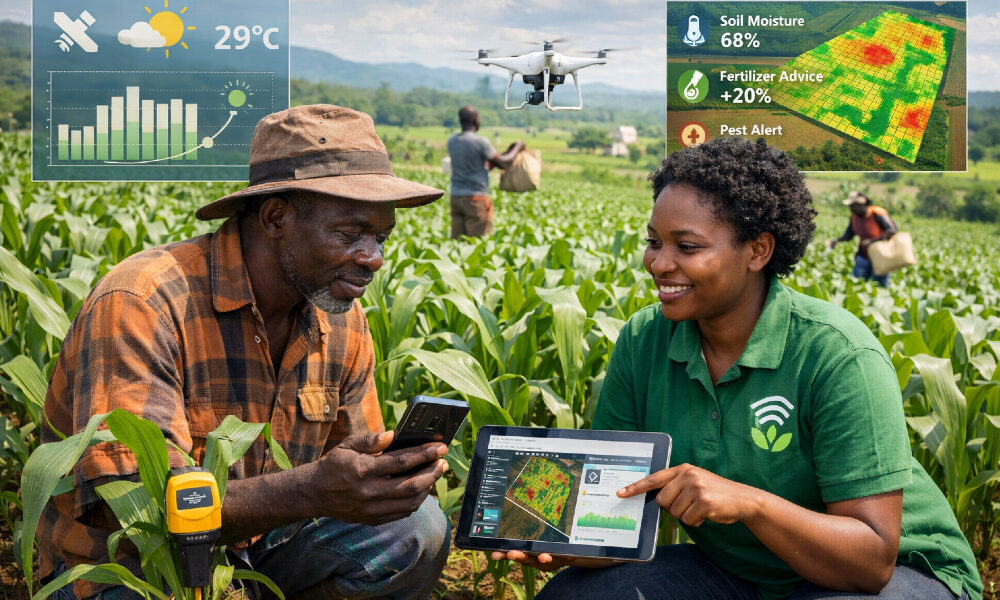
Artificial intelligence has not replaced farmers – it has amplified their capabilities. Smallholder farmers in Kenya now receive AI-powered pest and disease alerts via mobile platforms.
Nigerian agricultural cooperatives use satellite imagery and machine learning to optimize fertilizer application. Ethiopian livestock herders access AI-driven early warning systems for drought and disease outbreaks.
The Path Forward
Smarter farms yield better decisions and build resilience where it matters most: among the 250 million smallholder farming households across sub-Saharan Africa who feed the majority of the continent. Technology transfer, localized training datasets, affordable access models, and supportive policy frameworks will determine whether Africa captures this opportunity or watches from the sidelines as agricultural productivity gaps widen.
This is what progress looks like in practice – not dystopian automation displacing human labor, but intelligent systems augmenting human judgment. Africa possesses the demographic dividend, the arable land, and increasingly, the digital infrastructure.
What remains is embracing agricultural technology not as an imported solution but as a tool for African farmers to shape according to their needs, environments, and aspirations.
The question is not whether Africa should adopt AI in agriculture. The question is how quickly the continent can build the ecosystems – technical, financial, educational – that enable farmers to harness these tools effectively.
The world’s food security increasingly depends on African agriculture reaching its potential. Technology is not the obstacle. It is the accelerant.
Jean Claude Niyomugabo is an entrepreneur and digital communication specialist with a strong passion for Africa’s development. He is dedicated to harnessing the power of social media to drive positive change and enhance livelihoods. With diverse interests and a strategic approach to digital engagement, he strives to create meaningful impact through innovation and connectivity.