Opinion
AI and Africa’s Agricultural Reckoning
The continent’s coming workforce explosion demands a new kind of farming – and technology may be the catalyst that makes it possible.


By Jean Claude Niyomugabo
Africa is standing at the edge of a demographic event unlike anything the modern world has witnessed. By 2035, the continent’s workforce is projected to surpass one billion people. More than 60 percent of Africa’s population is already under the age of 25. Every year, millions of young people enter an economy that must find somewhere to put them – and fast.
For the vast majority, agriculture is not merely one option among many. It is, as a matter of structural reality, the only sector with the scale to absorb them.
Manufacturing remains underdeveloped across much of the continent. Services are concentrated in a handful of urban centers.
Farming, by contrast, is already woven into the fabric of rural life from the Sahel to the Zambezi. If Africa’s youth employment crisis is to be managed rather than inherited, agriculture must evolve – or collapse under the weight of expectation.
Structural Pressures on African Agriculture
The challenge is acute. Farm sizes are shrinking as land is subdivided across generations. Rainfall patterns have grown erratic, driven by climate pressures that disproportionately punish smallholder farmers with little buffer against a bad season. Input costs – seed, fertilizer, fuel – are rising. And commodity markets have grown more competitive, less forgiving, and harder to read without access to reliable data.
The agriculture that sustained the previous generation will not sustain the next. This is precisely where artificial intelligence, deployed thoughtfully and at scale, has the potential to matter.
The case for AI in African agriculture is not about automation displacing rural labor – a concern that, while legitimate in richer economies, misreads the African context entirely. It is about decision support: giving individual farmers the information they need to work smarter, reduce losses, and compete.
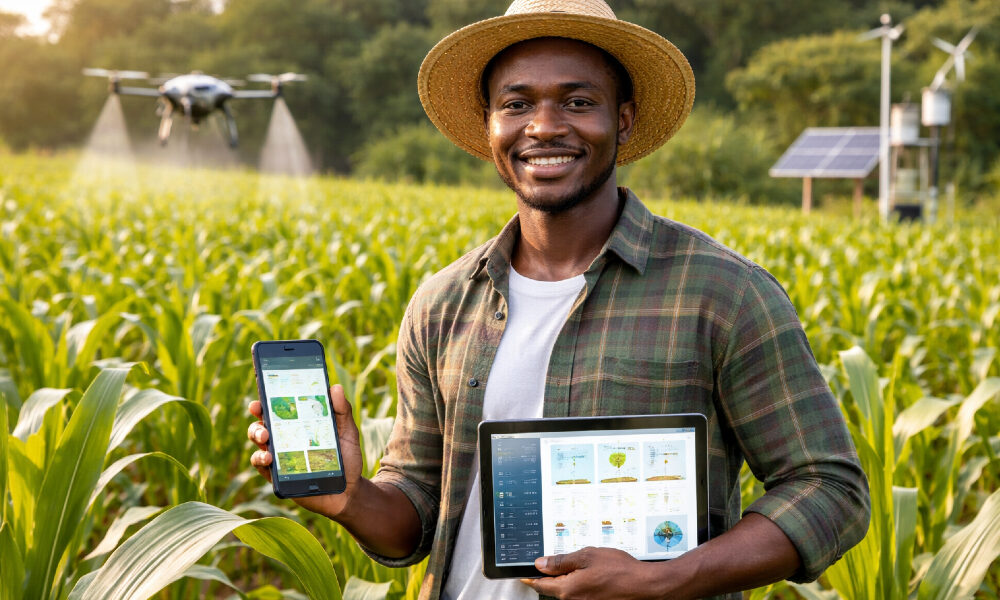
Precision weather forecasting can help a smallholder in northern Nigeria decide when to plant and when to wait. Soil diagnostics delivered through a mobile interface can guide a young farmer in Kenya toward the right inputs before the money is wasted.
Market price tools can tell a cooperative in Ghana whether to sell today or hold for a better price next week.
None of these interventions are dramatic in isolation. Aggregated across tens of millions of farms, they amount to something transformative.
Profitability is the crux of the matter. Young Africans are not, as a tired trope suggests, inherently opposed to farming. They are opposed to farming as a path to poverty.
When agriculture becomes a viable livelihood – when yields are predictable, markets are accessible, and the work is supported by tools that reduce risk – it becomes a sector young people can rationally choose. When it does not, they leave for cities already straining under the pressure of informal urbanization.
The calculus is simple, if the execution is not. Productive farms create rural income. Rural income sustains communities. Sustained communities build local agribusinesses, processing plants, storage facilities, and the training centers that train the next cohort of farmers.
Africa’s future workforce will not be built exclusively in Lagos or Nairobi or Accra. Much of it will be built in villages, in cooperatives, in the fields where a young person decides whether farming has a future worth choosing.
The Limits and Promise of AI as a Policy Tool
Technology, of course, is not sufficient on its own. Infrastructure gaps, limited digital literacy, unreliable electricity, and fragmented extension services all stand between the promise of AI and its delivery to a smallholder without a reliable internet connection.
Innovation without distribution is theater.
The harder question – and the more honest one – is not whether artificial intelligence will transform African agriculture. It will. The question is whether those transformations will reach the farmers who need them most, or whether they will accrue, as so many technological advances have before, to those already well-positioned to capture them.
Africa’s agricultural future will not ultimately be decided by what technology exists. It will be decided by whether the next generation – the billion-strong workforce arriving whether the continent is ready or not – can look at a farm and see not a last resort, but a livelihood worth building.
That is the challenge that deserves the continent’s full attention. And, arguably, the world’s.
Jean Claude Niyomugabo is an entrepreneur and digital communication specialist with a strong passion for Africa’s development. He is dedicated to harnessing the power of social media to drive positive change and enhance livelihoods. With diverse interests and a strategic approach to digital engagement, he strives to create meaningful impact through innovation and connectivity.