A Diaspora View of Africa
AGOA Is Resurrected


By Gregory Simpkins
Throughout 2025, the African Growth and Opportunity Act (AGOA) was considered dead. Legislation extending the trade process failed to get passed in late 2024, and after US President Donald Trump imposed universal tariffs, it seemed that the trade process would not be resurrected after it expired last year.
After all, duty-free, quota-free was the basis of AGOA.
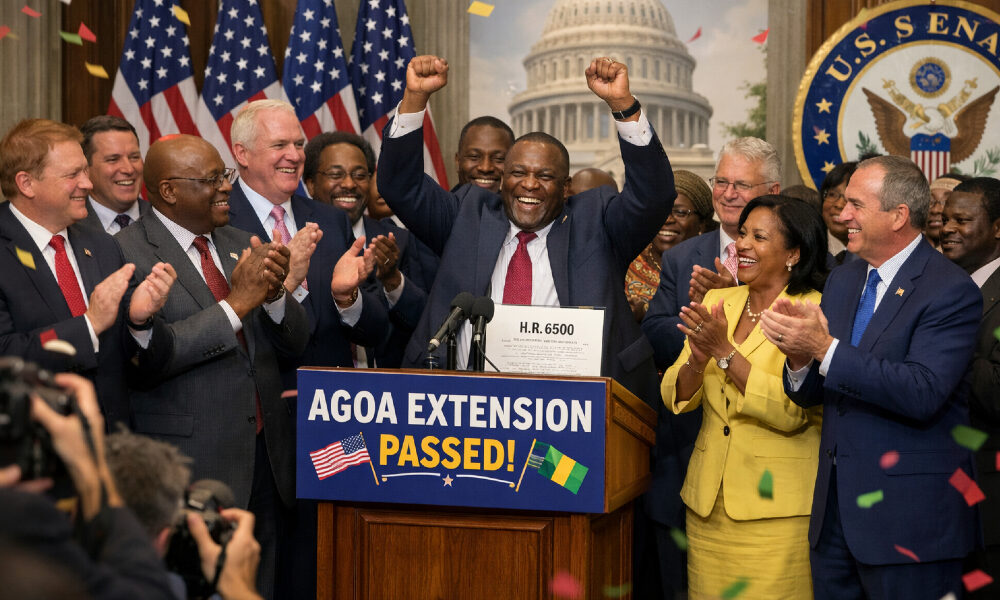
However, bipartisan supporters of the legislation continued to work behind the scenes, and early in January, by a bipartisan vote of 337-55, the US House of Representatives passed the AGOA Extension Act (HR 6500). The legislation is now before the US Senate, but further examination of its wording, especially on labor protections, is required before a vote is scheduled.
HR 6500 extends AGOA until December 31, 2028. It also reaffirms the traditional duty-free status of AGOA.
This poses a direct challenge to Trump’s universal tariff policy. Congress does not uphold that policy, and its continuation is uncertain due to the Supreme Court considering its legality.
The US Constitution bestows the power to tax on Congress, but the administration declares that the president has emergency powers that would allow tariffs.
According to Manchester Trade, a leading trade consultancy, what makes this moment remarkable is that, less than two months ago, an AGOA extension was widely regarded as politically dead – by public officials, traditional and social media and much of the private sector. Today, it has been passed by the House and could become law by the end of January.
Those who wrote AGOA off underestimated its resilience and its central role in the United States’ economic engagement with Africa, the Manchester analysis states. They underestimated the long-standing commitment of the bipartisan leadership of the relevant congressional committees since AGOA’s inception a quarter century ago – most recently, House Ways and Means Committee Chair Jason Smith and Trade Subcommittee Chair Adrian Smith.
Naysayers failed to recognize the depth of bipartisan congressional support for AGOA, which has always been, and remains, largely a congressional initiative rather than an executive-branch project. They overlooked the unanimous backing of the Congressional Black Caucus.
They underestimated the effectiveness of the African Diplomatic Corps, comprising more than 50 missions in Washington, particularly the leadership of Ambassadors from the five principal apparel-exporting countries – Kenya, Lesotho, Mauritius, Madagascar, and Tanzania.
When AGOA was put together, the diplomatic corps had not yet begun to assert itself, but since then, African diplomats have become more astute on lobbying the US government on what is a key trade policy for African countries. Critics also failed to consider the growing US concern about trade inroads by China in Africa.
Taking advantage of the Trump universal tariff policy, China is offering tariff-free treatment for African exports.
Some of Africa’s exports lost on the US market may be redirected towards other partners such as Canada, Mexico, the UK, and countries from Latin America, the Middle East, and Asia.
AGOA Survived Despite Lower Trade Volumes
Even the recent tariff report by the Africa Union Commission, UN Economic Commission on Africa and African Development Bank (AfDB) acknowledges that Africa’s trade in goods with the US is not significant compared to other partners. Africa’s exports to the US were only 4.9 percent of total exports in 2023, compared to 31.8 percent to the European Union, 15.9 percent to Africa, 11.9 percent to China, 6.1 percent to the United Arab Emirates, and 4.9 percent to India.
Similarly, Africa accounts for just 1.4 percent of US total goods exports and 1.3 percent of total US goods imports. However, the US remains an important partner for some African countries.
Twelve African countries have higher shares of goods exports to the US than Africa’s average of about 5 percent. The impact of the US tariffs on Africa’s GDP would be moderate, though Africa’s exports to the US would decrease substantially.
The joint Africa report states that under the baseline scenario of a 10-percentage points tariff increase, Africa’s GDP will decline by 0.07 percent. GDP will fall by 0.21 percent under the “reciprocal tariffs” scenario, where all the reciprocal tariffs come into force.
On the other hand, Africa’s exports to the US will decline by 8.1 percent under the 10-percentage points baseline scenario and 21.5 percent under the reciprocal tariffs scenario.
While African countries are expected to look for potential new markets for their exports, imports from Asia are expected to increase slightly. Some of Africa’s exports lost on the US market may be redirected towards other partners such as Canada, Mexico, the UK, and countries from Latin America, the Middle East, and Asia.
Africa’s imports from Asia (e.g., China and the Republic of Korea) and countries from the European Free Trade Association (EFTA) may increase slightly. The joint tariff report states that effective coordination within the continent will be crucial to mitigate the risk of Africa becoming a market for large volumes of imports diverted from the US.
In light of the significant yet uneven impacts of the recent increase in US tariffs on African economies, particularly on countries heavily reliant on preferential access to the US market under AGOA and GSP, the joint report outlines a set of actionable and strategic policy recommendations aiming to mitigate immediate shocks, strengthen Africa’s trade resilience and repose the continent for long-term sustainable growth in the evolving global trade landscape.
Accelerate the Full Implementation of AfCFTA
The African Continental Free Trade Area (AfCFTA) remains Africa’s most strategic response to external shocks and trade uncertainty. Rapid and full implementation of the agreement – especially the removal of remaining tariffs and reduction of non-tariff barriers (NTBs) – is critical to enhancing intra-African trade and building regional resilience.
In parallel, measures to improve border infrastructure, streamline customs procedures and facilitate the movement of people and goods across borders should be prioritized.
Promoting the Development of RVCs
Building strong Regional Value Content (RVC) is essential to transition Africa from a supplier of raw materials and low-value manufacturing to a hub of integrated, value-added production. Governments should encourage investment in key sectors with high RVC potential by facilitating cross-border production linkages and regional joint ventures.
African policymakers must use the AfCFTA as a platform to deepen RVCs by developing domestic and regional upstream industries.
Diversify Export Markets Using Data-Driven Tools
African countries should proactively reorient exports toward alternative markets, both within and outside the continent. Leveraging tools like the UN Economic Social Commission for Asia and the Pacific – Economic Commission for Africa (ESCAP-ECA) Trade Intelligence and Negotiation Adviser (TINA), governments can identify top importers of the most affected products and develop targeted trade promotion strategies.
Negotiate as a Unified Continental Bloc
Given limited bargaining power at the individual country level, African nations should engage the US through a unified, continent-wide approach under the AU’s leadership. Future trade negotiations should build on the AfCFTA framework and aim to secure a stable, long-term US-Africa trade and investment agreement that goes beyond unilateral preferences and respects Africa’s regional integration priorities.
Institutionalize Continental Trade Dialogues and Coordination
Leveraging and strengthening existing institutional platforms for African trade policymakers is essential to enhance coordination and readiness for global trade shifts.
Regular dialogues and capacity-building sessions organized by the AUC, ECA, and AfDB can serve as effective venues for member states, Regional Economic Communities (RECs), and other stakeholders to assess impacts, exchange strategies, and share experiences in developing coordinated responses. By reinforcing these platforms, Africa can improve policy coherence, boost negotiation capacity, and project a stronger, unified voice in global trade forums such as the World Trade Organization.
Africa Confidential, the influential Africa newsletter, reports that though a handful of African countries faced a major hit from the loss of AGOA’s tariff- and quota-free trade offer in the 25 years after its ratification in 2000, AGOA has had an uneven effect Africa-US trade. It was good for Nigeria until the US became energy self-sufficient, and it was good for South African citrus fruits and manufactures – until this year’s diplomatic spat.
Kenya’s government has been lobbying hard for the AGOA extension for some time now.
In 2024, US AGOA imports stood at just US$8 billion, the newsletter states, and remained concentrated in a few countries and industries, with 25 percent accounted for by crude oil imports, most from Nigeria. South Africa’s car industry and Kenya’s textiles and clothing have been big beneficiaries.
Last year, cars and apparel exports to the US were worth US$2.4 billion and US$1.2 billion, respectively. This year the picture was clouded by the US’s new bilateral tariffs which were imposed across the board before AGOA formally lapsed in September.
AGOA has indeed been raised from the dead, but whether it achieves lasting survival remains to be seen. Still, Congress, even members of Trump’s own party, are beginning to show more independence and might override a veto of the revived AGOA should he take that path.
Gregory Simpkins, a longtime specialist in African policy development, is the Principal of 21st Century Solutions. He consults with organizations on African policy issues generally, especially in relating to the U.S. Government. He further acts as a consultant to the African Merchants Association, where he advises the Association in its efforts to stimulate an increase in trade between several hundred African Diaspora small and medium enterprises and their African partners.