Business
AGOA Expiry Poses Major Threat to African Export Diversification and Industrialization


By Mark-Anthony Johnson
Since its launch in May 2000, the African Growth and Opportunity Act (AGOA) has provided sub-Saharan African countries with preferential access to the U.S. market, supporting exports and fostering industrialization. However, the recent expiry of AGOA now threatens the continent’s progress toward export diversification and economic resilience.
In Lesotho, for example, roughly one-third of the country’s exports were linked to AGOA, primarily in the apparel sector, which employs between 30,000 and 40,000 workers – most of them women. The expiration of the program could jeopardize these jobs and undermine decades of industrial development.
Rising Trade Barriers
Both African and non-African exporters are already navigating heightened trade barriers in the U.S. market. Since April 2025, country- and sector-specific tariffs have been introduced, raising the average tariff for AGOA countries from below 0.5 percent to nearly 10 percent.
Key export categories – including agriculture, food products, metals, machinery, transportation, textiles, and apparel – have already faced double-digit increases in duties, signaling tougher times ahead for African exporters.
Disproportionate Impact on Light Manufacturing
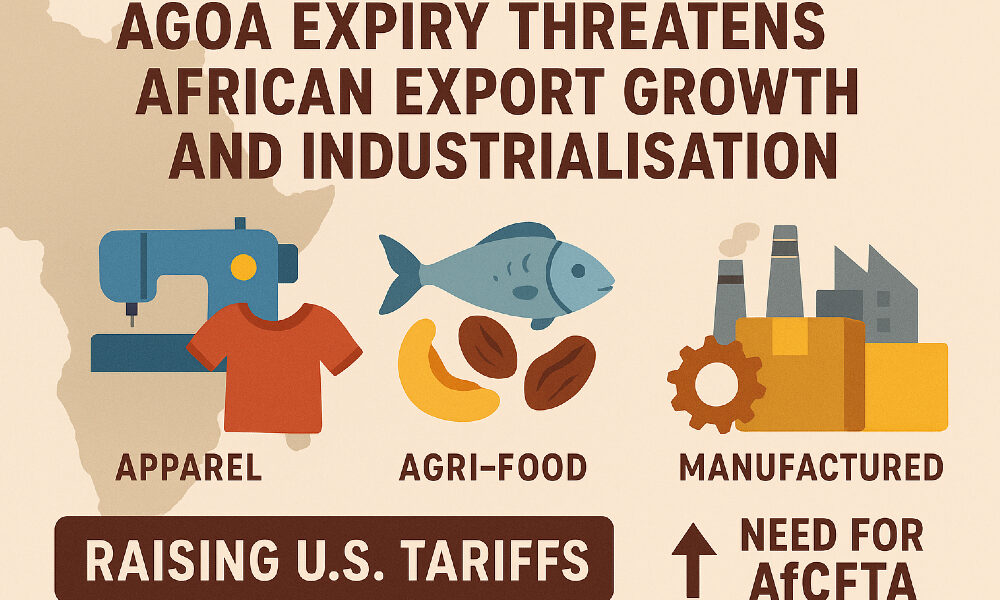
The end of AGOA will hit Africa’s light-manufacturing exports hardest, particularly apparel and agri-food products such as fish and dried fruits. Without preferential treatment, the 32 countries that benefited from AGOA until September 2025 will face a second wave of tariff hikes, as country-specific and sectoral tariffs are layered on top of standard Most-Favoured-Nation (MFN) rates.
In many cases, tariffs on agricultural and manufactured goods could be two to three times higher than those on fuels and minerals.
Minerals and Fuels Less Affected
Not all sectors are equally vulnerable. Exporters of mined commodities, including fuels and minerals, are largely shielded from the new tariffs.
Countries such as the Democratic Republic of Congo, Nigeria, and Angola – whose exports are dominated by minerals and fuels – face minimal tariff increases thanks to low MFN rates or exemptions from additional duties. Meanwhile, more diversified economies like South Africa are less exposed to AGOA’s expiration but have already felt the impact of country-specific and sectoral tariffs introduced earlier this year.
Looking Ahead: AfCFTA as a Strategic Solution
The expiration of AGOA underscores the urgency for African countries to accelerate the implementation and full operationalization of the African Continental Free Trade Area (AfCFTA). By strengthening intra-African trade, reducing dependency on external preferential schemes, and supporting industrial diversification, AfCFTA could provide a sustainable pathway for African exports in a post-AGOA era.
Mark-Anthony Johnson is the founder and CEO of JIC Holdings, a global asset and investment management firm founded in 2009. With over 30 years of experience and strong ties to Africa, his investments span mining, infrastructure, power, shipping, commodities, agriculture, and fisheries. He is currently focused on developing farms across Africa, aiming to position the continent as the world’s breadbasket.