Opinion
Africa’s Urban Future: Why Cities, Not Clinics, Will Determine the Continent’s Health
The next great health crisis on the world’s fastest-urbanizing continent is not a pathogen. It is a policy failure hiding in plain sight.


By Naomi Mutuku
Africa is in the midst of the most rapid urban transformation in human history. According to the United Nations, the continent’s urban population will double from roughly 700 million today to nearly 1.4 billion by 2050 – a moment at which one in every four people on the planet will be African.
That is not merely a demographic milestone. It is a ticking clock.
The Upstream Crisis That Hospitals Cannot Cure
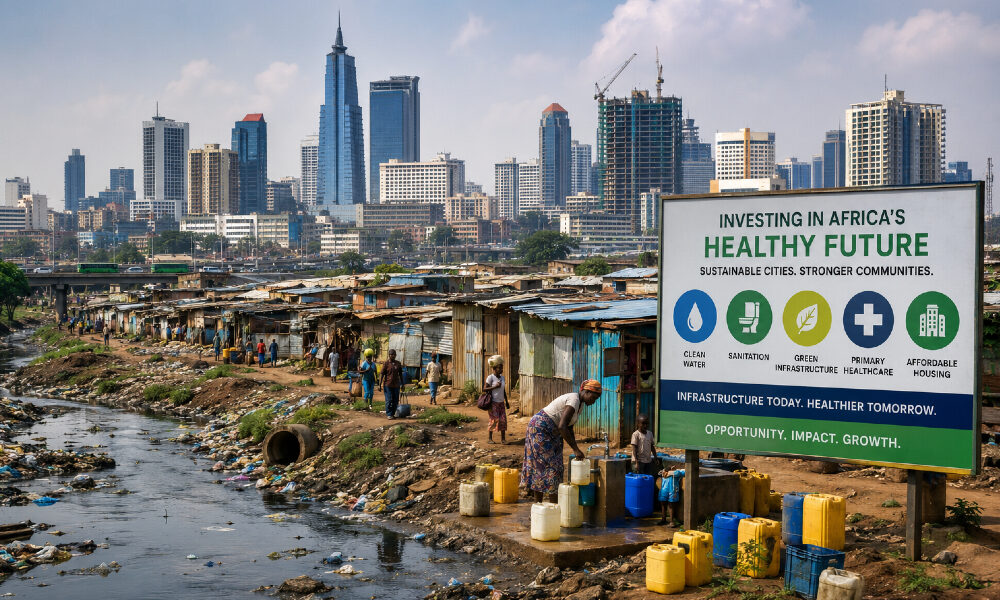
The conventional response to Africa’s health challenges has long fixated on the downstream: more hospitals, more physicians, more treatment capacity. Yet the more urgent battlefield lies upstream, in the informal settlements, open drains, and choked arterials where the majority of Africa’s urban poor already live.
More than 60 percent of urban residents across Sub-Saharan Africa occupy informal settlements with inadequate housing, unreliable sanitation, and limited access to primary care. Poor sanitation continues to fuel outbreaks of cholera, typhoid, and other entirely preventable diseases.
Air pollution – a crisis that barely registers in most discussions of African public health – is now among the leading environmental health risks on the continent, driving a quiet epidemic of respiratory and cardiovascular disease. Meanwhile, non-communicable diseases such as diabetes and hypertension are accelerating as urban lifestyles displace traditional ones.
Building Health Into the City’s Blueprint
The implication is uncomfortable for those accustomed to thinking about health in terms of hospitals and headcounts: the future health of Africa’s cities will be determined far less by what happens inside clinics than by how those cities are designed and built. Investments in sanitation infrastructure, clean water systems, waste management, affordable housing, and climate-resilient urban planning may ultimately deliver greater long-term health returns than an equivalent outlay on hospital beds.
The question is not whether African governments can afford to make those investments. It is whether decision-makers – and the investors who follow their signals – understand the opportunity they are sitting on.
For investors, that framing matters enormously. The intersection of urban development, water and sanitation, environmental health, and primary care infrastructure represents one of the most significant – and most underappreciated – opportunity sets on the continent.
Yet capital is not flowing toward it at the scale the moment demands.
A $330 Billion Gap – and Why Capital Is Not the Problem
That brings us to the second structural problem, one just as consequential as the cities themselves: the persistent mismatch between available capital and investment-ready projects.
Africa faces an SME financing gap that, according to the International Finance Corporation, exceeds US$330 billion annually. Yet billions of dollars in private capital remain available globally for bankable opportunities. The bottleneck is not, in most cases, a shortage of money. It is a shortage of preparation.
Every week, across agriculture, healthcare, renewable energy, manufacturing, and technology, entrepreneurs with genuine vision and real passion fail to attract the investment their ideas arguably deserve. The reason is almost never that investors are uninterested in Africa. It is that the projects they are being shown are not structured in ways that investors can evaluate with confidence.
Before committing capital, investors ask a predictable set of questions: Is there demonstrated market demand? Is the business model proven and scalable? Can the management team execute? What are the projected returns, and over what time horizon? How are risks identified and mitigated? Is governance in place? Is impact measurable? Is there a realistic exit? These are not unreasonable demands – they are the minimum conditions of fiduciary responsibility. And yet too many African entrepreneurs spend months refining pitch decks while neglecting precisely these fundamentals.
Preparation Is the Competitive Advantage No One Talks About
The most successful projects share a recognizable profile: strong market validation, rigorous financial projections, competent and credible leadership, robust governance, reliable data, scalable operating models, and a clear path to profitability. Passion is not on that list – not because it does not matter, but because it is assumed. What separates funded projects from unfunded ones is almost always preparation, not potential.
The lesson applies as directly to healthcare and urban infrastructure ventures as to any other sector. An entrepreneur developing a community sanitation solution in Nairobi or a climate-resilient housing model in Lagos may be addressing one of the most important challenges on the planet. But if that entrepreneur cannot demonstrate market uptake, financial sustainability, and governance credibility, the capital will flow elsewhere – not because investors lack conscience, but because they lack confidence.
The path forward requires two things to happen simultaneously. Policymakers and city planners must begin treating urban infrastructure as health infrastructure – recognizing that a city’s design is, in effect, its public health policy. And entrepreneurs, particularly those working at the intersection of urban development and health outcomes, must meet investors where they are: with structured, evidence-based, investment-ready propositions.
Africa’s cities are being built right now. The decisions being made today – about sanitation systems, housing density, transit corridors, and green space – will shape the health of hundreds of millions of people for generations. The same is true of the investment ecosystem that will fund, or fail to fund, the solutions those cities need.
The question for both policymakers and entrepreneurs is the same: Are you building something that works, or something that merely sounds like it should?
Funding, like health, does not follow good intentions. It follows preparation.
Naomi Mutuku is a trade and investment expert specializing in helping global companies enter Kenya and broader African markets. She focuses on reducing risk, accelerating market entry, and fostering sustainable growth. Based in Nairobi, Naomi is a regular commentator on Africa’s dynamic business landscape and is passionate about the continent’s growth potential. She can be reached via email at: mukuinaomi@gmail.com