A Diaspora View of Africa
Africa’s Ukraine war peace plan fails


By Gregory Simpkins
Now into its second year, the war ignited by Russia’s invasion of Ukraine drones on. After billions of dollars in weapons and financial support from the United States and its North Atlantic Treaty Organization (NATO) partners and sanctions aimed at Russia that have hit other nations in the world, including African countries, there finally have been efforts to mediate peace between the warring parties.
Unfortunately, such efforts have met with what could have been expected to be at least an initial failure.
According to rumors, early in the conflict, NATO opposed peace talks to end the war even though the Ukrainian government was said to be willing to consider such talks at its outset. As the war droned on, reports of war crimes by Russia increased. Attacks on civilian targets – hospitals, schools and energy sources – have created a situation in which Russian President Vladimir Putin is now being held accountable for such crimes against humanity.
The International Criminal Court in the Hague has issued an arrest warrant for war crimes, citing tens of thousands of individual war crimes, including the illegal deportation of Ukrainian children to Russia. Since the Russian invasion began in February 2022, women reportedly have been gang-raped, men castrated, children sexually abused and civilians forced to parade naked in the streets, according to the United Nations.
The seizure of the Crimea region of Ukraine several years ago has never been accepted by the Ukrainian government, and the Russian arrangement of a referendum to justify its invasion of the country’s Donbas area was the trigger for the current conflict. Add to that Russia’s threats to begin nuclear warfare against Ukraine and its allies in the West.
With these factors in mind, why would anyone think the situation was fertile for a peace accord to be negotiated when major European powers and the United States not only made no effort to negotiate peace but continue to support the Ukrainian war effort. In fact, the U.S. government has just announced an accounting error that allows more than a billion dollars more in aid to the Ukrainian war effort.
Timing
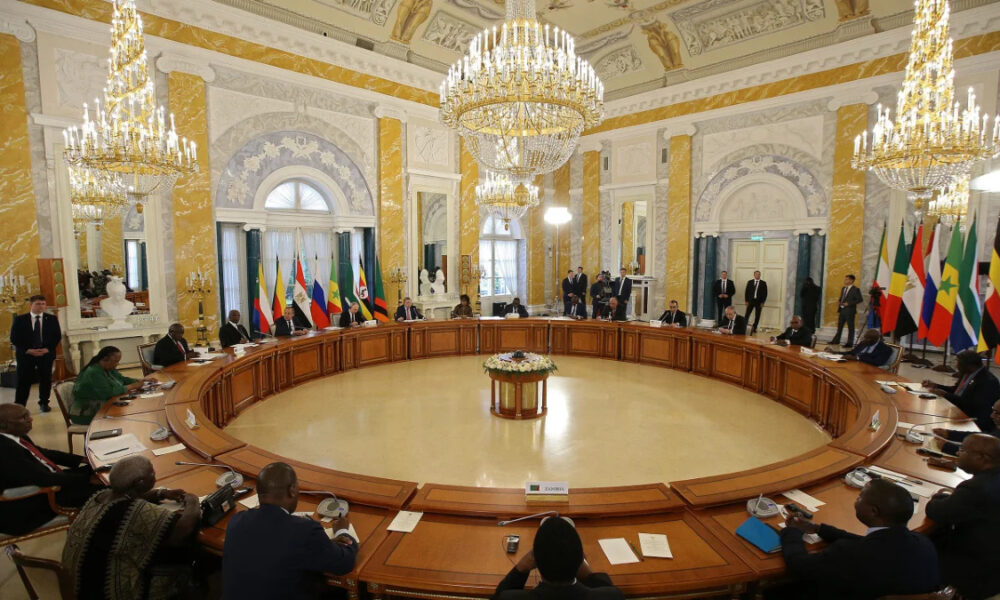
Representatives from Senegal, Egypt, Zambia, Uganda, Congo Republic and Comoros – evidently led by South African President Cyril Ramaphosa – comprised the delegation. As it turns out, the African peace mission was ill-advised, particularly because of its timing and the lack of leverage the participating nations had to push the warring sides to the peace table. There are three elements that made this point quite clearly.
First, China, a superpower, weighed in with its proposals to bring the fighting to a halt – at least in a cease-fire. China released a twelve-point document proposing a framework for a political settlement, repeating Beijing’s support for the UN Charter and the territorial integrity of states, but the document condemns unilateral sanctions and criticizes the expansion of U.S.-led military alliances. Chinese diplomats echoed the joint declaration signed by President Putin and his Chinese counterpart Xi Jinping on February 4, 2022, in which the Ukraine crisis was blamed on NATO expansion and the West’s disregard for Russia’s demands on European security.
So, it is more of a condemnation of the West’s intervention than any criticism of the Russian invasion itself. It seems to be more of a rebuttal to Western allegations that China has been a silent accomplice to Russia, and an attempt to bolster its image as a responsible world power in the eyes of developing countries, according to an analysis by Alexander Gabuev for the Carnegie Endowment for International Peace.
Gabuev wrote that China’s proposal lacked specifics on such issues as territorial integrity or security guarantees for Ukraine. This is in keeping with China’s ambiguous positions in previous Russian aggression in Georgia and Crimea. The Chinese like to keep their options open when it comes to ally Russia, and their overriding interest is in opposing the West.
Ursula von der Leyen, European Commission President, expressed her support for using Kyiv’s “peace plan” as the starting point for any efforts to end the Russian-Ukrainian war. As reported by Reuters, von der Leyen’s statement on the Ukrainian peace plan coincided with the visit of a top Chinese representative to several European capitals, which Beijing has described as aiming for a “political settlement” of the conflict in Ukraine.
Did the Africans determine whether their more detailed plan had Western or Chinese backing? Did the delegation feel out Zelensky or Putin in advance to determine their openness to their peace effort?
“Nothing about Ukraine without Ukraine. We should never forget that Ukraine is the country that was brutally invaded. It is therefore the one that should set out the core principles for just peace,” said the European Commission President.
While von der Leyen stressed Beijing should use its influence on Moscow to end the war, the EU’s top diplomat, Josep Borrell, recently expressed the opinion that China had already lost the opportunity to act as a mediator in Russia’s conflict resolution. The Chinese alliance with Russia, especially their refusal to call out Russia for its invasion and rather focus on Western sanctions for that action renders their proposal a non-starter for NATO and Ukraine despite the encouragement of at least some in the European Union for China to intervene.
Second, Russia has shown no interest in slowing or halting its assault on Ukraine even with a high-level African delegation in the Ukrainian capital to pursue peace. At least two explosions rocked Kyiv during the visit and air raid sirens wailed as part of what was described as the largest missile attack on the Ukrainian capital in weeks. This contrasted with President Joe Biden’s recent trip to Kyiv. There was an air raid siren triggered by a Russian fighter taking off from nearby Belarus, but there was no attack. Apparently, the safety of President Biden because of the potential for war with the United States forestalled any such aggressive actions during his visit. The African delegation had no such protection.
Third, the Ukrainians were in the process of a much-discussed offensive against Russian positions in their country’s eastern region. The Ukrainian military action has three focuses: the area around the heavily contested town of Bakhmut and in Luhansk province in the east, south and south-east from Vuhledar in Donetsk province and a major southward assault in Zaporizhia province. This offensive was long planned and is considered critical to the country’s effort to fend off the Russian invaders.
Unrealistic
Ukrainian President Volodymyr Zelensky said after meeting the African delegation in Kyiv that peace talks would require Moscow to withdraw its forces from occupied Ukrainian territory, something Russia has said is not negotiable. After meeting with the Africans, including some who have close ties to Moscow, President Volodymyr Zelensky suggested that their peace plans were unrealistic. Zelensky undoubtedly recalls the largely non-committal positions taken by African governments at the United Nations early in the conflict.
Putin opened talks the next day with representatives of Senegal, Egypt, Zambia, Uganda, Congo Republic, Comoros and South Africa in a palace near St. Petersburg by stressing Russia’s commitment to the continent, but after presentations from the Comoran, Senegalese and South African presidents, he challenged the assumptions of the plan, which were based on acceptance of internationally recognized borders even before the round of statements could go any further. Putin gave the delegation a list of reasons why he believed many of their proposals were misguided, putting a damper on a plan already largely dismissed by Kyiv.
Consequently, given the issues involved and the reaction of the warring parties, one wonders how much consultation the African delegation had prior to arriving in Kyiv, not to mention Moscow. At least some Europeans gave a positive reaction to the Chinese intention to intervene. Did the Africans determine whether their more detailed plan had Western or Chinese backing? Did the delegation feel out Zelensky or Putin in advance to determine their openness to their peace effort? Did they take note of the ongoing military actions by both sides, some of which put their members in danger in a war zone?
The answers appear to be no on all counts.
So, perhaps the delegation was counting on President Ramaphosa’s relationship with Putin through their BRICS partnership. However, South Africa seems to be considered a junior partner in that alliance with no leverage to push Russia in any way, especially without Chinese support. Ramaphosa has been linked to Russia in more than just the BRICS alliance. The U.S. ambassador to South Africa accused South Africa of materially aiding the Russian war effort. Thus, Ramaphosa taking the lead in talks with Zelensky would seem a non-starter from the outset.
South Africa’s President has described the African peace mission as successful, but there seems to be no evidence that anything positive was gained from the effort. On the contrary, this was a humiliation for African leaders trying to make their mark on the world stage. Successful peace missions are based on proper planning and pre-meeting reconnaissance. This mission apparently was based merely on hope and the overwhelming African need to bring this conflict to an end as it has so devastatingly impacted the continent. Yet hope and need are not viable elements of a successful pace effort, as this mission’s failure demonstrates.
Gregory Simpkins, a longtime specialist in African policy development, is the Principal of 21st Century Solutions. He consults with organizations on African policy issues generally, especially in relating to the U.S. Government. He also serves as Managing Director for the Morganthau Stirling consulting firm, where he oversees program development and implementation. He further acts as a consultant to the African Merchants Association, where he advises the Association in its efforts to stimulate an increase in trade between several hundred African Diaspora small and medium enterprises and their African partners.