Opinion
Africa’s Transcontinental Highway Dream Inches Forward Amid Reality Checks
The Trans-African Highway Network is closer to completion than ever – but formidable obstacles remain between ambition and asphalt.


By Mark-Anthony Johnson
More than fifty years ago, the United Nations Economic Commission for Africa (UNECA), the African Development Bank (AfDB), and the Organization of African Unity (OAU) – the precursor to the African Union set out to stitch a continent together with roads.
The Trans-African Highway (TAH) network – nine major corridors spanning nearly 60,000 kilometers (37,282 miles), linking Cairo to Cape Town, Dakar to Djibouti – was to be the physical expression of pan-African unity. As of February 2026, that vision is tantalizingly within reach, yet stubbornly incomplete.
The headline figure is encouraging: more than half of the network’s 56,683 kilometers (35,221 miles) are now paved, a milestone that would have seemed improbable a decade ago.
Yet paving statistics can flatter to deceive. A road that exists on paper, or even under tarmac, is not always a road that functions – and it is the gaps, both literal and figurative, that continue to define the TAH’s limitations.

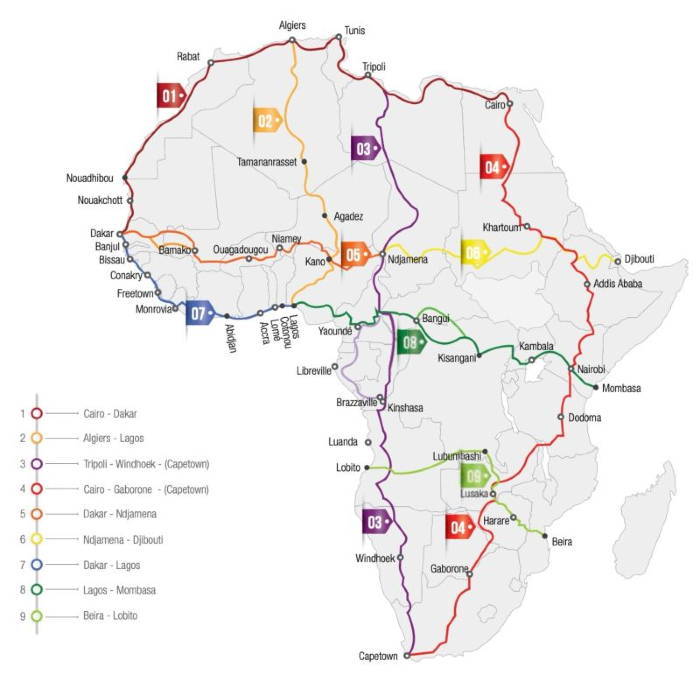
The Trans-African Highway Network’s nine corridors spanning 56,683 km across Africa
One Corridor Down, Eight to Go
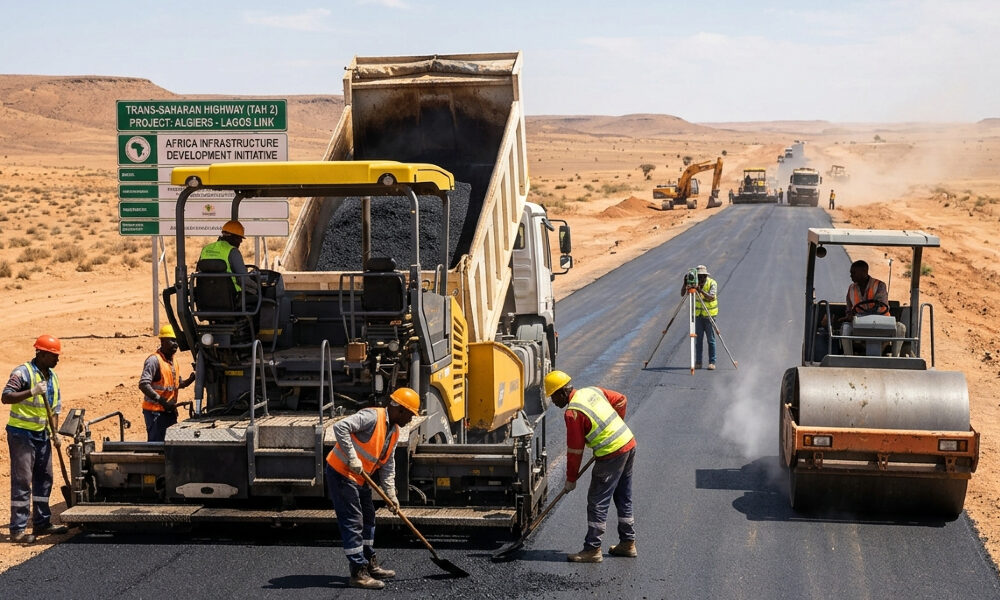
Of the nine designated corridors, only one – the Trans-Sahelian Highway (TAH 5), a 4,496-kilometer (2,794-mile) route connecting Dakar, Senegal, to N’Djamena, Chad – can be declared fully complete. Three others are reportedly nearing the finish line, including the Trans-Saharan Highway (TAH 2), which links Algiers to Lagos across 4,500 kilometers (2,796 miles) of desert and savanna, and is currently in its final stages of construction.
Progress elsewhere is considerably more uneven. The flagship Cairo–Cape Town corridor (TAH 4), at 10,228 kilometers (6,355 miles) the network’s longest and most symbolically potent route, remains a work in progress.
Egypt has completed its 1,155-kilometer (718-mile) segment in full. But significant delays persist in Sudan, Zambia, and Tanzania, where funding shortfalls, logistical challenges, and political instability have stalled construction indefinitely.
TAH 1, connecting Cairo to Dakar largely along the Mediterranean and Atlantic coasts, is substantially complete – save for one critical exception. The land border between Algeria and Morocco has remained closed since 1994, a casualty of a decades-old territorial dispute over Western Sahara.
No amount of asphalt can bridge a political impasse of that magnitude.
Perhaps the starkest illustration of the network’s unfinished state is TAH 8, the Lagos–Mombasa corridor. Its eastern half, traversing Kenya and Uganda, is functional and well-traveled. But a yawning “missing link” through the Democratic Republic of Congo renders the middle section effectively impassable for practical cross-continental traffic.
The DR Congo’s notorious infrastructure deficit – a product of chronic underfunding, conflict, and the sheer scale of the country – continues to frustrate regional connectivity across Central Africa.
There is, at least, fresh activity on the western coast. Construction on the Abidjan–Lagos Corridor, a 1,028-kilometer (639-mile) coastal motorway connecting two of West Africa’s most economically dynamic cities, is scheduled to commence in 2026, with completion projected for 2030.
When finished, it will form one of the continent’s most commercially significant stretches of highway.
The Economic Stakes
The TAH network is not merely an infrastructure project; it is the physical backbone of the African Continental Free Trade Area (AfCFTA), the ambitious multilateral agreement that seeks to create a single continental market of 1.4 billion people. Without functioning road corridors, intra-African trade – which, at roughly 15 percent of the continent’s total trade, remains embarrassingly low by global standards – cannot meaningfully expand.
The numbers are striking. Improved transport corridors under the TAH framework are estimated to increase average GDP across participating economies by up to 7.4 percent, primarily through reduced logistics costs, streamlined customs procedures, and greater market access for landlocked nations.
For a continent where geography has long served as an economic obstacle, that figure represents transformative potential.
The Obstacles Are as Old as the Vision
Yet the challenges are equally well-documented. Financing remains the network’s Achilles’ heel.
As of 2026, eight African nations are classified as being in debt distress, forcing governments to redirect infrastructure revenues toward debt servicing rather than road construction. The irony is painful: the very countries that stand to gain most from improved connectivity are least able to fund it.
Security and terrain compound the problem. Civil conflicts across parts of Central and East Africa have damaged existing roads, disrupted supply chains, and deterred private investment.
Extreme weather – increasingly erratic and severe as a result of climate change – erodes freshly paved surfaces, adding reconstruction costs to an already strained maintenance burden. Even roads that are completed require continuous upkeep; in several corridors, older sections have deteriorated faster than new ones are being built.
Reason for Cautious Optimism
None of this should obscure the genuine progress that has been made. The TAH network, first proposed in 1971, was always a generational project – one that would require sustained political will, multilateral financing, and decades of construction across some of the world’s most challenging terrain.
That more than half the network is now paved, and that three additional corridors are approaching completion, is a meaningful achievement.
The next decade will be decisive. If the Abidjan–Lagos Corridor is completed on schedule, if the DR Congo’s missing link can attract sufficient investment, and if the Algeria-Morocco border dispute finds any diplomatic resolution, the network’s transformative promise could begin to be realized in earnest.
The roads are being built. Whether Africa’s political and financial architecture can keep pace with the asphalt is the more urgent question.
Mark-Anthony Johnson is the founder and CEO of JIC Holdings, a global asset and investment management firm founded in 2009. With over 30 years of experience and strong ties to Africa, his investments span mining, infrastructure, power, shipping, commodities, agriculture, and fisheries. He is currently focused on developing farms across Africa, aiming to position the continent as the world’s breadbasket.