Business
Africa’s Trade Passport: Why Rules of Origin Will Decide the Fate of the AfCFTA


By Mark-Anthony Johnson
Every passport tells a story of belonging. In the world of trade, goods have their own version – a set of technical criteria that determine where a product truly comes from, and, more importantly, whether it earns the privileges that come with that origin.
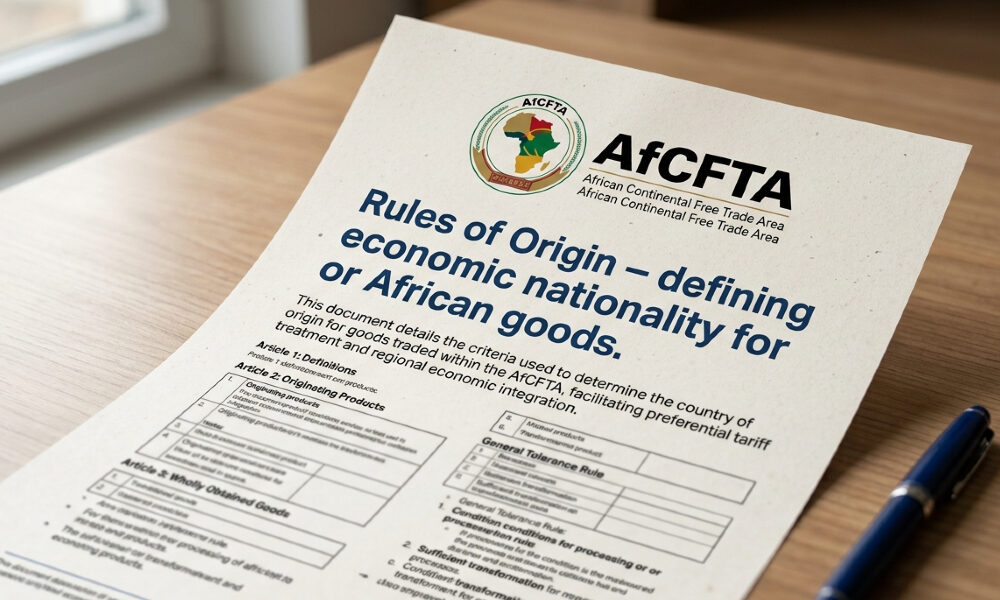
Within the African Continental Free Trade Area (AfCFTA), these criteria are known as Rules of Origin (RoO), and they may well be the most consequential – and least discussed – mechanism determining whether Africa’s landmark trade agreement delivers on its transformative promise.
Defining Economic Nationality
At their core, Rules of Origin are the instrument by which the AfCFTA assigns what trade economists call “economic nationality” to a product. The question they answer is deceptively simple: is this good genuinely African?
The answer, however, carries enormous consequence. Only products that satisfy AfCFTA origin criteria qualify for preferential tariff treatment – in many cases, zero import duties – across member states.
Without this gatekeeping function, the agreement’s carefully negotiated tariff concessions would be vulnerable to exploitation by non-African manufacturers routing goods through low-tariff member states to access the broader continental market.
That vulnerability has a name in trade policy circles: deflection. Rules of Origin exist, in no small part, to prevent it.
Two Pathways to Compliance
The AfCFTA framework recognizes two principal routes through which a product can establish its African credentials.
The first – and more straightforward – is the “wholly obtained” standard. Products that are entirely grown, harvested, extracted, or manufactured within a single AfCFTA member state qualify automatically. A Kenyan tea crop, a South African platinum ingot, or an Egyptian cotton bale would each clear this threshold without complication.
The second pathway applies to the more commercially significant category of manufactured and processed goods, where inputs frequently cross borders before a finished product emerges. Here, the operative concept is “substantial transformation” – the requirement that any non-African materials used in production undergo meaningful working or processing on the continent before the resulting product can claim African origin.
This transformation is typically measured either through a Change in Tariff Classification (CTC), which requires that the manufacturing process shift the product into a different customs category than its inputs, or through a minimum local value-added threshold, which mandates that a defined percentage of the product’s value be generated within Africa. These are not merely bureaucratic formalities.
The thresholds set under each criterion directly shape the economics of manufacturing on the continent, influencing where companies source inputs, where they locate production, and how deeply they integrate into African supply chains.
Building Regional Value Chains – By Design
Perhaps the most strategically significant dimension of the AfCFTA’s Rules of Origin framework is its deliberate architecture for regional value chain development. By permitting cumulation – the practice of counting inputs sourced from other AfCFTA member states as African content – the rules create positive incentives for businesses to procure raw materials, components, and intermediate goods from within the continent rather than from cheaper but extra-regional suppliers.
This is industrial policy embedded in trade law. A Rwandan garment manufacturer that sources fabric from Ethiopia, thread from Egypt, and buttons from Morocco can aggregate that continental content toward satisfying origin requirements.
The practical effect is to make cross-border sourcing within Africa commercially rational in a way that it has historically not been – intra-African trade has long languished at roughly 15 percent of the continent’s total trade, a figure dwarfed by intra-European trade at over 60 percent, or intra-Asian trade approaching 60 percent as well.
Rules of Origin, applied thoughtfully, are one mechanism by which that gap can begin to close.
Operationalizing the Framework
Sound policy architecture means little without consistent implementation. Recognizing this, the AfCFTA Secretariat has developed a Rules of Origin Manual designed to harmonize customs procedures across member states, providing officials with clear, uniform standards for origin certification and verification.
The consistency of this application will prove critical: a framework undermined by divergent national interpretations, bureaucratic discretion, or corruption at the border loses its integrity rapidly.
The RoO framework sits alongside four other operational instruments that together form the AfCFTA’s implementation backbone: tariff concessions schedules, a non-tariff barrier monitoring mechanism, the Pan-African Payments and Settlements System (PAPSS), and the African Trade Observatory. Each is necessary; none is sufficient alone.
But Rules of Origin occupy a particular position of foundational importance – they are the mechanism that determines whether the other instruments are operating in service of genuinely African trade, or merely facilitating arbitrage.
The Stakes
Africa is home to 54 countries, 1.4 billion people, and – according to projections by the African Development Bank – a combined GDP that could exceed US$29 trillion by 2050. The AfCFTA, if it functions as designed, represents the world’s largest free trade area by number of participating nations.
The ambition is extraordinary. The execution will be everything.
Rules of Origin will not capture headlines the way tariff elimination announcements do. They are technical, granular, and unglamorous. But they are the mechanism through which the AfCFTA’s stated commitment to African industrialization either becomes real or remains aspirational.
Get them right – appropriately demanding to drive genuine value addition, but not so restrictive as to make compliance commercially prohibitive – and the AfCFTA has a credible engine for manufacturing-led development. Get them wrong, and the agreement risks becoming a preferential channel for finished goods with little more than a continental stamp of approval.
Africa’s trade future is being written in the fine print. It is worth reading carefully.
Mark-Anthony Johnson is the founder and CEO of JIC Holdings, a global asset and investment management firm founded in 2009. With over 30 years of experience and strong ties to Africa, his investments span mining, infrastructure, power, shipping, commodities, agriculture, and fisheries. He is currently focused on developing farms across Africa, aiming to position the continent as the world’s breadbasket.