Opinion
Africa’s Trade Blocs: Pathway to Prosperity or Recipe for Confusion?


By Dishant Shah
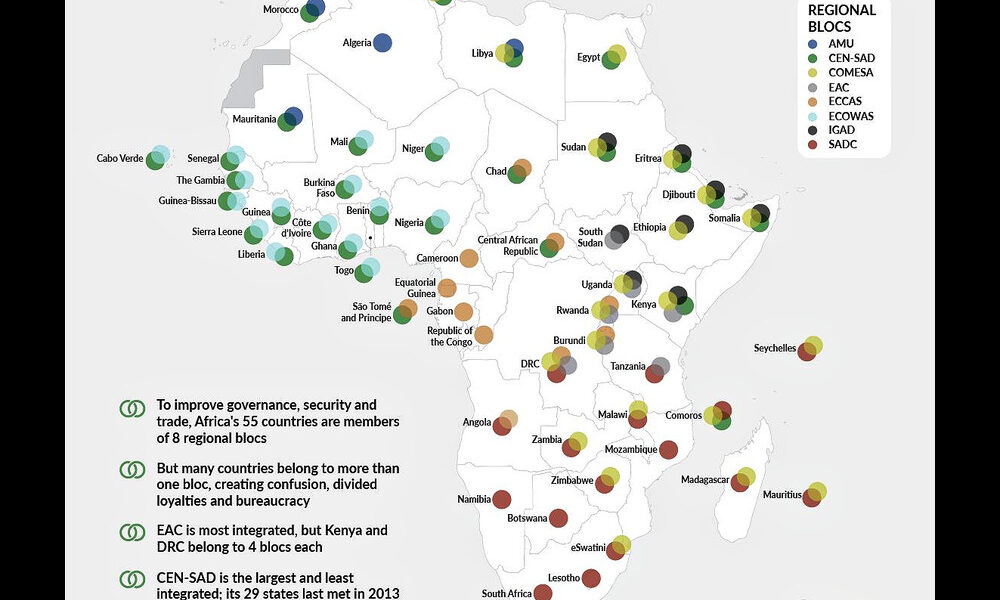
Africa stands out as the continent with the highest number of regional trade blocs – more than any other part of the world. The African Union (AU) officially recognizes over eight such blocs, with several unofficial or sector-specific groupings adding to the mix.
From ECOWAS in West Africa to the East African Community (EAC), the Southern African Development Community (SADC), and the Common Market for Eastern and Southern Africa (COMESA), these organizations span the continent. Others like IGAD, AMU, CEN-SAD, and ECCAS further complicate the landscape.
Each bloc was established with noble intentions: fostering regional trade, encouraging cooperation, promoting peace, and driving development. But with overlapping memberships and mandates, one can’t help but ask – are they delivering value, or simply creating confusion?
To put it into perspective, 19 African countries are members of two or more blocs, while some belong to three. Imagine being enrolled in three schools simultaneously, each with its own set of rules, exams, and expectations.
Take Kenya, for example – it’s part of the EAC, COMESA, and IGAD. This kind of overlap leads to duplicated efforts, conflicting trade regulations, and sometimes even competing agendas. Is this multiplicity strengthening Africa’s economic integration, or is it pulling it in too many directions?
The Case for Regional Blocs
Despite these challenges, regional trade blocs remain crucial. Many African economies are relatively small on their own, making regional integration a powerful tool for growth.
Larger markets attract investment, promote cross-border infrastructure, and enhance Africa’s bargaining power on the global stage. The EAC, for instance, has made significant strides by allowing the free movement of goods and people across member states.
According to the EAC Secretariat, intra-regional trade within the bloc has surged by over 20 percent in the past decade.
Yet, the numbers paint a mixed picture. Intra-African trade accounts for just 15 percent of the continent’s total trade, a stark contrast to Europe’s 60 percent and Asia’s 40 percent.
Despite the proliferation of trade blocs, African nations still trade far more with external partners than with each other. Why is this the case?
Challenges on the Ground
One reason lies in the gap between ambition and execution. While many blocs boast robust frameworks on paper, their practical implementation often falls short. Political will fluctuates, infrastructure remains underdeveloped, and customs procedures are riddled with inefficiencies and non-tariff barriers.
In some cases, countries prioritize bilateral agreements over regional commitments, undermining collective progress. When blocs fail to coordinate effectively, the entire system slows down, leaving businesses and consumers to bear the brunt.
Enter the AfCFTA: A Unified Vision?
This fragmented reality is precisely why the African Continental Free Trade Area (AfCFTA) was launched. Designed to bring coherence to the chaos, the AfCFTA aims to create a single, continent-wide market.
Instead of juggling multiple memberships, countries can focus on integrating under one overarching framework. However, the AfCFTA isn’t intended to replace existing blocs – it seeks to build on them.
If regional blocs function effectively, they can serve as stepping stones toward a truly integrated African economy.
The big question now is whether African nations will streamline their regional commitments or continue operating in silos. Success hinges not just on signing agreements but on tangible actions that facilitate the movement of people, goods, and ideas more efficiently and freely.
After all, regional integration is about more than paperwork – it’s about unlocking opportunities and fostering prosperity.
Can Multiple Circles Create One Strong Center?
Africa’s regional blocs undoubtedly hold immense potential – but only if they align better, communicate more effectively, and honor their commitments. Without greater coordination, the risk remains that too many overlapping initiatives could dilute their impact.
So, can multiple circles truly converge into one strong center? The answer lies in Africa’s ability to harmonize its fragmented trade architecture.
The stakes are high, but so are the rewards. By streamlining efforts and focusing on shared goals, Africa has the chance to transform its regional blocs from sources of confusion into engines of continental unity and growth.
The journey won’t be easy, but the destination – a thriving, interconnected Africa – is well worth the effort.
Dishant Shah is a partner at Legion Exim, a company specializing in facilitating the export of high-quality engineering products directly sourced from manufacturers in India to Africa. His areas of expertise include new business development and business management.