Opinion
Africa’s Supply Chains Need Governance, Not Just Resilience
The Gulf’s turmoil has exposed a deeper structural failure: the continent’s logistics are run by intelligence systems that reside elsewhere.


By Danilo Desiderio
The simultaneous destabilization of the Strait of Hormuz and the Red Sea – Suez corridor in 2026 looks, on its surface, like a logistical crisis. Ships are rerouting around Africa’s southern tip, adding weeks to voyage times. Freight rates are climbing. Fertilizer supplies are constrained. Air cargo capacity through Gulf aviation hubs has tightened. But to interpret what is happening as merely a shipping disruption is to mistake the symptom for the disease. What these events have truly revealed is something far more consequential: a governance failure at the very foundation of how Africa is wired into global trade.
The continent’s exposure here is not only geographical. It is structural. Africa hosts the physical endpoints of global supply chains – ports, roads, warehouses – but not the governing intelligence that animates them.
Routing decisions, risk pricing, insurance structuring, and real-time contingency planning are concentrated in external logistics hubs, principally in the Gulf. When those hubs destabilize, Africa does not merely experience delay.
It experiences distortion: inflationary pressure in food-importing economies, stress on humanitarian corridors in the Horn of Africa, and renewed external fragility across import-dependent nations. The continent is not just exposed to shocks; it is cognitively dependent on the systems that interpret and respond to them.
Africa is not only geographically exposed to supply-chain shocks. It is cognitively dependent on the external systems that interpret and respond to them.
Conventional diagnoses of Africa’s trade vulnerabilities focus on physical infrastructure deficits: inadequate ports, poor roads, fragmented rail networks. These are real, and they matter. But the present crisis illuminates a subtler and more consequential constraint – one that persists even when physical infrastructure improves.
Africa’s supply chains are embedded in governance architectures designed and operated elsewhere. The continent participates in global trade as a terminal node, not as a participant in the coordination systems that govern it.
This is not an accident of geography. It is the accumulated effect of decades of integration on terms set by others.
The Fragility of Linear Thinking
Africa’s logistics networks remain largely organized around fixed linear corridors: the Northern Corridor connecting Mombasa to the Great Lakes, the Central Corridor through Tanzania, the Djibouti–Addis Ababa rail axis, the coastal Abidjan–Lagos route. These corridors have brought genuine efficiency gains and improved trade predictability. But they encode a structural rigidity.
A single-path system converts global shocks into domestic crises with minimal buffering capacity. When a primary corridor is disrupted – whether by conflict, climate, or congestion – there is often no viable alternative route.
The system does not degrade gracefully. It fractures.
Recent analysis by the UN Economic Commission for Africa points to an emerging shift in East and Southern Africa toward multimodal logistics systems that combine road, rail, ports, and inland waterways. The World Bank and the International Road Union have documented that reducing border delays, improving coordination between transport modes, and enabling interoperability along high-volume corridors can yield significant reductions in total logistics costs – savings that translate into lower prices for consumers and improved competitiveness for exporters.
The strategic implication is architectural, not incremental: the goal is not to make existing corridors slightly more efficient, but to replace the corridor model’s rigid geometry with a genuinely adaptive logistics network – one in which flows can dynamically shift across modes and nodes as conditions change.
Achieving this requires building what Africa currently lacks: operational coordination infrastructure. Real-time logistics platforms. Interoperable customs systems.
Shared risk-monitoring architectures. These are not supplementary to physical infrastructure; they are the governance layer that makes physical infrastructure strategically useful.
The dominance of Gulf logistics hubs reflects not simply comparative advantage, but a vacuum in African coordination capacity. Filling that vacuum is not institutional layering – it is governance relocation.
Data Is The New Infrastructure
The recent disruptions have also exposed a second-order vulnerability that receives far too little attention: the fragility of the data infrastructure on which modern supply chains depend. The cutting of subsea communications cables along key maritime corridors underscored a point that logistics planners often overlook.
Supply chain control increasingly resides not in physical networks but in informational ones: tracking systems, predictive analytics, platform-based decision environments. Without sovereignty or resilience in these informational layers, investments in ports and roads yield diminishing returns.
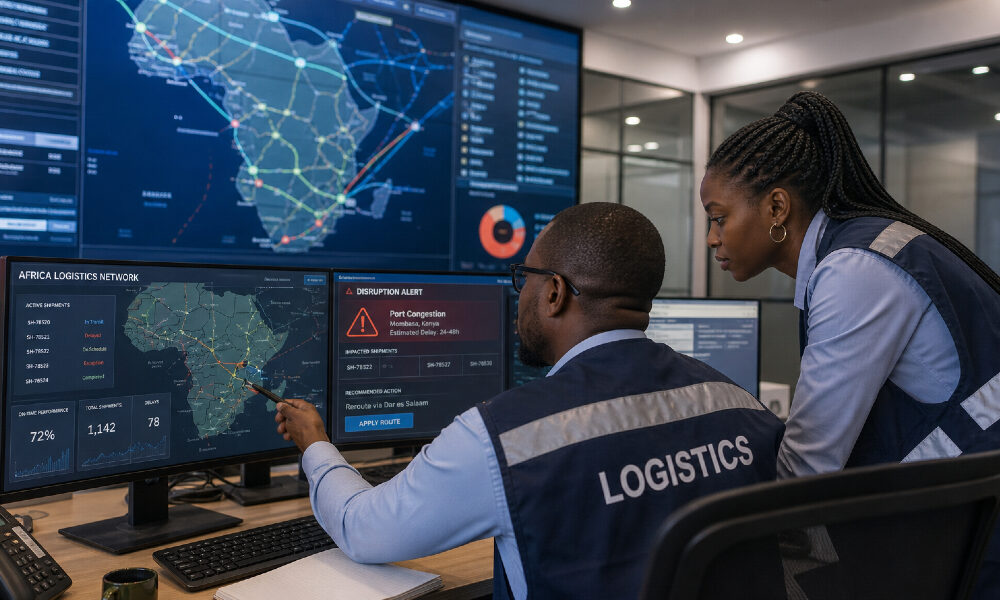
The strategic frontier is not only ports and corridors, but logistics intelligence systems: who sees flows, who models risk, and who decides rerouting under uncertainty.
The central question is: who sees the flows? Who models the risk? Who decides on rerouting when the system comes under pressure?
At present, those decisions are made in data environments that Africa neither controls nor, in many cases, fully has access to. Building African capacity in logistics intelligence – the ability to monitor, model, and respond to supply chain dynamics in real time – is not a secondary priority.
It is the precondition for everything else.
A Counterintuitive Opportunity
The rerouting of global shipping around the Cape of Good Hope does, paradoxically, create a window of opportunity. As vessels bypass the Red Sea and traverse Africa’s coastline, the continent is temporarily repositioned within global maritime geometry – not as a periphery to be passed, but as a transit space embedded in major trade flows.
Ports along the southern and western coasts find themselves on newly prominent shipping lanes. The potential economic gains from transshipment, bunkering, warehousing, light manufacturing, and regional cargo redistribution are real.
But capturing these gains is not primarily a question of physical capacity. It requires integration capacity: the ability to align ports, customs regimes, regulatory frameworks, and regional trade agreements into a coherent and interoperable logistics space.
Africa’s strategic horizon, in this sense, extends beyond adapting to global supply chains as they are currently structured. It lies in gradually shaping how those chains function – by positioning the continent not as a passive recipient of global flows, but as an active integrator within them.
Governing, Not Just Adapting
The disruptions in the Gulf are often framed as external shocks demanding external solutions – emergency rerouting, diversified suppliers, strategic reserves. These responses are necessary, but they operate within the same governance paradigm they seek to mitigate.
They are resilience measures, not structural reforms. The deeper transition that Africa’s position in global trade demands is a shift from resilient supply chains to distributed governance systems: systems in which coordination, intelligence, and decision-making are not externally concentrated but internally networked.
Supply chains, properly understood, are not merely logistical systems that move goods across space. They are distributed governance architectures that coordinate goods, data, finance, and risk through interconnected decision nodes.
What appears to be logistics is, in fact, a layered system of global coordination and control. Africa’s structural challenge is not simply that it is exposed to shocks, but that it has limited presence in the nodes where shocks are interpreted, assessed, priced, and converted into operational decisions that reshape global flows.
The question that policymakers, development institutions, and African governments must now confront is no longer how the continent adapts to global supply chains. It is how Africa moves from being governed by these architectures to actively participating in governing them.
That transition – from cognitive dependency to distributed governance – is the defining infrastructure challenge of the coming decade.
Danilo Desiderio serves as the CEO of Desiderio Consultants Ltd in Nairobi, Kenya, specializing in African customs, trade, and transport policies and is a senior associate to the Horn Economic and Social Policy Institute (HESPI).