Opinion
Africa’s Supply Chain Reckoning: From Participant to Power Player
The continent’s integration into global trade networks has exposed deep structural vulnerabilities – but the path to resilience runs through strategy, not just infrastructure.


By Naomi Mutuku
For the better part of a decade, African economies have deepened their ties to the arteries of global commerce – from fertilizer imports and energy flows to digital services and manufacturing inputs. The continent is no longer on the periphery of global trade; it is embedded within it.
But embedding is not the same as empowering. Africa participates in global supply chains, yet it does so overwhelmingly at their most vulnerable points.
The data are unambiguous. Intra-African trade reached approximately 16 percent of total trade in 2025, driven in large part by the African Continental Free Trade Area (AfCFTA) framework – a meaningful milestone, though still modest by the standards of other regional blocs.
Digital trade facilitation has cut border clearance times by 30 to 50 percent in select markets, demonstrating what systems-level thinking can unlock. Yet global supply chain shocks continue to fuel significant inflation across 29 African economies, particularly in food and tradable goods.
These are not isolated data points. They describe a structural condition.
When the World Sneezes, Africa Catches Pneumonia
The old cliché about emerging markets and external shocks has never felt more precise. Today’s disruptions do not arrive slowly – they cascade.
A conflict in the Middle East triggers fertilizer price spikes in East Africa within days. Shipping disruptions in the Red Sea translate into elevated freight costs across the continent within weeks.
Energy shocks ripple almost immediately into telecommunications, agriculture, and manufacturing.
Recent data show fertilizer prices rising 60 to 70 percent in direct response to global conflict, placing food security under acute threat in import-dependent economies.
This is not a temporary anomaly. This is the new normal – global shocks with immediate African impact and amplified local consequences.
The question, then, is not whether African economies are exposed. They are. The question is what structural repositioning can reduce that exposure and, over time, convert vulnerability into leverage.
Five Imperatives for a More Resilient Africa
Resilience, in the supply chain context, is not simply a matter of building more roads or ports – though infrastructure matters enormously. It is about redesigning the terms on which Africa engages with the global economy.
That requires action on five interconnected fronts.
Regionalization, not merely global integration. AfCFTA represents a foundational shift in ambition, but ambition requires execution. Harmonized customs procedures, the elimination of non-tariff barriers, and genuine industrial clustering are the unglamorous mechanics that determine whether the framework delivers real value or remains aspirational.
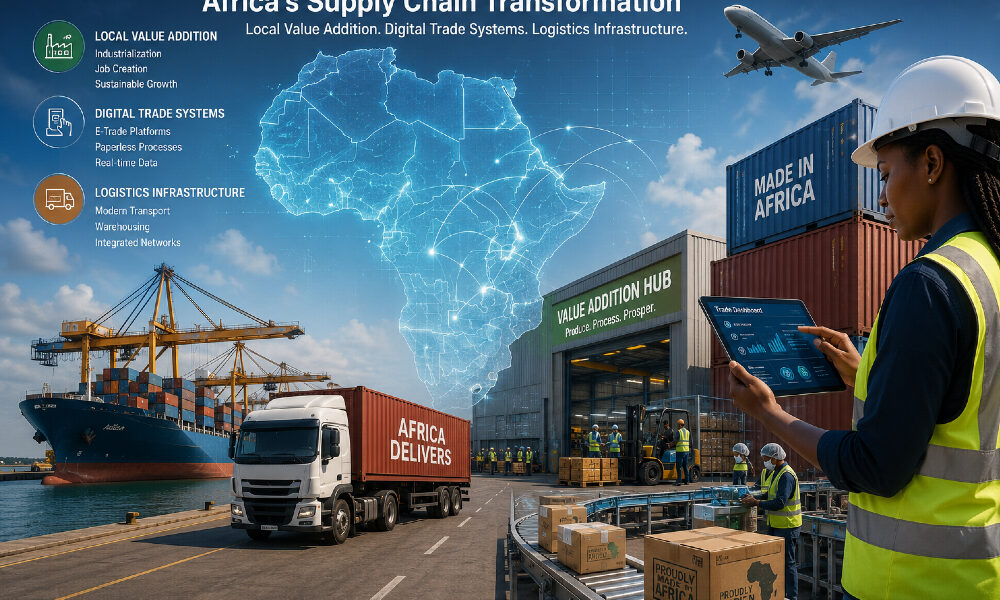
Local value addition. The model of exporting raw materials and re-importing finished goods at a premium is not just economically inefficient – it is strategically reckless. Industrialization and processing capacity must migrate closer to the source of production. Every step of value addition that occurs on the continent rather than abroad is a step toward reduced exposure.
Supply chain digitalization. Data visibility has become as consequential as physical infrastructure. Countries that invest in digital customs systems, real-time tracking, and predictive logistics do not merely move goods faster – they build the situational awareness necessary to anticipate and absorb disruption.
Energy independence within logistics systems. Energy costs account for up to 60 percent of operating expenses in some sectors, most notably off-grid telecom towers. That single vulnerability has enormous downstream consequences. The ongoing transition toward solar-powered logistics infrastructure is not incidental – it is strategic.
Expanded access to trade finance. Africa’s supply chains are constrained not only by logistics gaps but by liquidity gaps. Without accessible, affordable trade finance, even well-designed supply chains cannot scale. Capital flows must follow strategic intent.
The Strategic Question No One Should Avoid
Whether Africa should integrate into global supply chains is no longer a live debate – integration has already occurred, by design and by default. The more consequential and urgent question is whether Africa can transition from being a participant in global supply chains to becoming a controller of critical segments within them.
That distinction matters enormously. Participants absorb shocks. Controllers shape responses.
In a world defined by chronic disruption – geopolitical instability, climate volatility, pandemic risk, and great-power competition over critical minerals – the difference between the two is not merely economic. It is existential.
Resilience, ultimately, is not about reacting faster. It is about positioning smarter. The continent has the resources, the demographic momentum, and – with AfCFTA – the institutional architecture to make that transition. What remains is the political will and the executional discipline to see it through.
The world will not wait for Africa to be ready. But Africa, for once, does not have to wait for the world either.
Naomi Mutuku is a trade and investment expert specializing in helping global companies enter Kenya and broader African markets. She focuses on reducing risk, accelerating market entry, and fostering sustainable growth. Based in Nairobi, Naomi is a regular commentator on Africa’s dynamic business landscape and is passionate about the continent’s growth potential. She can be reached via email at: mukuinaomi@gmail.com