Opinion
Africa’s Strategic Moment: Integration as Leverage


By Ziad Hamoui
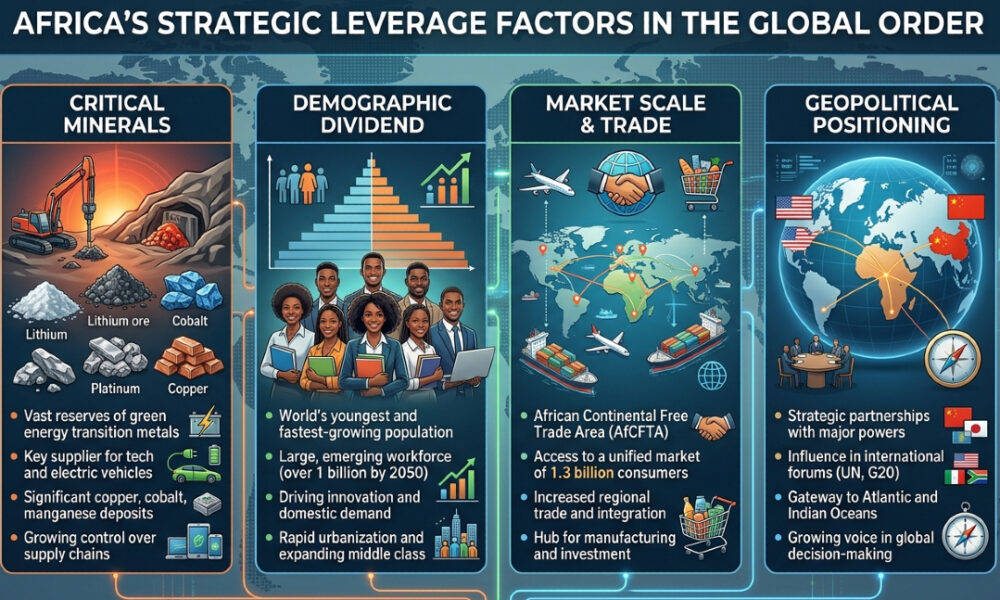
Africa controls roughly 30 percent of the world’s mineral reserves. By mid-century, its population will surpass 2.5 billion, making it home to the largest workforce on the planet.
The central strategic question of our era is not whether these assets exist – they plainly do – but whether Africa’s leaders will convert them into genuine, durable power, or allow them to perpetuate a familiar cycle of dependency.
A new report from the Tony Blair Institute for Global Change and JPMorganChase makes the stakes uncomfortably clear: the global order is being rewired, and Africa now sits at the center of that rewiring rather than at its margins. That is not rhetoric. It is arithmetic.
Bargaining Power Is Real – But Fragile
What the report identifies, and what those working on the ground have long observed, is that Africa possesses negotiating leverage it has not historically enjoyed.
Multiple geopolitical actors – the United States, China, the European Union, Gulf states, and emerging Asian economies – are actively competing for access to African markets, infrastructure corridors, and critical mineral supply chains. Demographics are generating market scale.
The global energy transition has elevated the strategic value of lithium, cobalt, copper, and manganese – minerals concentrated disproportionately across the African continent.
But leverage without execution is merely potential. And potential, as history repeatedly demonstrates, does not automatically compound.
The Traps That Neutralize Advantage
Three structural risks threaten to absorb Africa’s strategic moment before it can be fully realized.
The first is fiscal. Rising debt service costs – exceeding 20 percent of fiscal revenue in several African economies – are crowding out precisely the public investments in infrastructure, education, and industrial capacity that would transform a young population into productive economic output.
Demographics alone guarantee nothing. A large workforce without commensurate investment in skills, connectivity, and institutional capacity is a dividend deferred rather than a dividend earned.
The second is the raw-material trap. Mineral wealth translates into strategic power only when African states resist the well-worn pattern of exporting unprocessed resources and importing the finished value those resources ultimately generate.
Real competitive advantage lies upstream: in processing, refining, manufacturing, and the development of integrated industrial ecosystems. Every ton of lithium exported as ore rather than battery-grade material represents a transfer of value – and leverage – to someone else’s economy.
The third is governance. Weak institutions, persistent conflict, and regulatory inconsistency erode the long-term predictability that investors and industrial partners require.
No amount of mineral endowment or demographic scale compensates for an environment in which contracts are uncertain and policy shifts are unpredictable. Governance is not a soft prerequisite. It is a hard competitive variable.
Regional Integration as Strategic Infrastructure
The African Continental Free Trade Area (AfCFTA) is not merely a trade agreement. Properly implemented, it is the structural architecture that makes the rest of the strategy viable.
Industrial clustering, regional value chains, and cross-border manufacturing networks require the kind of market depth and regulatory coherence that only continental integration can provide. AfCFTA enables African industries to achieve the scale necessary to compete globally – not as commodity exporters, but as processors, manufacturers, and value-added producers.
This is not abstract. During engagements with European and Asian investors evaluating African market opportunities, the practical concerns are consistently concrete: logistics reliability, customs efficiency, cross-border connectivity, and corridor infrastructure.
These partners weigh integration quality as heavily as market size. Regional integration, in this context, is not a developmental aspiration – it is a competitive differentiator.
Trade facilitation, corridor infrastructure investment, and institutional strengthening are therefore not secondary concerns to be addressed after growth arrives. They are the preconditions that determine whether growth arrives at all.
The Terms of the Emerging Order
The report’s central conclusion deserves to be stated plainly: Africa can help set the terms of the emerging global order, or it can become the terrain on which others compete.
There is no neutral position. The choices made over the next decade – on industrial policy, integration, governance, and investment – will determine which path prevails.
For West Africa specifically, this means accelerating AfCFTA implementation with measurable urgency, investing in processing capacity along established trade corridors, and deepening the governance reforms that create the agility and competitiveness that global capital increasingly demands.
A Call to the Network
The institutional architecture exists. The ECOWAS Commission and the AfCFTA Secretariat have the mandates. What remains is the political will to prioritize execution over deliberation.
I would invite colleagues across the network to engage directly with this question: what concrete steps should the ECOWAS Commission and AfCFTA Secretariat prioritize in 2026 to accelerate the structural shift from raw material exports to regional value chains? The window is open. The question is how long it stays that way.
Ziad Hamoui is the Co-Founder and Past President of the Borderless Alliance, a leading private-sector advocacy group promoting economic integration and removing trade and transport barriers in West Africa. With extensive experience in Ghana’s road transport, logistics, and shipping sectors, he currently serves as Executive Director of Tarzan Enterprise Ltd., a long-established family business. He is a former Co-Chair of the Africa Food Trade Coalition, Co-Founder of the Trade Facilitation Coalition for Ghana, and serves on multiple high-level advisory committees on trade, transport, agriculture, and security. A Chartered Fellow of the Chartered Institute of Logistics and Transport (CILT) Ghana, he is also a former member of its Governing Council.