Opinion
Africa’s Strategic Crossroads in the New Multipolar Trade Order


By Danilo Desiderio
The global trading system is fracturing, and Africa faces a pivotal choice: become a strategic player or remain a passive bystander in a rapidly reorganizing world economy.
A new report from Boston Consulting Group’s Center for Geopolitics, timed for the World Economic Forum in Davos, reveals what many policymakers have quietly acknowledged but few have articulated so clearly. The world is not sliding toward protectionism, nor is it maintaining the postwar multilateral consensus.
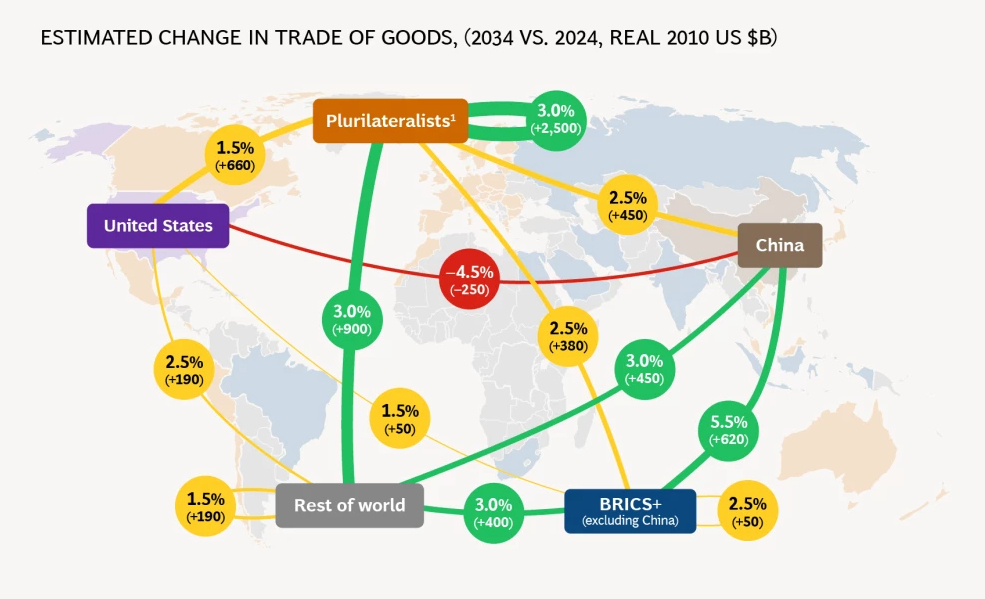
Instead, international commerce is crystallizing around four distinct power centers: the United States, China, the expanding BRICS+ coalition, and a bloc of Plurilateralist economies committed to rules-based cooperation.
Each pole increasingly writes its own rulebook, pursues its own priorities, and cultivates its own networks of allies. The implications for countries caught between these competing spheres of influence could hardly be more consequential.
The New Geography of Global Commerce
Trade flows are being fundamentally redrawn along geopolitical fault lines. The Plurilateralist group – encompassing the European Union, European Free Trade Association (EFTA) members, Japan, South Korea, Australia, Canada, and key emerging markets like Chile, Malaysia, Mexico, Singapore, and Morocco – is projected to experience above-average trade growth both internally and with much of the Global South.
Meanwhile, China deepens its commercial integration with BRICS+ nations and developing economies, while America’s share of global goods trade continues its gradual decline as Washington prioritizes domestic manufacturing and strategic autonomy.
Africa sits conspicuously outside these major poles, grouped instead among Global South “free agents” that must navigate between competing centers of power. This position brings both peril and promise.

Sources: S&P Global Trade Analytics Suite; BCG analysis.
Fragmentation’s Double Edge
The risks are substantial and immediate. Shifting tariff regimes will increase costs and complexity for African exporters.
Regulatory divergence between the major poles threatens to fragment standards and compliance requirements. Perhaps most critically, the continent risks remaining trapped in its historical role as a commodity supplier – shipping raw materials to others who capture the value through processing and manufacturing.
Yet fragmentation also creates openings that did not exist in a unipolar or purely Western-dominated system. Expanding South-South trade corridors, particularly with China and Plurilateralist economies, offer pathways to higher growth.
The key variable is whether African nations can leverage these opportunities through strategic investments in value addition, industrialization, and carefully calibrated partnerships.
The Path Forward Demands Strategy, Not Wishful Thinking
BCG’s analysis underscores an uncomfortable truth: geopolitical fragmentation is accelerating, driven by competing industrial policies, selective engagement with trade norms, and divergent regulatory frameworks. This reality will continue reshaping supply chains and market access regardless of African preferences.
Success requires African governments and businesses to move beyond reactive postures. The continent must strategically position itself by balancing relationships across multiple poles, strengthening supply-chain resilience, pursuing genuine industrial upgrading, and capturing higher value rather than perpetuating extractive export models.
This means difficult choices. It means investing in processing capacity rather than simply expanding mining output.
It means negotiating partnership terms that transfer technology and skills, not just capital. It means building regional value chains that can compete globally while reducing dependence on any single external power.
A Moment of Agency
The multipolar trade era presents Africa with a rare moment of agency. The major powers need resources, markets, and geopolitical alignment – assets the continent possesses in abundance.
But translating these latent advantages into tangible prosperity requires abandoning comfortable assumptions about Africa’s role in the global economy.
The continent’s future influence will depend less on passive participation in international markets and more on active engagement with multiple trade centers, strategic partnership cultivation, and genuine industrial transformation. Africa has the potential to thrive amid fragmentation, but only if it adapts deliberately rather than waiting to be acted upon.
The question is no longer whether the global trading system will fragment – that process is already well advanced. The question is whether Africa will position itself as a strategic actor shaping that fragmentation, or allow itself to be marginalized by forces beyond its control.
The choice, for once, is largely Africa’s to make.
Danilo Desiderio serves as the CEO of Desiderio Consultants Ltd in Nairobi, Kenya, specializing in African customs, trade, and transport policies. He is a customs and trade expert at the World Bank and a senior associate to the Horn Economic and Social Policy Institute (HESPI).