Opinion
Africa’s Rural Reversal: Why the Western Urban Model Is a Development Mistake
The West is paying its young people to leave cities and return to the land. The advice flowing into Africa points stubbornly in the opposite direction.


By Sheena Raikundalia
A new report from the Mastercard Foundation – its Africa Youth Employment Outlook 2026 – arrives laden with data and good intentions. Yet reading it carefully surfaces an uncomfortable question that the development community has been too slow to confront: What if the very model of progress it assumes is already unraveling in the countries that invented it?
For decades, a particular sequence has been treated as axiomatic in development economics. Move people from rural to urban. Shift labor from agriculture to services. Bring workers from the informal economy into formal, centralized employment.
It is a tidy ladder, and much of the world has been told to climb it. But the ladder’s top rungs are looking increasingly shaky.
The West Is Quietly Reversing Course
In Italy, a generation of young professionals is abandoning Milan and Rome, trading open-plan offices for vineyards and artisan food brands in the Apennines. In Spain, rural broadband initiatives are seeding technology clusters in villages that were hemorrhaging population a decade ago. Japan – confronting its own demographic crisis with characteristic directness – is now paying families thousands of dollars to relocate from Tokyo to rural prefectures.
These are not the choices of people who failed to make it in the city. They are deliberate rejections of a model that promised fulfillment and delivered burnout, loneliness, sky-high rents, and a creeping disconnection from community and food.
The 9-to-5 corporate career, long the gold standard of “making it,” is losing its luster among young people in the very societies that perfected it.
And yet, in parallel development conversations about Africa, the prescription remains unchanged: more skyscrapers, more cubicles, more centralized employment. More of the model the West is quietly walking back.
The Formality Fallacy
The standard rebuttal is familiar: formal employment offers income stability and legal protections that informal rural work cannot match. The argument is not without merit. But it deserves far more scrutiny than it typically receives.
At Kuza, an organization working directly with rural agripreneurs across Africa, the income data challenges easy assumptions. Some of the smallholder farmers and agricultural entrepreneurs in the program earn upward of US$3,000 per month – figures that would be respectable in any formal sector.
The income is there. What is often absent are the surrounding structures: portable insurance, accessible savings products, and pension mechanisms that travel with the worker rather than being tethered to a single employer or office address.
That is a solvable infrastructure problem. It is not an argument for mass urban migration.
The question development practitioners should be asking is not how to move Africa’s youth out of rural areas or out of agriculture. It is how to make rural areas and agriculture more profitable, more technologically sophisticated, more financially protected, and – crucially – more aspirational.
The Structural Case for Rural Investment
Africa’s demographic profile makes this question urgent in ways that are still underappreciated globally. The continent has one of the youngest populations on earth. A median age hovering near 19 means that feeding Africa is not a short-term logistics challenge – it is a multigenerational strategic imperative.
Three successive shocks – the COVID-19 pandemic, Russia’s invasion of Ukraine, and cascading disruptions to global shipping and commodity supply chains – demonstrated with brutal clarity that food security is not a soft concern for agricultural ministries. It is a hard geopolitical variable.
Countries and regions that had allowed domestic food production to atrophy paid for that neglect in inflation, shortages, and political instability.
Africa’s traditional crop portfolio deserves particular attention in this context. Across the continent, varieties of sorghum, millet, cassava, cowpea, and teff have evolved over centuries to tolerate drought, resist pests, and thrive in soils that defeat imported hybrid strains.
These crops are not relics. They are precisely calibrated responses to the climatic conditions that climate models project will become more common – not less – over the coming decades.
Against the backdrop of an ultra-processed food crisis spreading through middle-income countries worldwide, their nutritional profiles represent an undervalued comparative advantage.
The Digital Rural Economy Is Not a Contradiction
The implicit assumption behind the urbanization-as-development thesis is that rural life is incompatible with technological sophistication, financial access, and economic dynamism. That assumption is becoming harder to defend by the month.
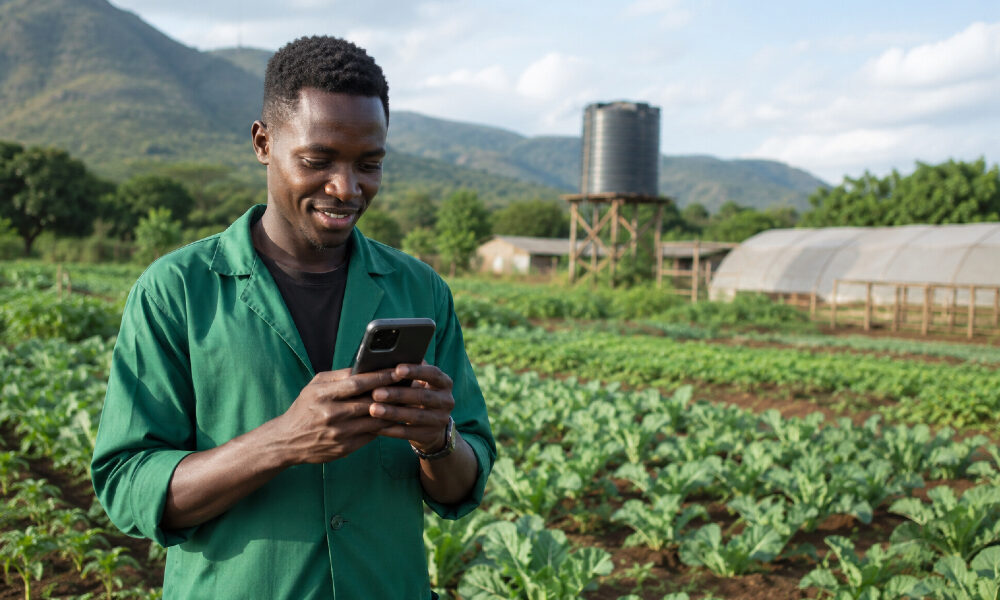
Mobile money platforms have demonstrated that financial infrastructure does not require a bank branch. Precision agriculture tools – affordable soil sensors, satellite-derived crop advisory services, AI-powered pest identification – are reaching smallholders without requiring them to move.
Cold-chain investments and aggregator models are connecting rural producers directly to regional and export markets in ways that strip out intermediaries and return more margin to the farmer.
The digitally connected rural economy is not a utopian concept. Versions of it are being assembled, piecemeal but persistently, across Kenya, Rwanda, Ghana, and Nigeria.
What it requires is investment, policy imagination, and – perhaps most importantly – a willingness to stop treating the movement of people into cities as the default measure of economic success.
A Different Kind of Ambition
There is nothing inherently wrong with cities, or with the aspiration to build them. Africa’s urban centers will grow substantially regardless of policy choices, and they deserve the infrastructure investment to grow well.
But city-building and rural investment are not a zero-sum contest.
The more consequential error is the one embedded in the development conversation’s baseline assumptions: that rural Africa represents backwardness to be overcome rather than a foundation to be strengthened. That error is expensive. It misallocates capital, misorients young people’s aspirations, and dismisses some of the continent’s most durable competitive assets.
The countries now paying young people to move back to the countryside learned something through experience. Africa has the opportunity to learn it through foresight.
Rural Africa is not behind the curve. It may, in fact, be where the next model of human prosperity is taking shape – if the development community is willing to look.
Sheena Raikundalia is an accomplished entrepreneur, former lawyer, government policy advisor, and angel investor with deep expertise across the legal, financial services, and impact investment sectors in Europe and Africa. She has played a pivotal role in advancing Africa’s technology and innovation ecosystems, leveraging a career that spans top-tier London law firms, leadership as Country Director of the UK-Kenya Tech Hub for the UK Foreign, Commonwealth & Development Office (FCDO), and her current position as Chief Growth Officer at agri-tech company Kuza One. Sheena is recognized for her strategic vision, commitment to fostering innovation, and strong advocacy for Africa’s growth potential in technology, entrepreneurship, and impact investment.