Opinion
Africa’s Rockefeller Moment: What the Dangote Refinery Case Really Asks of the Continent
Dangote’s refinery raises a question that goes far beyond Nigeria: can Africa build industrial giants without allowing them to become untouchable?


By Sheena Raikundalia
John D. Rockefeller once controlled roughly 90 percent of American oil refining. History, on balance, remembers him as an industrial titan. Aliko Dangote now dominates Nigeria’s petrol-refining market. Court filings call it something less flattering: a monopoly.
Last month, this column examined an America that global markets would have blacklisted at 66 years old – roughly Kenya’s age today. That inquiry led somewhere unexpected: straight into a Lagos courtroom, and a legal dispute that Africa’s policymakers would be wise to watch closely.
America’s Industrial Bargain
The United States industrialized behind some of the steepest tariff walls the world had ever seen. Washington handed the railroads about 130 million acres of public land to build the arteries of a continental economy. Rockefeller, for his part, used secret rebates from railroad companies and relentless consolidation to bring Standard Oil to roughly 90 percent market control. Andrew Carnegie built a steel empire so vast that he sold it for $480 million in 1901 – a figure that still staggers when adjusted for inflation.
These men built precisely what a young America desperately needed: railways, steel, oil, and factories at a scale no one else could finance or coordinate.
But let’s resist the temptation to romanticize it. That same system produced monopolies, political capture, brutal working conditions, and staggering concentrations of wealth. America did not simply build industrial capacity – it then spent decades reckoning with the consequences of how that capacity was built.
The Sherman Antitrust Act arrived in 1890. Journalist Ida Tarbell exposed Standard Oil’s practices in 1904. The Supreme Court finally broke the company into 34 separate entities in 1911. The pattern is unmistakable: the industrialists built the capacity first, and the institutions built the correction roughly a generation later.
Lagos Enters the Story
Now consider Lagos today. Dangote’s US$20 billion refinery is doing something Nigeria has needed for sixty years: replacing imported fuel with homegrown supply. By April 2026, the refinery supplied nearly 80 percent of the country’s petrol, while fuel imports fell by around 60 percent year-on-year in the first quarter alone.
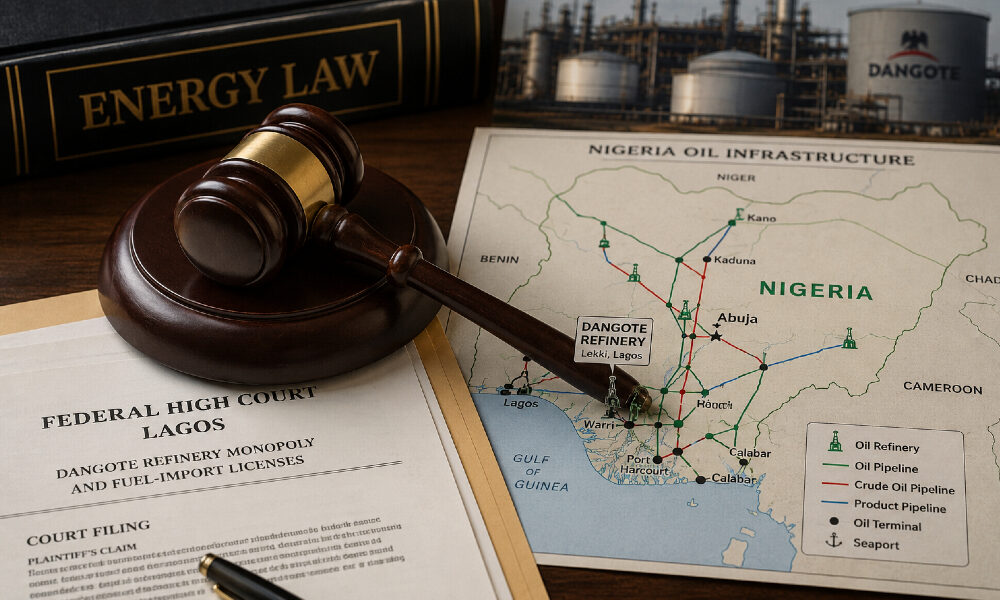
That achievement matters enormously for a country that has spent decades importing refined products despite sitting on some of Africa’s largest crude reserves. It is also, notably, the subject of active litigation. Dangote is challenging the Nigerian state over fuel-import licenses, arguing that the law reserves import rights for genuine domestic shortfalls. The Nigerian National Petroleum Company (NNPC) counters that restricting import licenses risks handing a single company effective control over national energy security.
Both arguments carry genuine weight. A judge, not a columnist, will ultimately decide.
A Familiar Sequence, A New Cast
America built its barons first and its trust-busters later. South Korea took a different but structurally similar path, nurturing Hyundai, Samsung, and other industrial champions behind tariff protection and cheap state credit, while using export performance as a discipline mechanism to keep them competitive. Japan, too, used deliberate state policy to cultivate globally competitive industrial conglomerates, or keiretsu.
None of these countries eliminated economic concentration. They managed it – imperfectly, unevenly, and often belatedly – and each eventually had to confront the political and economic power its champions had accumulated along the way.
Africa is now being handed the same choice, playing out in real time, in a Lagos courtroom.
The Question Africa Cannot Avoid
Can the continent refuse to follow the old sequence? Can Nigeria, and Africa more broadly, build the factory and the regulator simultaneously – the national champion and the competitive framework it must answer to – allowing scale to grow without hardening into permanent political power?
Or will Africa build its barons now, as America, Korea, and Japan did before it, and simply hope the trust-busters arrive a generation later, the way they always seem to?
The answer will shape not just Nigeria’s fuel prices, but the template every other African economy watching from the sidelines chooses to follow.
Sheena Raikundalia is an accomplished entrepreneur, former lawyer, government policy advisor, and angel investor with deep expertise across the legal, financial services, and impact investment sectors in Europe and Africa. She has played a pivotal role in advancing Africa’s technology and innovation ecosystems, leveraging a career that spans top-tier London law firms, leadership as Country Director of the UK-Kenya Tech Hub for the UK Foreign, Commonwealth & Development Office (FCDO), and her current position as Chief Growth Officer at agri-tech company Kuza One. Sheena is recognized for her strategic vision, commitment to fostering innovation, and strong advocacy for Africa’s growth potential in technology, entrepreneurship, and impact investment.