Opinion
Africa’s Renaissance: From Resources to Technology and Execution
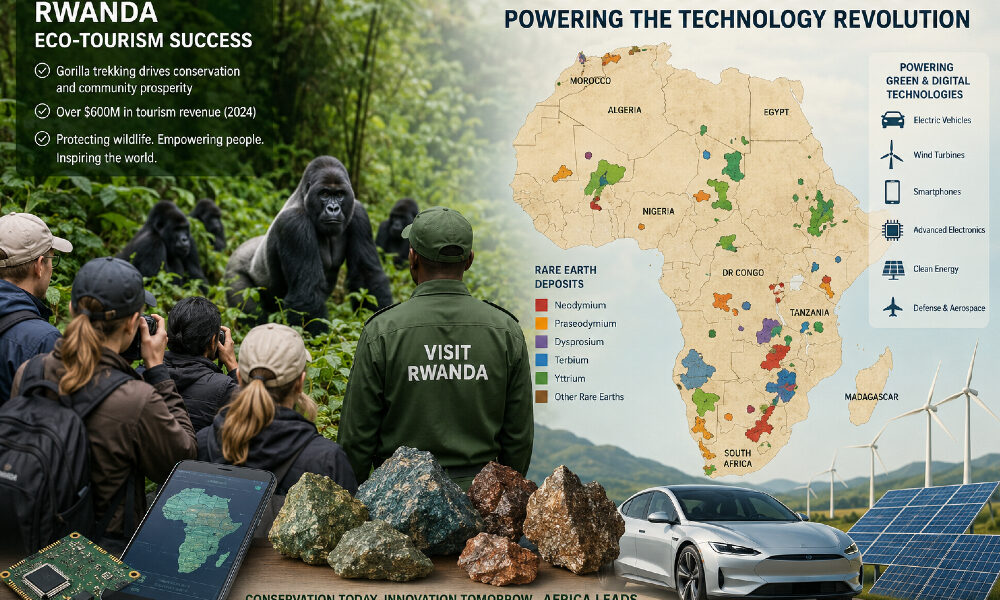
From gorilla tourism to rare-earth minerals, the continent’s next chapter will be written not by what lies beneath its soil, but by the strategy built on top of it.


By Ratnakar Wagh
For decades, the conversation about Africa’s economic future has followed a familiar script: a continent blessed with extraordinary natural wealth, perpetually waiting to convert that wealth into prosperity. Two stories emerging today – one from the hills of Rwanda, the other from beneath a dozen African countries’ soil – suggest the script needs revising.
The raw material was never the constraint. Strategy was.
Rwanda’s Masterclass in Brand Discipline
Start with tourism, and with a small East African nation few investors would have picked a generation ago as a case study in destination marketing. Rwanda’s tourism receipts have climbed to a historic US$685 million (roughly Rwf 1 trillion), driven by 1.49 million visitor arrivals and a meetings-and-events sector robust enough to host more than 160 international gatherings. Those are respectable numbers on their own. What makes them instructive is how Rwanda got there.
Three decisions stand out.
First, Rwanda abandoned passive advertising in favor of embedded visibility. Rather than buying billboard space and hoping tourists noticed, the country struck sponsorship deals with elite global sports institutions – Arsenal, Paris Saint-Germain, Atlético Madrid, and major American franchises among them. The “Visit Rwanda” logo now appears on shirt sleeves watched by hundreds of millions of people who have never opened a traditional travel brochure. This is brand-building as infrastructure: durable, high-frequency, and aimed squarely at a younger, more global audience than tourism boards typically reach.
Second, Rwanda chose value over volume. Instead of competing on price for mass-market tourism, it doubled down on high-value, low-impact eco-tourism – most visibly, strictly limited access to mountain gorilla trekking. The strategy protects a fragile natural asset while extracting far more revenue per visitor than a high-traffic, low-margin model ever could.
Third, and perhaps most consequential, Rwanda built institutions to match its ambition. The Rwanda Development Board operates with something closer to corporate efficiency than typical government bureaucracy, and a genuine revenue-sharing arrangement with local communities has turned conservation into a shared economic interest rather than an externally imposed constraint.
None of this happened by accident. It is the product of coordinated policy, patient investment, and a willingness to prioritize long-term brand equity over short-term visitor counts. That combination – not gorillas, not scenery – is the actual export.
The Bigger Prize Sitting Beneath the Surface
If tourism shows what disciplined branding can achieve, Africa’s rare-earth deposits pose a far larger question – one with implications well beyond the continent.
Rare-earth elements are the seventeen minerals that quietly make modern technology possible: electric-vehicle motors, wind turbines, smartphones, aerospace components, robotics, and defense systems all depend on them, typically in combinations rather than isolation. Africa’s known deposits are extensive and geographically diverse:
- Tanzania (Ngualla, Wigu Hill) – strong potential in neodymium and praseodymium, the elements behind high-strength magnets.
- Malawi (Songwe Hill, Kangankunde) – sizable resources with projects advancing toward concentrate and separated-product output.
- Angola (Longonjo) – one of the continent’s most advanced projects, combining rare earths with niobium.
- Uganda (Makuutu) – a major ion-adsorption clay deposit spanning a broad range of magnet-grade elements.
- Madagascar (Ampasindava, Tantalus) – rich in neodymium, praseodymium, dysprosium, and terbium; Ampasindava has drawn U.S. interest as Washington looks to diversify supply chains away from China.
- South Africa (Steenkampskraal, Zandkopsdrift, Phalaborwa) – multiple pathways involving monazite and phosphate-processing residues.
- Namibia (Lofdal, Kalkfeld, Eureka) – deposits often associated with niobium and tantalum alongside rare earths.
- Morocco (Lahjeyra, Lamiaga, Twihinate) – several large exploration-stage projects.
- Mozambique (Monte Muambe) – a significant developing resource.
- Zambia (Nkombwa Hill) – a major deposit tied to niobium and phosphate.
The strategic value here is obvious to any government or manufacturer trying to reduce dependence on a small handful of processing hubs, China chief among them. What is less obvious – and far more important – is what Africa chooses to do next.
The Question That Actually Matters
It would be easy, and historically consistent, for African governments to treat rare earths the way many resource economies have treated oil, copper, and diamonds: as commodities to be extracted, sold in raw form, and processed elsewhere, with the bulk of the value captured downstream. That path is available, and it would generate revenue. It would not, however, build lasting economic leverage.
The more consequential question is not how much Africa can earn from its minerals, but whether it can build the refining, processing, and manufacturing capacity to convert those minerals into finished technology – and capture the value that comes with doing so. Rwanda’s tourism story offers a useful, if imperfect, analogy: the country did not simply have gorillas and volcanoes; it built the branding, institutions, and revenue architecture to make those assets valuable in a global market. Rare earths require the same deliberate construction, at far greater scale and cost.
Global buyers currently competing to secure long-term African mineral commitments know this. Some, like the American engagement in Madagascar, appear designed with exactly this leverage question in mind. Whether African governments negotiate for extraction rights alone or for genuine processing capacity and technology transfer will determine which version of the next commodity cycle they experience.
The Common Thread
Rwanda’s tourism revenue and Africa’s rare-earth reserves are, on the surface, unrelated stories. Underneath, they make the same argument: Africa’s natural and cultural endowments have never been the binding constraint on its economic trajectory. Aggressive, data-driven branding; institutions capable of executing at pace; and a willingness to hold out for value rather than settle for volume – these are the variables that turn potential into performance.
The continent that once waited to be discovered is now positioned to decide, on its own terms, what it does with what the world has finally noticed. The minerals will still be there in a decade. Whether Africa still owns the value chain built on top of them is the far more interesting question – and the one worth watching.
Ratnakar Wagh is an entrepreneur, management professional, and CEO of Tanzania-based Kinglion Investment Company, an investment firm driving industrial development across Africa through initiatives in manufacturing, renewable energy, and logistics infrastructure. He specializes in organizational transformation, sustainability, and leadership, with a strong focus on building high-performing teams and creating long-term value across emerging markets.