Opinion
Africa’s Regional Integration: Progress, Pitfalls, and Pathways Forward – Insights from ARIA XI


By Danilo Desiderio
The 11th edition of the Assessing Regional Integration in Africa (ARIA XI) report – jointly published by the United Nations Economic Commission for Africa (UNECA), the African Union Commission (AUC), and the African Development Bank (AfDB) – offers a comprehensive assessment of Africa’s progress toward regional integration and highlights both achievements and persistent challenges.
Released after a notable delay due to methodological revisions, this biennial flagship report provides critical insights into the continent’s journey toward realizing the African Economic Community (AEC), a vision outlined in the 1991 Abuja Treaty. The AEC envisions a unified continental market with a common currency, shared economic policies, and deep political integration.
Rethinking the Metrics: From ARII to AMRII
One of the most significant developments since the previous ARIA X report in 2021 has been the revision of the African Regional Integration Index (ARII). Feedback from Regional Economic Communities (RECs) and member states highlighted limitations in the ARII’s reliance on comparative analysis and its narrow scope.
In response, the AUC launched a comprehensive review in 2016, culminating in the creation of the more robust African Multidimensional Regional Integration Index (AMRII) in 2020.
The AMRII introduces a broader framework, incorporating eight dimensions and 33 indicators – including thresholds for performance and new metrics to track implementation delays and alignment with Agenda 2063 and the Abuja Treaty. However, despite these advancements, ARIA XI still relies on the older ARII methodology for its current analysis, which evaluates five key pillars of integration:
- Trade Integration
- Productive Integration (value chains)
- Infrastructure Integration
- Financial and Macroeconomic Integration
- Free Movement of People
These are assessed using a mix of quantitative data (e.g., trade flows, energy connectivity) and qualitative factors (such as visa openness and policy harmonization).
Key Findings: Measured Progress Amid Structural Hurdles
ARIA XI paints a nuanced picture of Africa’s integration landscape:
- Gradual but Real Advancement: While progress remains uneven, Africa is inching closer to the AEC goal, particularly through the establishment of Free Trade Areas (FTAs) and Customs Unions at the REC level.
- AfCFTA as a Game-Changer – But Not Enough Alone: The African Continental Free Trade Area (AfCFTA) marks a historic milestone for intra-African trade liberalization. Yet, the report stresses that deeper integration beyond tariff reductions is essential – especially in digital trade, infrastructure development, and regulatory cooperation.
- Persistent Structural Barriers: Overlapping REC memberships, weak institutional frameworks, and misaligned national policies continue to impede effective integration. Enforcement mechanisms remain underdeveloped across many RECs, further complicating coordination and implementation.
Regional Performance: Leaders and Laggards
The report identifies several high-performing RECs:
- East African Community (EAC): Leads in overall integration, particularly in trade liberalization and freedom of movement.
- Economic Community of West African States (ECOWAS): Excels in financial and macroeconomic integration, bolstered by coordinated monetary systems.
- Southern African Development Community (SADC): Makes strong strides in infrastructure development, especially in transport and energy.
- Common Market for Eastern and Southern Africa (COMESA): Shows promise in productive integration and value chain development.
Conversely, several RECs face significant hurdles:
- Arab Maghreb Union (AMU), Community of Sahel-Saharan States (CEN-SAD), and Economic Community of Central African States (ECCAS) lag behind due to political instability, poor enforcement, and inadequate cross-border infrastructure.
- Intergovernmental Authority on Development (IGAD), while reporting surprisingly high intra-African trade levels (36 percent), has yet to establish even a basic Free Trade Area – a contradiction that warrants further scrutiny.
Intra-African Trade: A Mixed Picture
Despite the AfCFTA’s promise, intra-regional trade across Africa remains low – just 16 percent at the continental level. IGAD reports the highest proportion of intra-African trade, likely driven by Kenya and Uganda’s robust regional ties, along with Djibouti’s role as a re-export hub.
The East African Community (EAC) follows closely with 28 percent intra-trade.

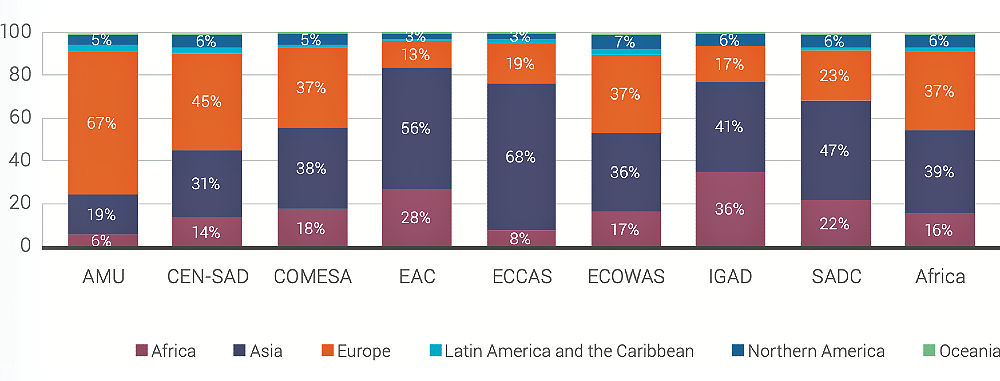
RECs’ merchandise exports to world regions, average 2019–23 (percent)
However, these figures underscore a broader challenge: many African countries trade more with external partners than with their neighbors – a trend that undermines the continent’s collective economic potential.
Policy Recommendations: The Road Ahead
To accelerate integration, ARIA XI outlines several priority actions:
- Strengthen Inter-Institutional Coordination: Improve collaboration between the African Union and RECs. While a new digital coordination platform was launched in July 2024, it remains largely inactive, signaling the need for greater follow-through.
- Fast-Track AfCFTA Implementation: Focus on services and investment protocols to unlock the full potential of the free trade area.
- Harmonize Policies and Legal Frameworks: Transition from FTAs and Customs Unions to full-fledged economic communities requires consistent legal and regulatory alignment.
- Boost Digital Connectivity and Cross-Border Payments: Investments in digital infrastructure and systems like PAPSS will be crucial for facilitating seamless trade and financial integration.
Conclusion: A Vision Within Reach
The African Economic Community envisioned in the Abuja Treaty remains attainable – but only if African governments commit to sustained reforms, deepen cooperation, and align national priorities with continental goals. As ARIA XI makes clear, integration is not just about signing agreements; it’s about implementing them effectively, ensuring coherence, and fostering trust across borders.
Africa’s future depends on how well it can unify – not just politically, but economically and institutionally. With the right leadership and policy focus, the dream of a truly integrated Africa can become a reality.
Danilo Desiderio serves as the CEO of Desiderio Consultants Ltd in Nairobi, Kenya, specializing in African customs, trade, and transport policies. He is a customs and trade expert at the World Bank and a senior associate to the Horn Economic and Social Policy Institute (HESPI).