Opinion
Africa’s Regional Economic Communities: Driving Integration or Facing Roadblocks?


By Dishant Shah
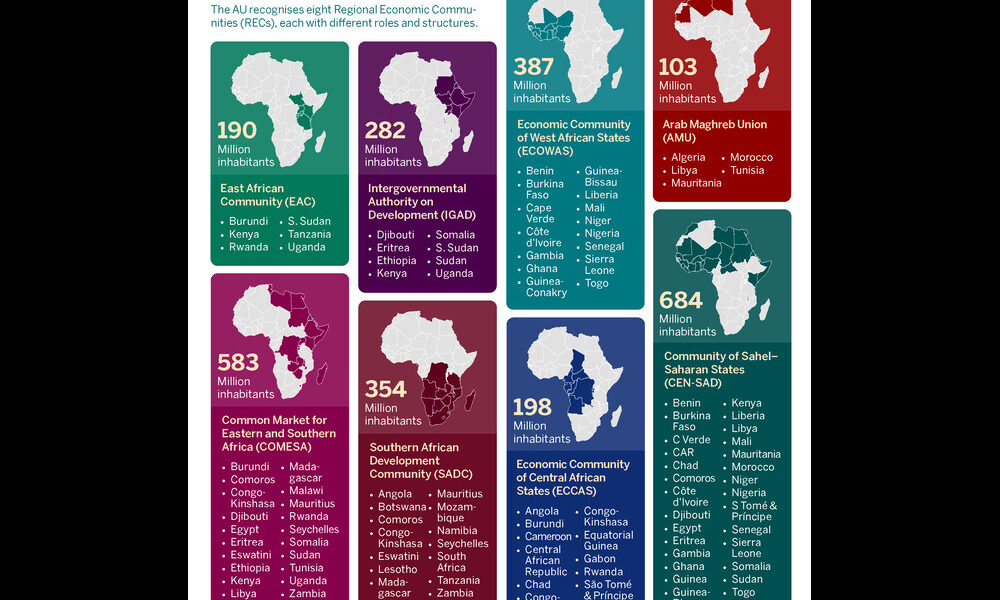
Africa’s economic landscape is being shaped by eight major Regional Economic Communities (RECs), each striving – sometimes successfully, sometimes not – to drive regional integration.
These RECs are designed to enhance trade, develop infrastructure, and create economic opportunities. While progress varies across regions, their impact on Africa’s future cannot be overstated.
ECOWAS: A Leader in Free Movement and Trade
Take the Economic Community of West African States (ECOWAS), for example. Representing 15 nations and a population of 387 million, ECOWAS has made significant progress in facilitating the free movement of people and goods.
It is also spearheading efforts to introduce a common currency, the Eco, to reduce reliance on foreign currencies and strengthen regional economic stability.
SADC: Southern Africa’s Economic Powerhouse
In Southern Africa, the Southern African Development Community (SADC) spans 354 million people and boasts one of the continent’s strongest trade and infrastructure networks. Countries such as South Africa, Tanzania, and Zambia are deeply integrated, contributing to some of Africa’s highest intra-regional trade levels.
However, challenges like energy shortages and policy misalignment continue to hinder full economic integration.
COMESA: A Giant with Bureaucratic Hurdles
The Common Market for Eastern and Southern Africa (COMESA) is one of Africa’s largest RECs, covering 583 million people across Eastern and Southern Africa. While it has taken steps to simplify trade policies, its vast membership creates bureaucratic complexities.
For instance, Kenya, Uganda, and Rwanda are also part of the East African Community (EAC), leading to overlapping trade agreements and regulatory inconsistencies.
EAC: A Model for Regional Integration
Despite its smaller size – just six member states and a population of 190 million – the EAC stands out as Africa’s most successful regional bloc. It has established the most effective free movement policy on the continent, allowing citizens to travel, work, and live across borders with minimal restrictions.
This level of integration remains a challenge for many other RECs.
AMU: A Potential Powerhouse Stalled by Politics
The Arab Maghreb Union (AMU) could have been a formidable economic force in North Africa. However, longstanding political tensions between Algeria and Morocco have severely hindered its progress.
With a population of 103 million, it remains one of Africa’s least active RECs, struggling to achieve meaningful economic integration.
IGAD: Stability Over Trade
In the Horn of Africa, the Intergovernmental Authority on Development (IGAD) focuses more on political stability than economic growth. Covering 282 million people, IGAD has played a crucial role in conflict resolution, from South Sudan’s civil war to the Ethiopia-Eritrea peace negotiations.
While its contributions to regional security are undeniable, economic integration remains secondary.
CEN-SAD: The Largest but Least Effective Bloc
With 684 million people, the Community of Sahel-Saharan States (CEN-SAD) is Africa’s largest REC by population. However, its effectiveness is often questioned.
Many of its member states prioritize other RECs, reducing CEN-SAD to more of a political alliance than a functional economic bloc.
The Challenge of Overlapping Memberships
One of the biggest hurdles facing Africa’s RECs is overlapping memberships. Countries like Kenya, the Democratic Republic of Congo, and Egypt belong to multiple blocs, leading to conflicting trade regulations that slow down economic progress and complicate regional trade agreements.
The Road Ahead
Despite their challenges, Africa’s RECs remain instrumental in shaping the continent’s economic future. They influence policies on border management, trade, and infrastructure, laying the groundwork for deeper integration.
With Africa’s population projected to double by 2050, their role will become even more critical.
The key question remains: Can these RECs overcome their challenges and work together to create a truly borderless Africa, or will persistent obstacles continue to hold them back?
Dishant Shah is a partner at Legion Exim, a company specializing in facilitating the export of high-quality engineering products directly sourced from manufacturers in India to Africa. His areas of expertise include new business development and business management.