Business
Africa’s Regional Blocs: The Real Investment Framework Beyond a Single Market
Investors who evaluate African markets country by country are asking the wrong question entirely.


By Lailla Mutajogera
The most consequential mistake foreign investors make in Africa is also the most elementary: they treat it as a collection of isolated economies rather than as a network of interconnected regional systems. A single-country analysis, however rigorous, misses the structural logic that defines where capital compounds and where it stalls.
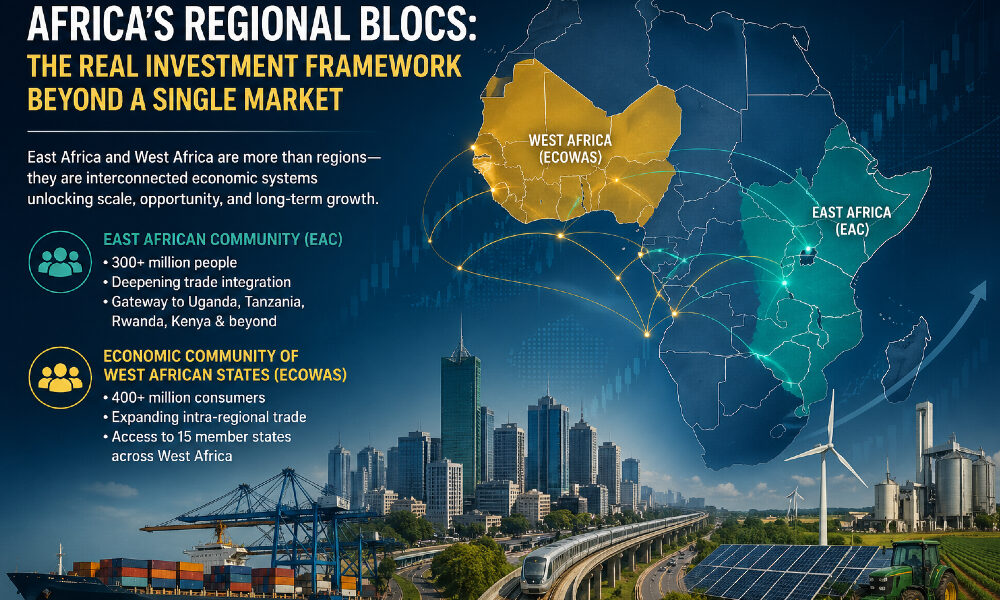
The continent’s two most dynamic investment corridors – East Africa and West Africa – are not simply geographic designations. They are institutional frameworks, bound by trade agreements, shared regulatory architectures, and accelerating intra-regional commerce.
To understand one is to understand the leverage embedded in all of them.
The Gateway Logic
The East African Community encompasses more than 300 million people and is deepening its internal trade integration at a pace that would have seemed implausible a decade ago.
An investor who anchors in Rwanda or Kenya is not merely purchasing exposure to a single national economy. They are acquiring a platform – a jurisdictional beachhead from which expansion into Uganda, Tanzania, and the broader bloc becomes structurally easier, not harder.
The same logic applies in West Africa. The Economic Community of West African States represents more than 400 million consumers. A presence in Ghana or Nigeria, established and structured correctly, opens access to neighboring markets with far fewer barriers than most foreign capital allocators appreciate when they first arrive.
This is what might be called the gateway principle: the right question is never simply “Is this country attractive?” The right question is “What does this country give me access to?”
Where the Opportunity Concentrates
The sectoral opportunities in each bloc reflect their distinct economic profiles and development trajectories.
In East Africa, the most compelling investment themes cluster around rapid urbanization and infrastructure deficit. Real estate and affordable housing are being driven by demographic pressure that outpaces construction supply by wide margins.
Infrastructure and energy – roads, power generation, smart systems – remain chronically underfunded relative to demand. Agribusiness and food processing benefit from fertile land and growing consumer markets.
Tourism and hospitality are expanding as connectivity improves. And the region’s technology and fintech ecosystems, particularly in Kenya, have demonstrated that African markets can leapfrog legacy financial infrastructure entirely.
In West Africa, the opportunity set tilts toward resource extraction and industrial development. Commodities and mining – gold, bauxite, oil and gas – remain foundational.
Manufacturing and industrialization are beginning to capture value that was previously exported as raw material. Agriculture and value-added processing are expanding as governments prioritize food security.
Energy, particularly power generation and distribution, represents one of the continent’s most significant unmet needs. And trade and logistics infrastructure is being built to support all of the above.
The Demographic Arithmetic
The macroeconomic backdrop is, by now, well documented – though not yet well internalized by the majority of global allocators. Africa’s population is projected to reach 2.5 billion by 2050, representing the largest concentration of young consumers in human history.
Urbanization is accelerating across both blocs. In sector after sector – housing, energy, food, financial services, digital infrastructure – demand is outrunning supply by multiples.
These are not projections that require speculative optimism. They are arithmetic.
The Systems Problem
Yet demographics alone do not produce returns. What separates successful market entry from stranded capital is something less visible and more consequential: the operating system beneath the opportunity.
Entering any African market without a regional strategy is precisely where most capital gets stuck. The failure mode is consistent: investors identify an attractive asset, underestimate the regulatory complexity, misread the local partnership landscape, and find themselves unable to scale or exit efficiently.
The more durable approach is to treat market entry as a sequencing problem. Where should capital anchor first, given both the immediate opportunity and the regional optionality it creates?
How should expansion proceed – which adjacent market, in which order, under which structure? How are regulations best navigated, not merely tolerated? And critically, which local partners provide genuine operational leverage rather than simply institutional legitimacy?
These are not peripheral questions. They are the questions that determine whether a regional strategy delivers on its structural promise or collapses into a series of expensive, isolated experiments.
Building for the Network
The investors who are generating durable returns in Africa are not those who found the single best country. They are those who understood that the right positioning in East or West Africa means building for a network – one whose value compounds as trade integration deepens, as infrastructure connects markets, and as consumer purchasing power rises across the bloc.
That realization does not make Africa a simple or risk-free proposition. It makes it a structurally coherent one. And for investors willing to engage with that structure seriously, the leverage is significant – and largely unclaimed.
Lailla Mutajogera is an investor, entrepreneur, and CEO of Muta Investment Firm, a cross-border investment company with operations in Uganda, Rwanda, and Dubai. She specializes in connecting global investors with high-impact opportunities in African markets, focusing on commercial real estate, tourism, agribusiness, and asset management. Committed to practical, growth-driven investments, she champions projects that drive sustainable development across the continent.