Opinion
Africa’s Refinery Boom Means Nothing Without Open Roads
West Africa is building the capacity to produce its own fuel. Now it must build the systems to move it.


By Ziad Hamoui
Afreximbank’s plan to finance three new oil refineries in Nigeria is a bold and welcome commitment to West Africa’s energy sovereignty. Alongside the Dangote Oil Refinery, these facilities promise to reduce the region’s chronic dependence on petroleum imports and insulate its economies from the worst swings of global energy markets.
The financing rationale is sound. The strategic intent is admirable.
But here is the uncomfortable truth: a refinery is only as valuable as its reach.
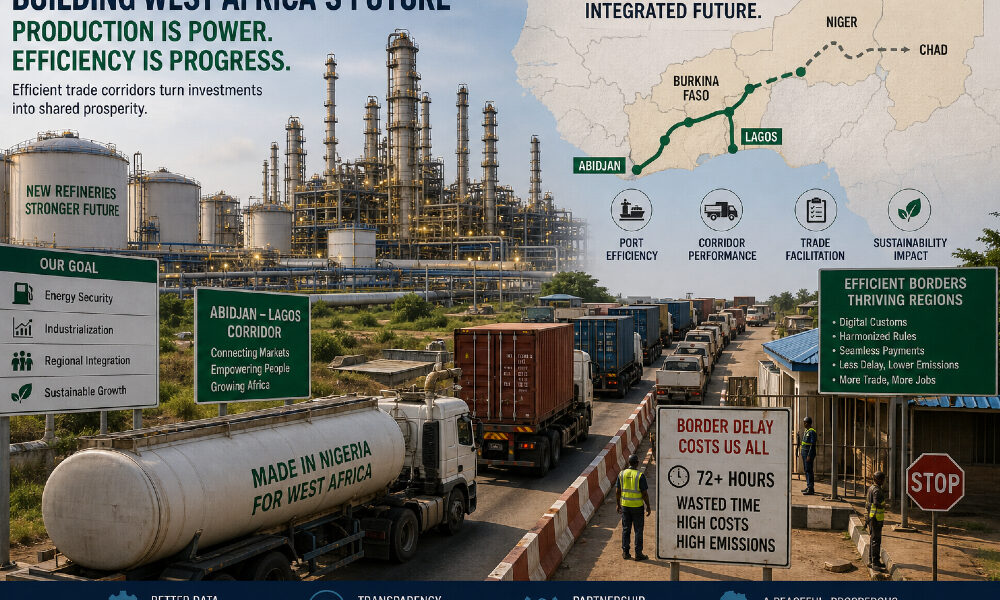
A state-of-the-art processing facility in Lagos delivers little regional benefit if its products cannot efficiently cross into Burkina Faso, Niger, or Chad. Today, 72-hour border delays are not an anomaly across ECOWAS trade corridors – they are routine.
Non-tariff barriers compound the problem. Together, they risk transforming these billion-dollar industrial assets into expensive islands, cut off from the very markets they were built to serve.
Consider the US$4 billion in untapped trade potential between Nigeria and Benin alone. Realizing that figure demands more than production capacity.
It demands functioning corridors – ones built on digital customs systems, harmonized axle-load limits, and cross-border payment infrastructure such as the Pan-African Payment and Settlement System (PAPSS). Without this institutional architecture, Nigeria’s logistics competitiveness will continue to erode relative to more efficient ports in Abidjan, Lomé, and Tema.
The refineries will produce. The goods will wait.
The Hidden Carbon Tax at Every Checkpoint
The costs of border inefficiency extend well beyond economics. When trucks sit idle for days awaiting clearance, they burn diesel without advancing a single kilometer.
Across ECOWAS’s ports and land crossings, this translates into thousands of tons of avoidable emissions every year – a self-imposed carbon penalty that dwarfs anything yet levied by the European Union’s Carbon Border Adjustment Mechanism (CBAM).
Africa’s most damaging “carbon tax” is not external pressure from Brussels. It is domestic dysfunction at border posts.
This reframing matters enormously. Trade facilitation has long been sold on its economic merits – faster clearance, lower costs, more competitive exports.
Those arguments are correct but insufficient to unlock political urgency. Adding a carbon dimension changes the calculus. Policymakers respond to climate metrics. Financiers increasingly require them.
Time Release Studies have tracked border delays and their associated costs for years. It is time those same studies begin recording carbon impact – quantifying the emissions avoided for every hour shaved from clearance times.
Incorporating carbon accounting into border-efficiency metrics would give National Trade Facilitation Committees a powerful new mandate: not just to speed up trade, but to clean it up.
Measuring What Matters: A Corridor Efficiency Scorecard
The African Development Bank’s newly launched African Port Index marks genuine progress. For the first time, 38 African port authorities are working from standardized performance data, creating the transparency necessary to drive regional competitiveness. That is a foundation worth building on.
But port efficiency is only the first mile of the trade journey. Cargo that clears a top-ranked port in record time can still languish for days at inland checkpoints, harassed by informal payment demands – that persistent “hidden tax” on operators moving goods along corridors like Abidjan-Lagos, West Africa’s busiest trade artery.
What is needed now is a complementary instrument: a Corridor Efficiency Scorecard.
Such a tool would link the AfDB’s port performance data with on-the-ground realities along trade corridors – checkpoint frequency, transit delays, dwell times, and the incidence of informal payments. Applying the Time Release Study methodology developed by UNCTAD beyond the port gate, to the full length of a corridor, would produce a clear and comprehensive picture of where trade flows and where it stalls.
Piloting this scorecard on the Abidjan-Lagos corridor would be a natural starting point. The timing is favorable: the CALAO development initiative is gaining momentum, driven by TradeMark Africa, Enabel, and Agence Française de Développement, as demonstrated at the recent EU Regional Business Forum in Abidjan.
The scorecard would also give the Abidjan-Lagos Corridor Management Authority (ALCoMA) a concrete tool to monitor connectivity progress along this critical economic artery.
The Investment Case for Integration
This is not merely operational housekeeping. It connects directly to the central challenge of African development finance.
The AfDB’s 2026 Annual Meetings are organized around the theme of mobilizing development financing at scale. Attracting that capital requires reducing perceived risk.
Transparent, data-driven corridor scorecards offer exactly the kind of evidence that serious investors need before committing funds to infrastructure in emerging markets. They demonstrate that spending on roads, ports, and border facilities will translate into genuine economic integration – not just physical construction.
Afreximbank’s refinery investment is the right move. But policymakers and development financiers must now commit with equal conviction to the trade facilitation reforms that make production capacity meaningful: digital customs systems, harmonized standards, cross-border payment infrastructure, and corridor performance accountability.
Africa has long had the resources. It is building the industrial base. What remains is the institutional will to ensure that goods – and the prosperity they carry – can actually move.
Ziad Hamoui is the Co-Founder and Past President of the Borderless Alliance, a leading private-sector advocacy group promoting economic integration and removing trade and transport barriers in West Africa. With extensive experience in Ghana’s road transport, logistics, and shipping sectors, he currently serves as Executive Director of Tarzan Enterprise Ltd., a long-established family business. He is a former Co-Chair of the Africa Food Trade Coalition, Co-Founder of the Trade Facilitation Coalition for Ghana, and serves on multiple high-level advisory committees on trade, transport, agriculture, and security. A Chartered Fellow of the Chartered Institute of Logistics and Transport (CILT) Ghana, he is also a former member of its Governing Council.