Opinion
Africa’s Quiet Revolution: How the AfCFTA Is Rewriting Global Trade
The world’s largest free trade area is already reshaping the continent’s economic architecture – and the rest of the world should be paying close attention.


By Martin Camara
Africa is quietly executing one of the most ambitious economic transformations in modern history. Since the African Continental Free Trade Area (AfCFTA) opened for business in 2021, it has set out to resolve a stubborn structural paradox at the heart of the continent’s economy: Africa trades far more with the rest of the world than it does with itself.
For decades, that imbalance has been stark. Intra-African trade languished at a mere 15 percent of the continent’s total commerce – and once South Africa’s outsized regional footprint is stripped from the data, that figure collapses to just 6 percent, as of 2018.
The contrast with other major trading blocs is damning. Asian economies conduct roughly 60 percent of their trade among themselves.
European nations keep 70 percent of commerce within the continent. Even North America, with only three major economies, sustains cross-border trade at 54 percent. Africa, by comparison, has been leaving enormous growth on the table.
A Single Anecdote That Tells the Whole Story
Consider Kenya. The country exports approximately US$1 billion worth of goods annually to the European Union and around US$500 million to the United States – against total exports of US$6 billion. Yet in 2017, Kenya exported a paltry US$69 million to Ethiopia, its next-door neighbor and one of the world’s fastest-growing economies.
The culprit, in large part: prohibitively high intra-regional trade tariffs that make selling across the continent more expensive than selling across an ocean.
That dynamic is now shifting. Intra-African trade surged by 20 percent in 2022, a rise directly attributable to the early implementation of AfCFTA provisions. That is not a rounding error – it is a directional signal.
The Scale of the Opportunity
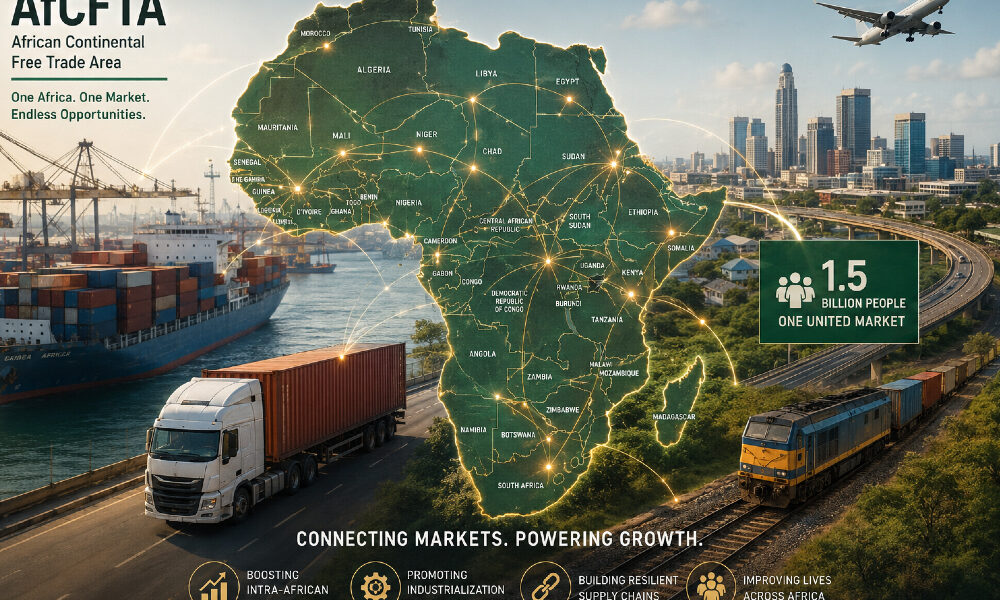
The AfCFTA is not simply a trade agreement. It is the world’s largest free trade area by number of member nations, spanning all 55 countries of the African Union and creating a unified market of more than 1.5 billion people – including an estimated 220 million premium consumers with the purchasing power to drive demand for sophisticated goods and services.
By 2030, regional business spending and investment could reach US$6.7 trillion.
The structural advantages undergirding this opportunity are considerable. Africa offers shorter and simpler supply chains for primary inputs, reducing both cost and complexity for manufacturers operating regionally.
Its labor force – young, digitally literate, and increasingly adaptable – represents a competitive asset that aging economies elsewhere cannot replicate. And its rapidly expanding middle class is generating demand for precisely the kinds of higher-value goods and services that regional producers are well-positioned to supply.
The long-term numbers are equally compelling. Full implementation of the AfCFTA could increase Africa’s collective income by US$450 billion and unlock more than US$84 billion in untapped intra-African export potential by 2035, according to widely-cited projections.
Data from the African Export-Import Bank already shows strengthening trade corridors across West, East, and Southern Africa – evidence that momentum is building beneath the surface.
From Fragmentation to Continental Market
The deeper ambition of the AfCFTA is a strategic one: to complete the transition from a patchwork of 55 fragmented national economies to a single continental market capable of competing on the global stage. That means Africa not merely as a supplier of raw materials to wealthier nations, but as a prominent manufacturing destination for technology-intensive industries and a consequential link in global supply chains.
The geopolitical timing is, if anything, favorable. As Western corporations reassess their dependence on distant, politically exposed supply chains – a reckoning accelerated by the disruptions of the last several years – Africa’s combination of abundant natural resources, a growing consumer base, and a continent-wide trade framework presents a compelling alternative.
The AfCFTA will not transform Africa overnight. Implementation remains uneven, infrastructure gaps persist, and political will across 55 sovereign governments is never a given.
But the architecture is in place, the early data is encouraging, and the prize – a self-sustaining continental economy generating wealth for its own people – is extraordinary in its scope.
The question is no longer whether Africa can build a unified market. It is whether the rest of the world will recognize what is being built before it is too late to shape it.
Martin Camara is Director General of the Global Council for the promotion of International trade.