Opinion
Africa’s Quiet Leap into Space – And Why It Matters


By Gregory September
Nineteen African countries now operate satellites in Earth’s orbit. This transformation happened without slogans, without international fanfare, without the breathless coverage reserved for Silicon Valley’s latest ventures.
Yet space infrastructure doesn’t require applause to reshape power dynamics. It does so quietly, methodically, and with profound implications for how we understand Africa’s technological trajectory.
The continent is no longer merely consuming global technology – it is constructing strategic infrastructure above the planet itself. And satellites, contrary to their frequent portrayal as aspirational symbols, function as instruments of tangible power.
They determine how nations manage land resources, plan urban expansion, respond to environmental crises, and monitor their own sovereign territory.
Africa’s space footprint remains modest compared to established powers. But modest no longer means invisible.
The Strategic Shift
As of December 30, 2025, 68 satellites launched by 19 African nations orbit Earth, according to data from Spacehubs Africa. Egypt, which pioneered the continent’s space presence with Nilesat-101 in 1998, recently launched SPNEX on December 10, 2025, becoming the latest nation to expand its orbital capabilities.
Botswana joined this select group with BotSat-1 in March 2025. The count has grown from 64 satellites across 18 countries just eight months ago – a pace that suggests deliberate, systematic development rather than sporadic experimentation.
What does this orbital infrastructure enable?
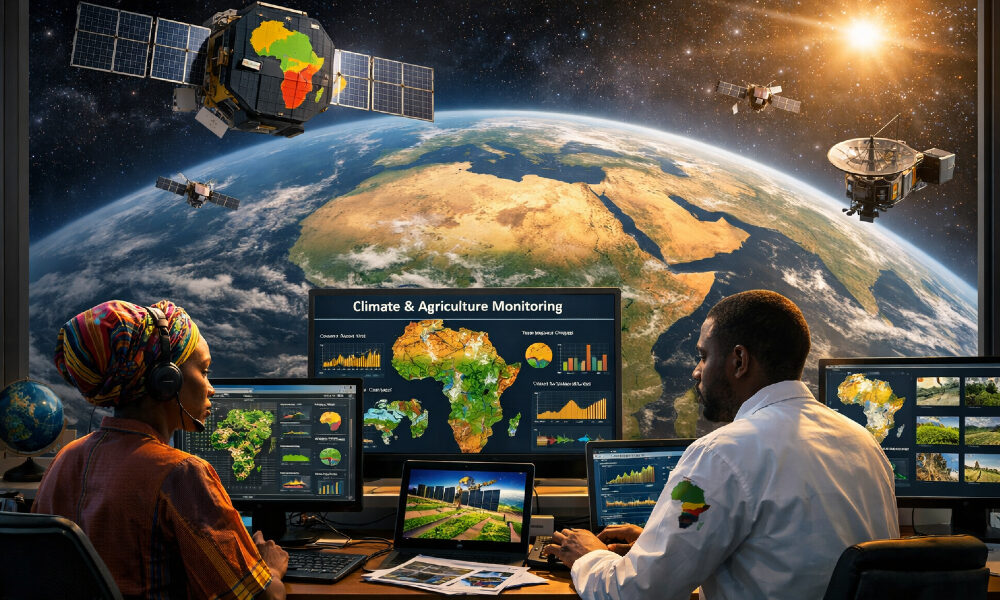
Five critical capabilities emerge: data sovereignty, disaster response capacity, climate monitoring systems, agricultural planning tools, and national security coordination. Each represents a shift from dependence to agency, from requesting information to generating it.
Consider data sovereignty. When a government must purchase satellite imagery of its own territory from foreign providers, it operates under informational constraints that affect everything from resource negotiations to emergency planning. Indigenous satellite capacity changes that equation fundamentally.
The Development Calculus
The connection between orbital infrastructure and sustainable development goals deserves serious examination. Satellites directly support progress across multiple UN targets that African nations have committed to achieving.
For SDG 9 – Industry and Innovation – space programs catalyze local research capacity, engineering expertise, and digital infrastructure development. The knowledge transfer alone justifies significant portions of the investment.
SDG 13 – Climate Action – depends heavily on earth observation. Improved climate tracking, early warning systems, and adaptation planning all require consistent, reliable satellite data that commercial providers may not prioritize for African regions.
SDG 11 – Sustainable Cities emphasizes urban planning that leverages geospatial data to optimize transport networks, guide housing development, and strengthen disaster risk reduction – an essential approach as African cities confront rapid and unprecedented population growth.
SDG 2 – Zero Hunger is advanced through agricultural monitoring, which enhances crop tracking, weather forecasting, and food security planning – capabilities that are increasingly critical as climate variability intensifies.
Finally, SDG 16 – Strong Institutions – benefits from enhanced data infrastructure that improves governance through stronger planning, greater transparency, and increased institutional accountability.
The Uncomfortable Question
Should African governments invest more heavily in space infrastructure, or prioritize other development needs first?
The question itself reveals a persistent, perhaps patronizing assumption: that resource-constrained nations must choose between “basic needs” and “advanced technology,” as though these categories remain fixed and separate. Modern development challenges – climate adaptation, agricultural productivity, disaster management, urban planning – are fundamentally information problems.
The tools that solve information problems increasingly orbit overhead. Framing space investment as discretionary luxury rather than strategic infrastructure misreads both the nature of contemporary development challenges and Africa’s demonstrated capacity to pursue multiple objectives simultaneously.
The more troubling question may be: Why has this progress generated so little international attention? When private companies launch satellite constellations, the coverage is exhaustive.
When African nations methodically build orbital capabilities that serve concrete development needs, the silence is remarkable.
Beyond the Narrative
Perhaps the muted response reflects discomfort with Africa’s technological agency – a continent supposedly waiting for solutions rather than engineering them. Or perhaps the steady, unglamorous nature of institutional capacity-building simply lacks the narrative appeal of disruption and innovation theater.
Either way, the satellites continue their orbits, and the data continues accumulating. Nineteen countries have decided that space infrastructure serves their interests.
Sixty-eight satellites represent not wishful thinking but operational capacity. The question for observers is whether we will recognize this shift for what it represents: not a feel-good story about African potential, but a pragmatic demonstration of African capability already deployed and delivering results.
The revolution won’t be televised – but it will be monitored from orbit, increasingly by Africa itself.
Gregory September is a South African academic, author, and geopolitical analyst with extensive experience in government and Parliament. He is the founder and CEO of SAUP (Sustainability Awareness and Upliftment Projects NPC), which focuses on sustainability education and community development. He previously served as Head of Research and Development for the Parliament of South Africa. His work centers on sustainability, African geopolitics, and economic development, and he regularly contributes to analysis of global political and economic affairs.