Opinion
Africa’s Power Opportunity in a Fragmenting World


By Dishant Shah
The world is fracturing along fault lines that would have seemed improbable a decade ago. US-China rivalry has escalated from trade tensions to a full-spectrum competition encompassing technology, finance, and strategic resources.
Reshoring initiatives are reversing decades of globalization orthodoxy. Industrial policy, once dismissed as protectionist folly, has roared back into fashion from Washington to Brussels.
Geopolitical blocs are redrawing supply chains according to friend-shoring principles that prioritize political alignment over economic efficiency.
For most regions, this fragmentation represents an unmistakable threat – a world of higher costs, reduced market access, and zero-sum competition. Yet Africa occupies a paradoxical position in this splintering order.
While the rest of the world retreats behind walls, Africa is pursuing precisely the opposite trajectory: deeper continental integration on a scale unprecedented in its modern history.
This divergence creates a strategic opening that occurs perhaps once in a century. The question is whether African nations will seize it or squander it.
The Risk of Passivity
The stakes could not be higher. Without coordinated action, Africa risks becoming merely a theater for great power competition rather than an architect of its own economic destiny.
History offers sobering lessons. During previous waves of globalization, resource-rich regions that failed to present a unified front often found themselves locked into extractive relationships – exporting raw materials while importing finished goods, perpetually relegated to the bottom rungs of global value chains.
Fragmentation amplifies this danger. As major economies scramble to secure critical mineral supplies and diversify production away from geopolitical rivals, uncoordinated African states risk being played off against one another.
One country offers preferential mining terms to undercut its neighbor. Another provides tax holidays that trigger a race to the bottom. The result: resources flow outward, but industries fail to take root. Africa extracts wealth from its soil only to watch value accrue elsewhere.
The continent cannot afford to become a passive playground where external powers extract what they need without building what Africa requires – industrial capacity, technological capabilities, and sustainable employment for the 830 million Africans who will enter working age by 2050.
Five Strategic Imperatives
Africa can transform global disorder into continental advantage, but doing so requires deliberate strategy across five dimensions.
- First, collective bargaining power
The African Union and the African Continental Free Trade Area (AfCFTA) must evolve from aspirational frameworks into genuine negotiating platforms. When Africa speaks with one voice on mineral pricing, investment terms, or technology transfer requirements, it commands attention. Fragmented, individual nations lack leverage. United, the continent becomes indispensable. - Second, strategic positioning as the world’s neutral production base
In an era of friend-shoring, Africa’s relative non-alignment becomes an asset. Companies seeking to diversify away from China without committing entirely to Western-dominated supply chains need alternatives. Africa can position itself as that alternative – a place where American, European, and Asian firms can all operate without triggering geopolitical alarm bells. - Third, coordinated resource governance
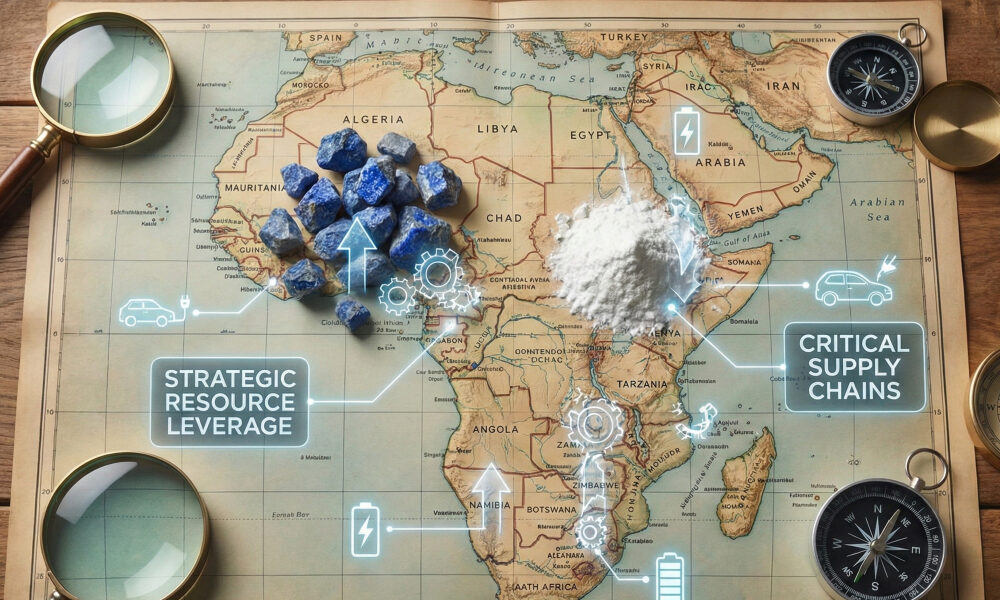
Africa controls approximately 40% of the world’s critical minerals – cobalt, lithium, manganese, and rare earths essential for electric vehicles, renewable energy, and advanced electronics. Yet competition among African producers often depresses prices and weakens negotiating positions. A coordinated approach to mineral policy, similar to OPEC’s role in petroleum markets, could ensure that African nations capture fair value from resources that are literally irreplaceable in the green energy transition. - Fourth, building regional champions
Integration without industrialization is merely a larger market for imported goods. Africa needs homegrown champions in logistics, power generation, manufacturing, and agricultural technology – companies with the scale to compete regionally and eventually globally. This requires patient capital, supportive industrial policy, and a willingness to protect infant industries during their vulnerable early years. - Fifth, linking integration directly to industrialization
The AfCFTA should not merely facilitate trade in existing goods but catalyze new production. Rules of origin requirements, local content mandates, and coordinated industrial strategies can ensure that integration drives manufacturing capacity rather than simply expanding import volumes.
Africa’s Countercyclical Moment
While the world fragments, Africa integrates. This countercyclical positioning is historically unusual and strategically significant.
The AfCFTA represents the world’s largest free trade area by number of countries, encompassing 54 nations and a combined market of 1.4 billion people. When fully implemented, it promises to boost intra-African trade by more than 50 percent and increase the continent’s collective income by US$450 billion by 2035.
No other region is attempting integration on this scale in the current environment.
Africa’s demographic trajectory reinforces this advantage. Seven of the world’s ten fastest-growing economies in 2024 were African.
The continent’s median age is 19 years – compared to 38 in China, 43 in Europe, and 38 in the United States. By 2050, one in four people on Earth will be African.
This represents either an enormous dividend or a catastrophic burden, depending entirely on whether economic opportunity keeps pace with population growth.
The critical minerals dimension cannot be overstated. The Democratic Republic of Congo alone produces 70 percent of the world’s cobalt.
Africa dominates manganese production, holds substantial lithium reserves, and possesses significant deposits of graphite and rare earth elements. Every major economy’s climate transition depends on African resources.
This is leverage – if wielded collectively.
Integration as Power
In a fragmenting world, Africa’s accelerating integration is not merely a development strategy. It is a power move.
The continent possesses what fragmented global powers desperately need: resources, markets, and the neutral ground necessary for diversified supply chains. But these assets create value only if Africa coordinates their deployment.
Fragmentation among African states surrenders the very advantages that integration would unlock.
The alternative to strategic coordination is grim: a continent trapped in extractive relationships, its resources flowing outward while its vast young population faces unemployment and instability. History will not look kindly on leaders who, possessing unprecedented leverage during a moment of global realignment, failed to act collectively.
Africa’s choice is clear. It can leverage this once-in-a-century moment to finally industrialize, to capture value rather than merely extract resources, and to position itself as an indispensable node in 21st-century supply chains.
Or it can remain fragmented while the world around it fragments further, squandering advantages that will not recur.
The continent’s integration, advancing while others retreat, is not an accident of timing. It is an opportunity deliberately created.
The only question remaining is whether African nations possess the political will to exploit it.
Dishant Shah is a partner at Legion Exim, a company specializing in facilitating the export of high-quality engineering products directly sourced from manufacturers in India to Africa. His areas of expertise include new business development and business management.