Opinion
Africa’s Population Boom: A Test and Opportunity for Global Manufacturers
Why the coming demographic boom in Africa – not the slowdown at home – should be reshaping how manufacturers think about the next twenty years.



By John Kourkoutas
Look at a map of global fertility rates and one continent glows red: Africa. Almost everywhere else, including the markets that built the modern manufacturing economy, is some shade of blue.
Blue means below the replacement rate of roughly 2.1 children per woman. It means fewer weddings, fewer first apartments, fewer starter homes – and, quietly, a shrinking pool of new customers. Red means the opposite: a growing number of households forming every year, for decades to come.
This is not a column about the politics of birth rates. It is a column about a business opportunity that most manufacturers are reading as a footnote in a development report, when it should be sitting on the first page of their strategic plan.
The Blue Wall
Here is the arithmetic, and it really is just arithmetic: the number of new households forming each year in Europe, and across most of the industrialized world, is falling. This was effectively locked in two decades ago, when the birth rates behind today’s household formation numbers were first recorded. No advertising campaign, loyalty program, or clever bit of positioning changes it.
That matters enormously for any company whose growth depends on new household formation – appliance makers, furniture manufacturers, automakers, and everyone selling the unglamorous machinery of daily life. Every one of these categories is fighting a demographic headwind at home that has nothing to do with how good the product is.
The Red Frontier
Now look at where the households are actually forming: across sub-Saharan Africa, in cities such as Lagos, Nairobi, Dar es Salaam, Kinshasa, and Abidjan.
New households do not consume like established ones. They buy a first cooker. A first refrigerator. A first mattress. A first set of tools. A first vehicle. This is the same demand curve that fueled European manufacturing through the 1950s and 1960s – a wave of first-time purchases across an entire generation – and it has not been seen at that scale in the West since.
Layer urbanization on top of that demographic wave, and the opportunity compounds. These new households are not staying in the countryside; they are moving into cities. An urban household spends differently from a rural one – more on packaged goods, appliances, transport, and services, and it spends sooner. Together, population growth and urbanization are not two separate trends. They are one long demand curve with a manufacturer’s product category written all over it.

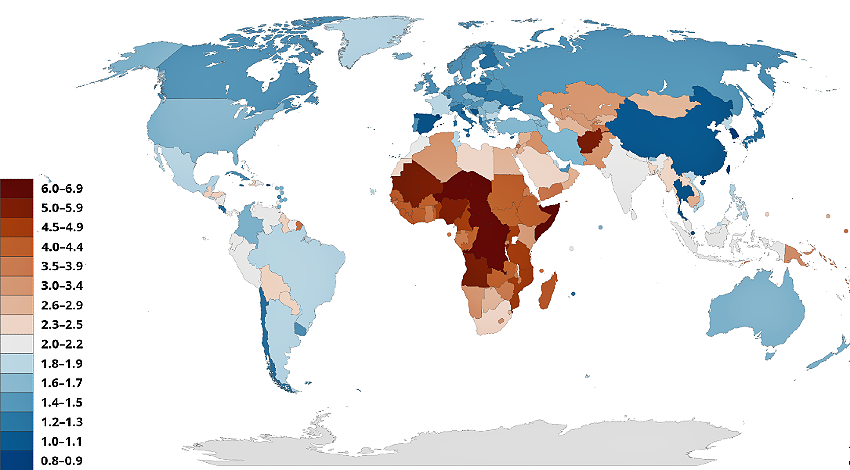
Births per woman by region. Africa remains the only continent well above replacement rate – the world’s next great consumer market.
Why This Map Gets Ignored
Most executives who see this fertility map file it away as a demographic curiosity, or a talking point for aid agencies and population researchers. That is a mistake. It is not a statistic about development. It is a twenty-year forecast of where new demand will come from – one of the few in economics that comes with this much certainty this far in advance.
Companies that built their fortunes on Europe’s postwar baby boom understood this instinctively: get to the new household before it forms brand loyalty elsewhere. The company that is a natural fit for that first purchase – the first appliance, the first vehicle, the first set of tools – typically keeps that customer, and often their children, for a very long time.
The Question That Matters
The demand created by Africa’s demographic wave is not really in question. Household formation across the region is set to keep climbing for decades, even as it stalls or reverses almost everywhere else. What remains genuinely uncertain is which manufacturers will be positioned to capture it – present with distribution, brand recognition, and product-market fit – by the time that demand fully materializes, and which will still be fighting over a shrinking, saturated market back home.
The map has already been drawn. The only open question is who bothers to read it.
John Kourkoutas is business development expert that specializes in helping companies, export teams, and business leaders succeed in Africa’s dynamic and emerging markets.