Owusu on Africa
Africa’s New Realism: Resource Nationalism, Security Sovereignty in a Multipolar World
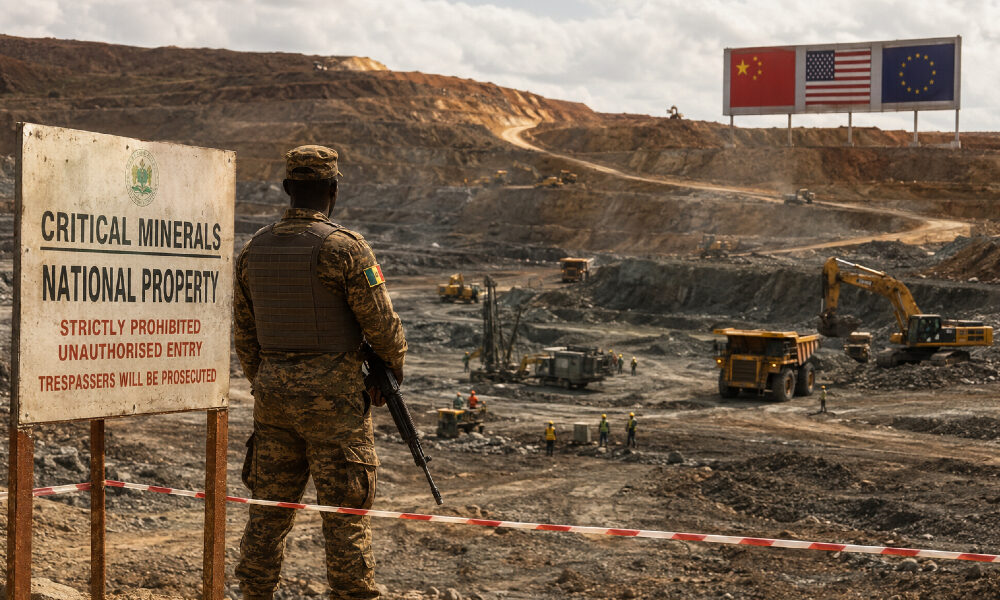
Africa’s windfall from critical minerals is arriving at precisely the moment the continent can least afford to be complacent about its own defense.


By Fidel Amakye Owusu
The fall of the Berlin Wall triggered a quiet but profound reordering of African statecraft. With the Cold War’s ideological contest extinguished, governments across the continent pivoted away from the garrison state. Defense budgets shrank. Social spending rose. Schools, clinics, and roads replaced barracks as the symbols of political ambition.
The logic was sound. In a world no longer divided between Washington and Moscow, African regimes faced fewer externally sponsored insurgencies, fewer covert destabilization campaigns, fewer coup plotters with superpower backing.
A near-unipolar order also brought democratic tailwinds: constitutions were rewritten, multiparty elections institutionalized, civil liberties cautiously expanded. The era was not without its horrors – Somalia, Liberia, Sierra Leone, and Rwanda all descended into catastrophic violence – but the broad continental trend ran toward openness and away from militarism.
That moment has passed.
A More Dangerous Neighborhood
The world is multipolar again, and Africa has become its most contested terrain. Great powers – established and ascending alike – are competing for influence, access, and resources across every sub-region of the continent.
Their interests are not identical to Africa’s. Several are plainly indifferent to African stability when it conflicts with their strategic calculus.
History offers little comfort on this point.
The security environment has deteriorated independently of geopolitics, too. Two decades ago, transnational jihadist networks were largely a distant concern for most African governments. Today, affiliates of both al-Qaeda and the Islamic State operate across every geopolitical zone, with the Sahel and the Lake Chad Basin serving as the operational heartland of an insurgency that has already consumed tens of thousands of lives and displaced millions more.
The violence is spreading, not receding.
Simultaneously, the scramble for Africa’s critical minerals – cobalt, lithium, manganese, rare earths, and others essential to the global green energy transition – has intensified dramatically. Every major power and a growing roster of middle powers are engaged in this competition.
African governments have responded, rightly, with a wave of resource nationalism: revising extraction codes, demanding greater domestic equity stakes, tightening royalty and tax regimes, and insisting on more of the value chain remaining on African soil.
Revenue Without Security Is an Illusion
This is where the strategic tension becomes acute.
The resource nationalism drive is generating real fiscal gains. But revenue is only as durable as the stability within which it is collected.
Where active conflicts rage – or where neighboring conflicts are close enough to spill across porous borders – development remains fragile almost by definition. Infrastructure is destroyed. Investment retreats. Human capital flees. The economic dividend from a renegotiated mining contract means far less in a country that cannot guarantee the rule of law in its own territory.
The uncomfortable truth is this: Africa cannot afford to fund its own security at the scale the current environment demands, and simultaneously cannot afford not to. Policymakers face a genuine dilemma, not a false one.
The Case for Strategic Self-Reliance
There is a powerful moral and political argument against diverting rising mineral revenues into defense. Africa’s youth bulge – the largest and fastest-growing young population on Earth – demands jobs, universities, hospitals, and functioning cities. Squandering a resource windfall on arms imports would repeat the mistakes of earlier commodity booms and betray the generation that should benefit from them most.
But the alternative – chronic dependence on external security providers – carries its own severe costs. Foreign security partnerships come with conditionalities, strategic interests, and exit risks.
They are, by nature, transactional. Several African governments have discovered in recent years that security guarantees are neither permanent nor unconditional. A partner’s domestic politics can dissolve a decade-long commitment overnight.
The answer is not to choose between development spending and security investment, but to pursue both with greater sophistication and urgency. This means smart investment in defense capability – prioritizing modern technology, intelligence capacity, and interoperability – rather than expensive and often obsolete hardware.
It means building institutional capacity within armed forces, not merely enlarging their headcount. And it means approaching security partnerships as a negotiating state with its own interests, not as a junior recipient of external largesse.
Africa must lead on its own turf.
Technology Is Changing the Calculus
Critically, the cost structure of effective security is shifting. Surveillance drones, satellite imagery, artificial intelligence-enhanced threat analysis, and networked communications are making smaller, better-equipped, and better-informed forces far more effective than large, poorly coordinated ones.
These are not futuristic luxuries; several African militaries are already integrating such capabilities with meaningful results.
This technological shift is an opportunity. It allows African states to close security gaps without the full fiscal burden of conventional military buildups.
It also creates genuine possibilities for regional cooperation – shared intelligence platforms, coordinated border surveillance, joint rapid-response capacity – that multiply the return on each country’s individual investment.
Stability Is the Prerequisite
None of this is an argument for militarization. It is an argument for realism.
Africa is entering a period of significant economic potential, driven by demographics, digital infrastructure, and the global demand for the minerals beneath its soil. That potential is not self-fulfilling. It requires an environment in which investors commit capital, firms hire workers, and governments collect taxes reliably over time.
Physical insecurity is the most reliable destroyer of all three.
Owning Africa’s security – not outsourcing it, not neglecting it, but investing in it deliberately and intelligently – is the precondition for everything else that African governments say they want to achieve. The revenues from resource nationalism provide, for the first time in a generation, a genuine opportunity to close that gap.
The question is whether African leaders have the strategic clarity to seize it.
Fidel Amakye Owusu is an International Relations and Security Analyst. He is an Associate at the Conflict Research Consortium for Africa and has previously hosted an International Affairs program with the Ghana Broadcasting Corporation (GBC). He is passionate about Diplomacy and realizing Africa’s global potential and how the continent should be viewed as part of the global collective.