Opinion
Africa’s New Bargain: “Process Here” Is the One Clause Investors Can’t Ignore
How Kenya’s critical-minerals stance – and a wave of overlooked legal fine print across the continent – is quietly rewriting the rules for foreign capital in Africa.


By Dr. Princess C. Mutisya
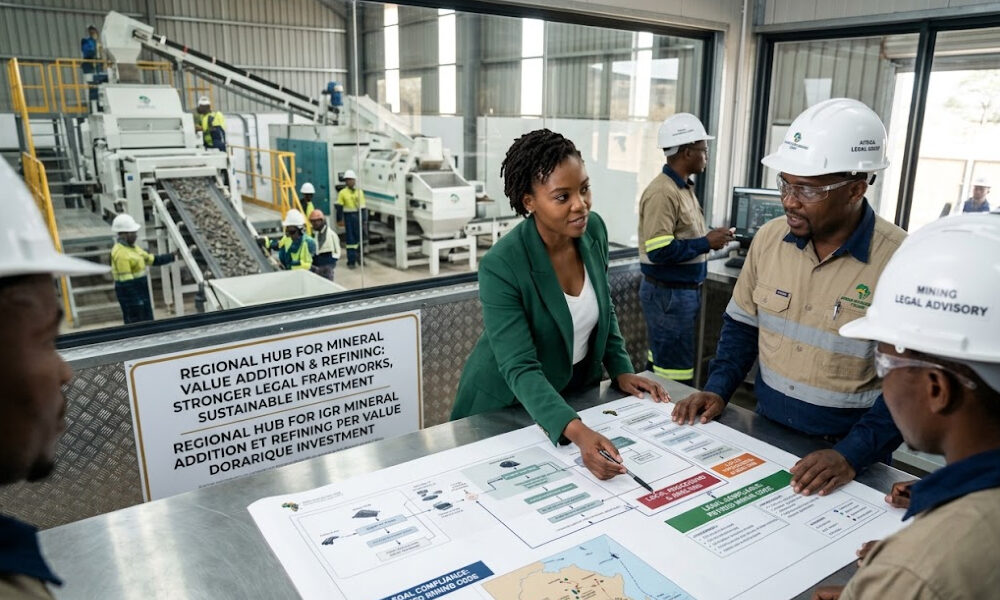
Kenya recently said something to a G7 partner that African governments have rarely stated so plainly. Not “invest here.” But “invest here, and process here too.”
It sounds like a minor clarification. It isn’t. Buried in the country’s position on an emerging critical-minerals partnership is a sentence that signals a much larger shift in how African nations intend to engage with foreign capital.
The End of “Extract, Export, Repeat”
For decades, the arrangement was straightforward: minerals came out of the ground, left the continent, and were refined, manufactured, and monetized somewhere else. The jobs, the margins, and the technology transfer all happened abroad. Africa supplied the raw material; other economies captured the value.
That bargain is now being renegotiated – and not only in Kenya. Similar demands are surfacing in the Democratic Republic of Congo. What looked like an isolated policy position is fast becoming a regional pattern.
Legitimacy, Not Resource Nationalism
Here’s what many investors are getting wrong: this shift is not punitive resource nationalism, the “we’re taking this back” posture that spooks markets and triggers capital flight.
It’s something more durable. It reads less like a threat and more like a statement of principle: we have decided what our resources are worth, and it isn’t just the price of the ore.
That distinction matters enormously. A legitimacy claim doesn’t behave like an opportunistic policy shift tied to an election cycle or a populist moment. It tends to outlast the politicians who first articulated it, because it taps into a broader, cross-partisan sense of national interest.
For patient capital – the kind of investor built to hold African infrastructure and resource positions for a decade rather than a quarter – this isn’t a risk to be priced around. It’s a condition to be built with.
Investors who structure their deals around local processing now, while the policy is still forming, will look prescient in five years. Those who wait for it to harden into non-negotiable law will find themselves renegotiating from a position of weakness.
The question worth asking is simple: Is your Africa resource thesis built around extraction economics, or around the value chain the continent is now insisting on keeping?
Three Stories, One Underlying Fact
This week alone brought three developments that most observers will read as unrelated:
- A trade agreement still awaiting ratification.
- A mining policy asking foreign capital to process minerals onshore rather than simply extract them.
- A banking sector racing toward a capital deadline that will force consolidation whether boards are ready or not.
Three sectors. Three timelines. But one underlying fact connects them: none of these are truly economic stories. They are legal-infrastructure stories dressed up in economic headlines.
Law Before Capital
There is a phrase missing from most conversations about capital in Africa: law is not what happens after the money arrives. It’s the condition that determines whether the money can arrive at all – and whether it stays.
Roads, power grids, and ports earn the label “infrastructure” because everyone can see the consequences when they fail. Contract enforceability, licensing certainty, and ratification status fail just as often – they are simply invisible until a deal collapses because of them.
Here is the pattern worth sitting with, whether you are an investor, a board member, or a policymaker: capital doesn’t price a country. It prices a country’s legal architecture.
- A Comprehensive Economic Partnership Agreement (CEPA) that’s signed but not ratified is a road that’s paved but never opened to traffic.
- A mining license silent on beneficiation requirements is a bridge with no posted weight limit.
- A bank with no clear merger pathway ahead of a hard capital deadline is a building with no marked fire exit.
None of this shows up in a pitch deck. All of it is visible in the statute, the gazette, and the licensing conditions – if anyone bothers to read that far.
The Real Work Ahead
That, ultimately, is the work that matters most right now: reading Africa’s legal architecture with the same rigor typically reserved for the market opportunity. Increasingly, the two are becoming the same document.
The investors who understand this early won’t just avoid nasty surprises. They will be the ones writing the terms everyone else eventually has to accept.
Dr. Princess C. Mutisya is a Strategic Legal Architect, author, and international business leader with more than 14 years of cross-border experience across Africa and the UAE. She is the Founder & CEO of CR Advocates LLP (Kenya) and CR Advocates Consultants LLC (UAE)among other leadership Roles. A recipient of Doctor of Laws (LLD) in International Legal Strategy and Doctor of Business Administration (DBA) in International Business & Global Transformation, Dr. Mutisya is an expert in international trade and investment law, advising governments, DFIs, and multinationals on investment law, sovereign frameworks, PPP structuring, Corporate Governance, trade facilitation, energy and infrastructure projects, real estate ventures, and private wealth structuring across Africa-GCC corridors. Beyond her legal and business enterprises, she is a global speaker and thought leader on economic diplomacy, policy innovation, and Africa’s emerging investment architecture.