Opinion
Africa’s Land, Gulf Food: Why UAE Farm Deals Betray Agenda 2063
The Emirates are quietly turning the continent’s most fertile soil into a foreign pantry – and Africa’s leaders are “muted.”


By Franco Bonghan
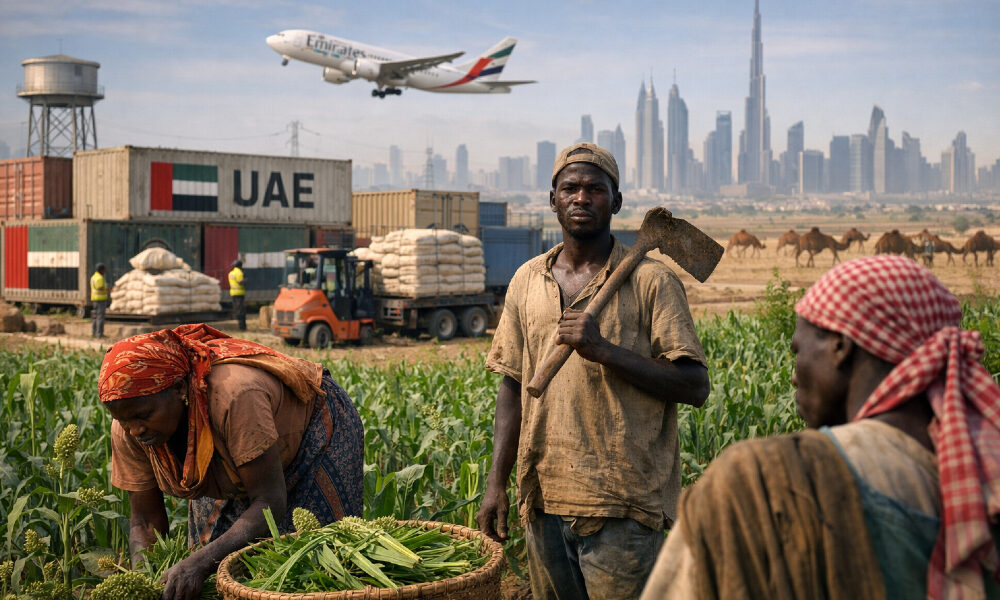
A quiet but consequential land rush is underway across Africa. The United Arab Emirates, a desert nation that imports roughly 90 percent of its food, has secured at least 56 farmland projects on the continent, with 14 more currently under negotiation.
Guided by Abu Dhabi’s 2018 food security strategy – which explicitly encourages the acquisition or leasing of agricultural land abroad – Emirati firms are locking up vast tracts in Sudan, Ethiopia, Angola, Mauritania, Zimbabwe, Kenya, and Liberia. The crops grown there: wheat, rice, alfalfa, and high-value fruits.
The destination: Gulf dinner tables. The cost: borne by Africa.
This is not investment. It is extraction wearing the costume of development.
A Continent Fed Last
The cruelest irony of the UAE’s offshore farming model is geographic. The countries targeted – Sudan, Ethiopia, Angola, Zimbabwe – are not agricultural surplus economies quietly offloading excess produce.
They are nations that face chronic food insecurity, elevated child malnutrition rates, and recurrent drought. Yet their most productive irrigable land, and the scarce water beneath it, is increasingly tied to export contracts engineered to serve Emirati food needs first and African hunger second – or not at all.
This is food security inversion at a continental scale. The land that could grow sorghum for Sudanese families is growing alfalfa for UAE livestock. The water that could sustain Ethiopian smallholders is irrigating berries bound for Gulf supermarkets.
The Environmental Toll of Industrial Monoculture
Beyond the humanitarian calculus lies an ecological one. Large-scale industrial monoculture – particularly wheat, alfalfa, and rice cultivation in fragile or semi-arid zones – is among the most resource-intensive forms of agriculture on earth.
It demands intensive irrigation, heavy fertilizer application, and systematic pesticide use. The consequences are well-documented: aquifer depletion, soil degradation, and the erosion of local biodiversity.
Africa’s arid and semi-arid regions are not wastelands awaiting foreign capital to unlock their potential. They are complex, often fragile ecosystems supporting pastoral and smallholder communities whose land-use systems have evolved over generations.
Industrial monoculture does not simply compete with those systems – it destroys them.
“Unused Land” and the Politics of Dispossession
The legal architecture of these deals deserves scrutiny. Agreements are routinely negotiated with central governments and framed around “unused” or “marginal” land – a classification that, upon inspection, frequently encompasses territory where pastoralists graze livestock, smallholders cultivate subsistence crops, or forest communities sustain livelihoods.
The opacity of these transactions, typically concluded with national elites who have little accountability to affected communities, is not a bureaucratic accident. It is a feature.
The result is displacement, land conflict, and the erosion of customary tenure rights that no formal title deed ever recorded. When communities resist, they rarely prevail.
When they are compensated, the amounts bear no relationship to what is lost.
Ports, Roads, and Strategic Lock-In
The UAE’s ambitions extend beyond agriculture. In Sudan and elsewhere, farmland concessions are paired with investments in ports, roads, and storage infrastructure.
This is not mere convenience. It reflects a strategic logic: control the production, control the corridor, and you control the leverage.
For African governments already navigating debt exposure and geopolitical competition, ceding both agricultural land and logistical infrastructure to a single external actor is a form of strategic encirclement – even if each individual deal looks benign in isolation.
What Agenda 2063 Actually Requires
The African Union’s Agenda 2063 is not a vague aspirational document. It is a continental blueprint that explicitly calls for food sovereignty, inclusive economic growth, sustainable resource management, and African-owned value chains.
Its core logic is straightforward: raise African agricultural productivity, feed African populations first, and then export processed surpluses that generate value – and jobs – on the continent.
The UAE model inverts that logic entirely. It converts prime African land into a dedicated production system for Gulf food security, entrenching the continent’s role as a land-and-water hinterland for wealthier nations.
This is incompatible with Agenda 2063 not merely in spirit but in structure.
There is no version of this model that builds African value chains. There is no version that prioritizes African food sovereignty. There is no version that constitutes sustainable environmental management. The deals are architecturally opposed to every pillar the AU has articulated.
Three Non-Negotiables Africa Cannot Abandon
Africa cannot simultaneously be the offshore pantry for other civilizations and a continent that still imports wheat and cooking oil. The contradiction is not rhetorical – it is fiscal, ecological, and strategic.
Land and water are not commodities to be leased away in 50-year concessions. They are the foundational assets upon which food security, economic dignity, and climate resilience are built.
Any foreign farmland agreement that African governments choose to entertain must be measured against three non-negotiable standards:
Africa feeds itself first. No export contract should take precedence over domestic food availability. Host-country food security obligations must be legally embedded in every concession agreement – not aspirationally mentioned in a preamble, but enforceable and binding.
Ecosystems are restored, not mined. Industrial agriculture in ecologically sensitive zones must be subject to rigorous, independently audited environmental impact standards. Aquifer extraction limits, soil health benchmarks, and biodiversity protections cannot be waived in the name of attracting capital.
Land remains under transparent, accountable, African control. Concession terms must be public. Duration must be finite. Community consultation must be genuine, not performative. Reversion rights must be unambiguous. A 99-year lease negotiated in secret with a capital-city elite is not a partnership – it is alienation.
The Pattern Is the Problem
From Sudan to Liberia, the structure repeats with depressing consistency: very large, long-term, foreign-controlled concessions in food-insecure countries, engineered toward export. The actors change – Gulf states, Asian sovereigns, European agribusiness – but the template does not.
And the template, by design, leaves Africa poorer in land, water, and strategic agency than it was before the deal was signed.
The UAE is not uniquely culpable; it is simply the most systematic current practitioner of a model that African governments have too often permitted in exchange for short-term capital inflows and elite rents. The accountability, ultimately, lies in Addis Ababa, Khartoum, Harare, and Luanda – not in Abu Dhabi.
Africa’s land belongs to Africa’s future. It is time its leaders started governing it that way.
Franco Bonghan is an international development strategist and Co-Founder/Co-Chair of the African and Caribbean Energy Network (ACEN) and Founder of Bright Light Projects (BLP). He curates the LinkedIn newsletter Global Pulse Africa, unpacking Africa’s economic challenges and showcasing innovative solutions for a sustainable future. He can be reached on X via https://x.com/Francobonghan