Opinion
Africa’s Invisible Economy: Why the AfCFTA Must Recognize Informal Trade


By Ziad Hamoui
Every year, somewhere between US$10 billion and US$24 billion worth of goods crosses African borders in what the United Nations Economic Commission for Africa delicately terms “informal” trade. Your government’s statistics capture almost none of it.
This is not a rounding error. It is a fundamental misunderstanding of how Africa actually does business.
Informal cross-border trade represents between 30 percent and 72 percent of official commerce between neighboring African countries, yet it remains systematically excluded from the policy frameworks designed to accelerate continental integration under the African Continental Free Trade Area (AfCFTA).
We are building a cathedral while ignoring the foundations already beneath our feet.
The Numbers Tell a Startling Story
Recent research published in AIB Insights by Kedir, Siwale, and Kamara exposes this reality with uncomfortable precision. In the Central African Economic and Monetary Community (CEMAC) region, unrecorded trade equals 96 percent of official trade between Cameroon and its neighbors.
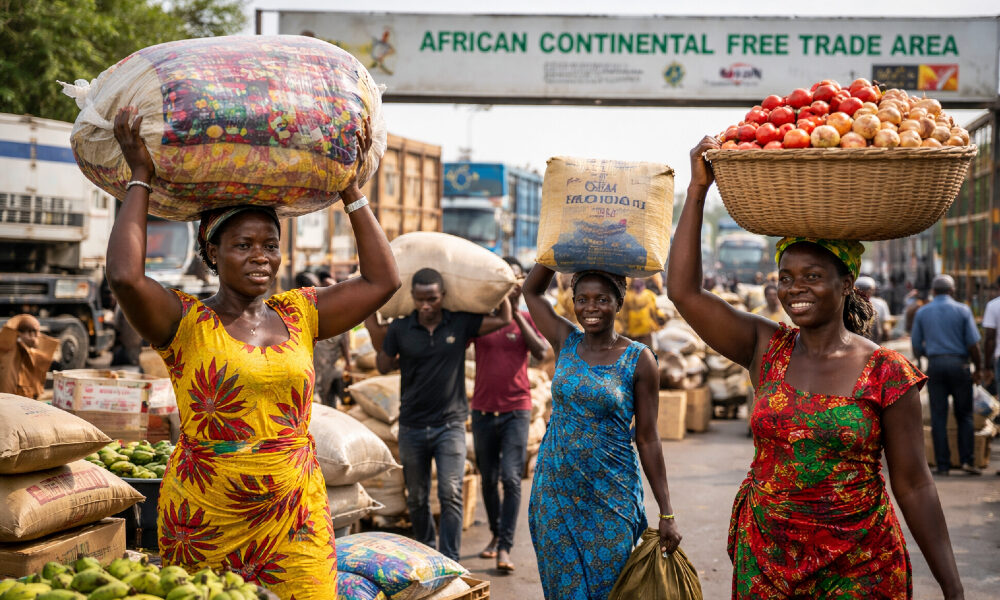
Across the Southern African Development Community (SADC), informal cross-border trade reaches US$17.6 billion annually – equivalent to 30-40 percent of total regional commerce. Women constitute 70 percent of these traders. Roughly 43 percent of young Africans depend on cross-border trade for their livelihoods.
These are not marginal figures. They represent the economic backbone of regional integration that policymakers have somehow convinced themselves does not exist.
Through our work with Borderless Alliance, we spent years advocating for trade facilitation based on formal statistics before confronting an inconvenient truth: we were designing systems for a minority of actual commerce.
When Ghana’s Statistical Service conducted its maiden Informal Cross-Border Trade Survey in late 2024, the findings confirmed what we had observed at border posts for over a decade. Informal trade accounted for 61.2 percent of total trade with Togo and 55.7 percent with Côte d’Ivoire (Ivory Coast).
The foundation of West African commerce rests not in formal customs ledgers, but in the informal networks of women and youth who move the majority of goods across borders.
Colonial Borders Cannot Erase Pre-Colonial Commerce
The persistence of informal cross-border trade is neither accident nor aberration. These networks have deep historical and cultural roots that predate colonial borders entirely.
Pre-colonial trading routes facilitated exchange across vast territories, sustained by kinship ties and trust-based relationships that modern nation-states have failed to replace with anything more effective.
When Brussels, Paris, Berlin, Madrid, Lisbon and London drew their lines across maps in the late 19th century, they did not extinguish centuries-old trading patterns. They merely rendered them “informal.”
The exclusion of informal cross-border trade from formal agreements like the AfCFTA thus undermines the very regional integration these frameworks purport to advance. A substantial portion of cross-border agricultural trade – crops and livestock that feed millions – occurs informally, creating uncoordinated regulatory frameworks that generate bottlenecks rather than facilitating seamless exchange.
Accessibility Without Opportunity
Women and youth gravitate toward informal cross-border trade primarily out of economic necessity. They find it more accessible than formal sector trading due to low entry barriers and operational flexibility.
But this accessibility often becomes a trap, consigning participants to vulnerable, low-growth environments without access to credit, business development services, or legal protections.
The weak governance of informal trade fosters precisely the corruption it seeks to avoid. Border officials extract informal payments from traders attempting to bypass restrictive regulations.
When governments criminalize rather than facilitate informal commerce, they expand the space for illicit activity while driving legitimate trade underground. Recognition and light-touch formalization could simultaneously reduce corruption and improve how borders actually function.
From Invisible to Indispensable
The path forward requires neither wholesale formalization nor romantic acceptance of the status quo. Instead, practical reforms aligned with commercial reality can bridge the gap between policy and practice.
Simplified customs procedures for small-scale traders, light-touch formalization pathways, partnerships with informal traders’ associations, and standardized data collection systems represent achievable first steps.
The continental methodology for informal trade data collection developed by the African Union Commission, African Export-Import Bank (Afreximbank), and the UN Economic Commission for Africa in 2024 provides the technical framework. Ghana, Uganda, Rwanda, and Nigeria have already piloted measurement studies.
The AfCFTA Secretariat must coordinate with national governments not merely to simplify trade procedures in the abstract, but to harmonize cross-border processes specifically for informal traders and accelerate their integration into the formal economy. The protocols exist on paper.
The networks that drive actual commerce exist on the ground. The chasm between them represents both a massive policy blind spot and an enormous opportunity.
Making the Invisible Visible
When informal cross-border trade moves from invisible to visible, from criminalized to facilitated, the AfCFTA can realize its full potential: a continental market built on networks that have functioned effectively for centuries. The alternative is to continue constructing elaborate trade architecture while the real economy operates in the shadows, unrecorded, unprotected, and unintegrated.
The question facing African policymakers is not whether to acknowledge informal trade, but whether they can afford not to. What specific steps are your national trade facilitation committees taking to bring informal traders into AfCFTA implementation?
The answer may determine whether continental integration becomes reality or remains an aspiration written in protocols that govern commerce nobody actually conducts.
The ghost economy is waiting to be recognized. The only question is how long policymakers will continue pretending it does not exist.
Ziad Hamoui is the Co-Founder and Past President of the Borderless Alliance, a leading private-sector advocacy group promoting economic integration and removing trade and transport barriers in West Africa. With extensive experience in Ghana’s road transport, logistics, and shipping sectors, he currently serves as Executive Director of Tarzan Enterprise Ltd., a long-established family business. He is a former Co-Chair of the Africa Food Trade Coalition, Co-Founder of the Trade Facilitation Coalition for Ghana, and serves on multiple high-level advisory committees on trade, transport, agriculture, and security. A Chartered Fellow of the Chartered Institute of Logistics and Transport (CILT) Ghana, he is also a former member of its Governing Council.