Opinion
Africa’s Investment Gap Isn’t Capital. It’s Architecture.
Reflections from the Africa-France Pre-Summit Business Dialogue, hosted by the Aspen Institute


By Sheena Raikundalia
The invitation to invest in Africa is older than the continent’s modern borders. And yet, the conversation at the recent Africa-France Pre-Summit Business Dialogue, hosted by the Aspen Institute, made one thing unmistakably clear: the real barrier to capital is not African risk – it is the architecture of international finance itself.
That is a harder argument to make in polite company than it should be.
The Myth of the “Uninvestable” Continent
Africa pays two to three times the borrowing costs of comparable economies elsewhere in the world. Risk perceptions, however, are divorced from reality: actual investment losses on the continent stand at just 1.9 percent, compared to 6.6 percent in North America.
Let that sink in. Africa is treated as the riskier bet, while delivering safer returns.
The anomaly does not end there. Currency volatility and interest rate exposure – not underlying economic weakness – drive a disproportionate share of Africa’s debt servicing burden.
And the continent loses an estimated US$5 billion every year simply moving money within its own borders, a structural tax on intra-African commerce that no amount of entrepreneurial ingenuity can fully offset.
This is not a story about African unreadiness. It is a story about a global financial system calibrated for a world that no longer exists – and, in critical respects, a world that never served Africa fairly to begin with.
The question worth asking is not how Africa can become “investable.” It is why institutions created in the postwar era continue to define investability in terms that systematically disadvantage the Global South.
Africa is not short of opportunity. It is short of fair terms.
Jobs, Dignity, and the Discomfort of Trade-Offs
The most uncomfortable session of the day did not involve numbers. It involved a question that anyone serious about African development must eventually confront: Do we need dignified jobs – or simply jobs?
The room did not reach consensus, and perhaps it should not have. Many participants argued, with some urgency, that when survival is the immediate constraint, scale of employment must come before quality of employment.
The Industrial Revolution was invoked: it generated millions of livelihoods, but the broader social dividends – labor protections, working conditions, equitable wages – took the better part of a century to materialize.
The historical parallel is instructive and unsettling in equal measure. It raises a legitimate policy dilemma: Can Africa’s working population afford to wait for ideal conditions?
Or does economic participation at scale – however imperfect – constitute the necessary precondition for everything that follows?
There are no clean answers here. But the willingness to sit with the discomfort of the question, rather than retreat into either technocratic optimism or moral absolutism, is exactly the kind of intellectual honesty that development policy has long needed.
Climate Finance: The Money Exists. The Question Is Who Gets It.
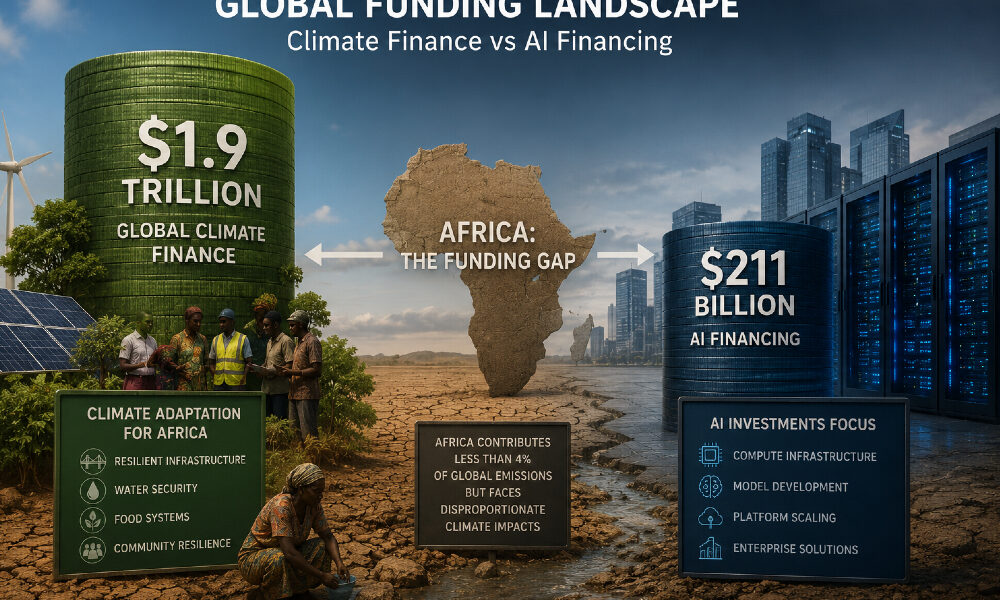
One of the most striking statistics of the day came from a speaker, who noted that global climate financing – at US$1.9 trillion – already dwarfs investment in artificial intelligence, which stands at roughly US$211 billion. The money, in other words, is not the problem.
The problem is distribution.
How much of that US$1.9 trillion actually reaches Africa? How much reaches communities on the frontlines of climate impact, rather than circulating within the financial architectures of donor countries?
And how much constitutes genuine adaptation finance, versus carbon market mechanics that allow wealthy economies to offset emissions without substantively reducing them?
The underlying contradiction is one that the international community has not yet found the courage to address directly: Africa is responsible for less than 4 percent of global greenhouse gas emissions, yet bears a disproportionate share of climate consequences. At the same time, Africa is expected to industrialize cleanly – to leapfrog the carbon-intensive development path that Europe, North America, and East Asia used to build the prosperity they now seek to protect.
That is not a technical challenge. It is a moral one.
One undercurrent that deserves more attention: as artificial intelligence scales globally, its energy demands will become one of the defining geopolitical and economic questions of the next decade. Africa’s extraordinary renewable energy potential – solar, hydro, wind, geothermal – positions it as a critical supplier of the power that the AI era will require.
Whether Africa captures the value of that position, or merely exports it, will depend on the policy and investment choices made now.
Venture Capital and the Exit Fallacy
A final note – and a personal one.
I come from a family of business builders. My grandfather, my father, my mother, my husband. Not one of them ever asked: How do I exit? The question simply did not arise, because the purpose of building a business was never to sell it. It was to sustain it – across generations, across cycles, as an institution rather than an instrument.
Venture capital, in its dominant Silicon Valley form, is premised on a fundamentally different logic: compress time, maximize growth, engineer an exit. That model has produced extraordinary companies.
It has also produced spectacular failures, persistent inequality, and a bias toward businesses whose returns can be realized within a ten-year fund cycle.
The African business landscape – with its emphasis on resilience, community embeddedness, and intergenerational continuity – may be far better served by a different model. Not unicorns built for acquisition, but institutions built for permanence. Not exits, but legacies.
That may not fit the spreadsheets of Sand Hill Road. But it may fit Nairobi, Lagos, Accra, and Johannesburg far better than anyone has been willing to admit.
Sheena Raikundalia is an accomplished entrepreneur, former lawyer, government policy advisor, and angel investor with deep expertise across the legal, financial services, and impact investment sectors in Europe and Africa. She has played a pivotal role in advancing Africa’s technology and innovation ecosystems, leveraging a career that spans top-tier London law firms, leadership as Country Director of the UK-Kenya Tech Hub for the UK Foreign, Commonwealth & Development Office (FCDO), and her current position as Chief Growth Officer at agri-tech company Kuza One. Sheena is recognized for her strategic vision, commitment to fostering innovation, and strong advocacy for Africa’s growth potential in technology, entrepreneurship, and impact investment.