Opinion
Africa’s Infrastructure Boom: Why the Continent Is Finally Becoming an Execution Story


By Dishant Shah
The era of potential has ended. Africa’s execution phase has begun.
More than US$200 billion in transformative infrastructure projects are fundamentally reconfiguring Africa’s economic architecture. For investors, policymakers, and businesses still viewing the continent through outdated frameworks, this reality presents both a challenge and an unmissable opportunity.
Three Projects That Define the Transformation
The evidence is no longer anecdotal. Consider three projects that exemplify the scale and ambition now materializing across African markets.
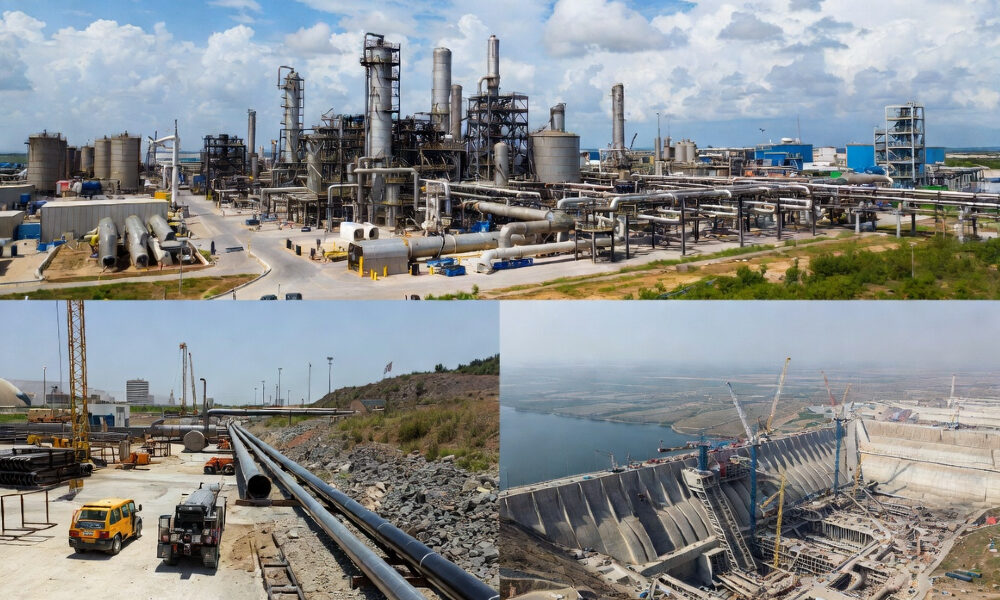
The Dangote Refinery in Nigeria – now operational as the world’s largest single-train facility – recently expanded its capacity from 600,000 to 1.4 million barrels per day, representing far more than just an increase in energy production. This US$19 billion installation signals a strategic pivot toward import substitution, foreign exchange stabilization, and industrial deepening – structural advantages that compound over decades, not quarters.
Similarly, the proposed Nigeria-Morocco Gas Pipeline – a US$25 billion transcontinental energy corridor stretching over 5,600 kilometers (3,480 miles) – embodies the convergence of energy security, regional economic integration, and downstream industrial development. When completed, it will supply gas to thirteen West African nations and extend to European markets, fundamentally altering the continent’s position in global energy networks.
Perhaps most ambitious is the Grand Inga Dam project in the Democratic Republic of Congo. With an estimated price tag exceeding US$100 billion, this hydroelectric installation could generate over 40,000 megawatts – enough to simultaneously power multiple African economies while providing renewable baseload capacity that dwarfs most comparable projects worldwide.
The Continental Scale: $3 Trillion and Rising
These are not isolated initiatives. They are data points in a continental transformation characterized by unprecedented scope and velocity.
Current assessments indicate approximately US$3 trillion in active infrastructure development across Africa, with West Africa alone accounting for more than US$1 trillion in projects. An additional US$245 billion sits in advanced pipeline stages across energy, transportation, and digital infrastructure sectors.
This magnitude matters because infrastructure functions as an economic multiplier rather than growth itself. It enables second-order effects that cascade through economies in ways traditional development models often fail to capture.
Consequently, economic forecasts now project approximately 4.0 percent GDP growth for Africa in 2026 – growth increasingly driven not by commodity extraction alone, but by renewable energy deployment, integrated logistics networks, digital infrastructure expansion, and deepening trade facilitation under the African Continental Free Trade Area framework.
The AfCFTA, representing a market of 1.3 billion people with combined GDP exceeding US$3.4 trillion, provides the institutional architecture to capitalize on these physical investments. As tariff barriers dissolve and regulatory harmonization progresses, the infrastructure being built today will service dramatically expanded intra-continental trade flows tomorrow.
What This Means for Market Participants
This convergence creates specific implications for market participants.
Infrastructure investments generate demand curves that precede their appearance in consumption data. They establish supply chain capacity in markets that traditional maturity metrics would prematurely dismiss.
Most significantly, they create asymmetric upside for participants who combine early positioning with operational sophistication.
The investment thesis has fundamentally shifted. Africa’s development narrative has moved from potentiality to execution, from promise to performance, from tomorrow to today.
Capital flows reflect this transition. Chinese infrastructure financing in Africa, while moderating from peak levels, remains substantial.
Simultaneously, American, European, and Gulf capital increasingly views African infrastructure through strategic rather than purely philanthropic lenses. The European Union’s Global Gateway initiative and America’s Partnership for Global Infrastructure and Investment represent acknowledgments that Africa’s infrastructure build-out carries geopolitical weight.
The Reality of Execution Risk
Yet execution risk remains formidable. Project delays, financing gaps, governance challenges, and capacity constraints plague numerous initiatives.
The Grand Inga Dam, despite decades of planning, still awaits full financial closure. The Nigeria-Morocco pipeline faces complex geopolitical and technical hurdles across multiple jurisdictions.
These challenges, however, should contextualize rather than negate the underlying transformation. Infrastructure development operates on timescales that frustrate quarterly earnings calls but reshape economies nonetheless.
The essential question facing businesses, investors, and policymakers is not whether Africa’s infrastructure revolution is occurring – the evidence is overwhelming – but rather who will position themselves to benefit from its compound effects.
This decade will not reward passive observation. It will reward operational engagement: manufacturers establishing production capacity ahead of visible demand signals, logistics providers building networks in advance of trade volume data, financiers structuring patient capital for projects with decade-long horizons, and technology firms deploying digital infrastructure that enables rather than extracts.
The narrative has shifted irrevocably. The capital is mobilizing. The infrastructure is rising.
What remains uncertain is which market participants will recognize this transition quickly enough to capture the asymmetric opportunities it creates – and which will continue debating Africa’s potential while others execute on its present.
Dishant Shah is a partner at Legion Exim, a company specializing in facilitating the export of high-quality engineering products directly sourced from manufacturers in India to Africa. His areas of expertise include new business development and business management.