Opinion
Africa’s Infrastructure Boom: The Real Fortune Lies In The Bulldozers
The continent’s most overlooked opportunity may be the machinery that builds everything else.


By Dishant Shah
The world has grown accustomed to viewing Africa through a familiar lens: vast mineral reserves, a surging consumer class, and an energy sector ripe for transformation. These are real opportunities, and they are being pursued with real capital. But in the rush to stake claims in the obvious, a quieter and arguably more durable prize is being missed – one measured not in barrels or carats, but in excavators, maintenance contracts, and spare parts depots.
Africa’s construction equipment sector is on the verge of a sustained structural boom, and the window to build a dominant position in it is open now.
A Continent Under Construction
The arithmetic is difficult to ignore. The continent’s population is projected to surpass 2.5 billion by 2050, a demographic swell that will demand an extraordinary expansion of physical infrastructure – roads, ports, railways, housing, factories, power plants, water systems, and logistics networks. Yet the financing gap required to build it exceeds US$100 billion annually. That gap does not signal weakness; it signals the scale of the mobilization ahead. As multilateral lenders, development finance institutions, sovereign wealth funds, and private capital increasingly turn their attention to African infrastructure, demand for the heavy machinery that makes construction physically possible will rise in lockstep.
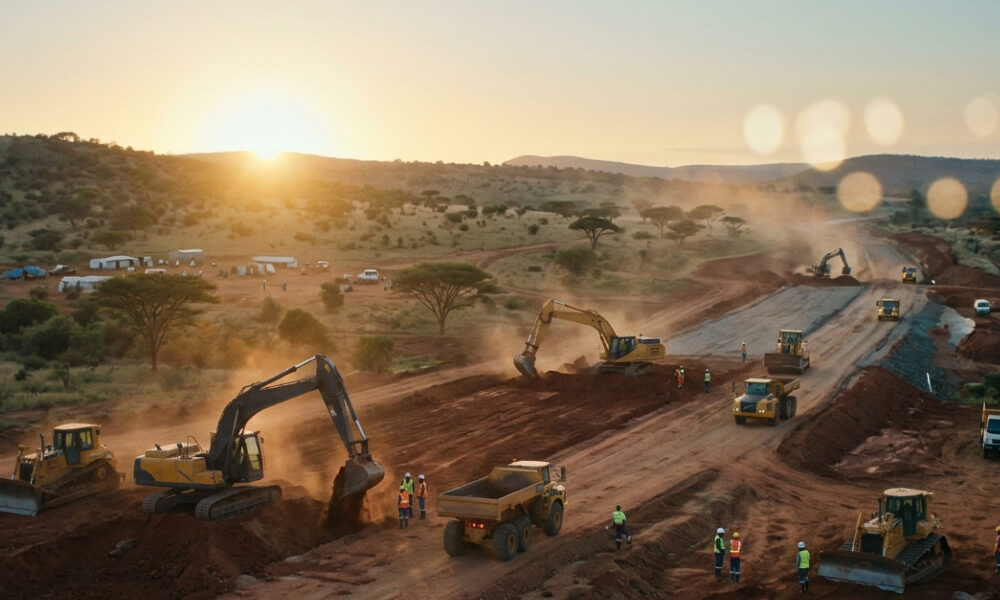
Urbanization is accelerating that demand further. Africa is urbanizing faster than any other region on earth, and city-building is, at its core, a capital equipment story. Excavators break ground. Cranes lift steel. Compactors lay roads. Every new mine, every renewable energy installation, every industrial park adds to the queue. The question is not whether demand will materialize – it already is. The question is who will be positioned to capture it.
Beyond the Machine: Where the Real Value Lies
The most perceptive investors understand that the real value in any infrastructure cycle rarely sits where the headlines do. It sits in the ecosystem. During America’s railroad boom of the nineteenth century, it was the suppliers of iron, the owners of timber rights, and the operators of coal depots who built generational wealth – not just the railroad companies themselves. The same logic applies here. Equipment sales are only the most visible layer of a far richer opportunity stack.
Consider what lies beneath: leasing and rental fleets that serve contractors who cannot afford outright purchases; spare parts distribution networks that command premium margins and create recurring revenue; maintenance and repair services that become indispensable once equipment is in the field; operator training programs that address a genuine and growing shortage of certified technicians; fleet management platforms that use telematics and digital monitoring to reduce downtime; financing solutions tailored to markets where traditional credit infrastructure remains thin; and a growing market for refurbished and reconditioned machinery that offers a cost-effective entry point to price-sensitive buyers. Each of these verticals is, in its own right, a business worth building.
Real Challenges, Real Moats
None of this is to suggest the path is without friction. Africa’s construction equipment market carries real structural challenges that cannot be wished away. The continent remains heavily reliant on imported equipment, with negligible local manufacturing capacity to buffer against currency volatility or supply-chain disruptions. Skilled technicians are scarce relative to the demand that is coming. Project delays – caused by permitting bottlenecks, financing gaps, or political transitions – can strand capital in expensive machinery that sits idle. Regulatory environments vary widely across 54 sovereign states and can shift with little warning.
These are not fatal objections. They are the conditions that reward those who build robust operations over those who seek quick returns. Markets with friction are markets with moats. A company that solves the spare parts problem in West Africa, or that trains 10,000 equipment operators across East Africa, is building something that cannot be easily replicated by a competitor parachuting in with a price discount.
The Lesson of Every Infrastructure Boom
History is instructive. In every major infrastructure wave – from the post-war reconstruction of Europe to the China-led boom of the early 2000s – the companies that emerged with lasting franchises were those that embedded themselves in the supporting ecosystem, not merely those that sold the most machines. They became indispensable. They built trust, technical depth, and distribution before the cycle peaked.
Africa’s infrastructure build-out is not a short-term trade. It is a multi-decade transformation of the physical fabric of the world’s youngest and fastest-growing continent. The opportunity is not to show up at the peak with a catalog of heavy machinery. It is to build, right now, the infrastructure behind the infrastructure – the networks, services, skills, and institutions that will underpin everything else.
Those who move early and build deep will not merely participate in Africa’s growth. They will help determine its pace.
Dishant Shah is a partner at Legion Exim, a company specializing in facilitating the export of high-quality engineering products directly sourced from manufacturers in India to Africa. His areas of expertise include new business development and business management.