Opinion
Africa’s Infrastructure Boom Risks Failure Without Trade Facilitation


By Ziad Hamoui
Multilateral Development Banks now account for more than half of Africa’s net financial flows – a 124 percent increase that is fueling one of the most consequential infrastructure buildouts the continent has ever seen. With the Africa Finance Corporation’s recent “A” credit rating driving down the cost of capital, the opportunity to build is, by any measure, immense.
Yet a critical question persists: what kind of infrastructure are we actually funding?
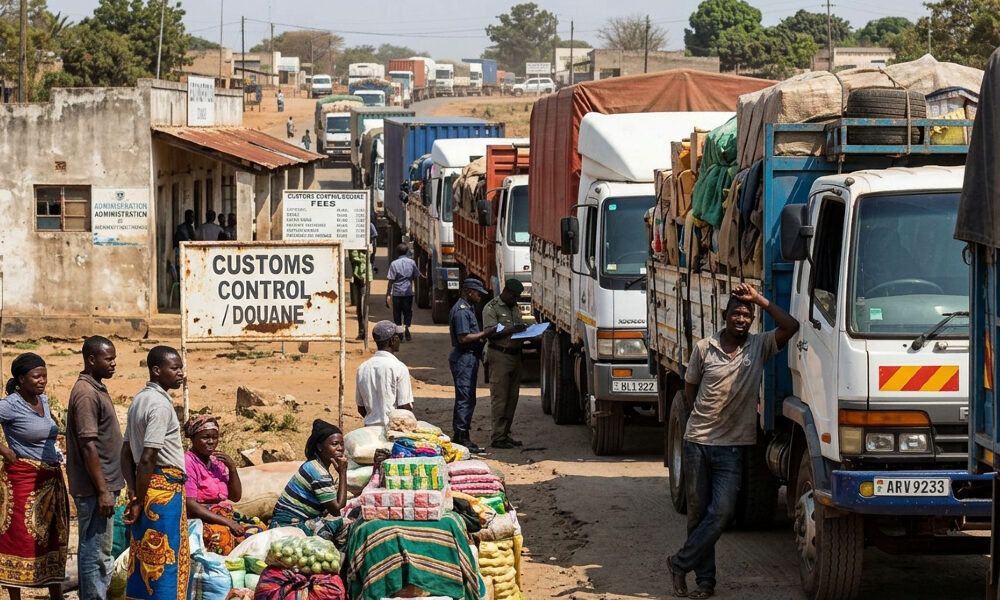
Flagship physical projects like the Abidjan-Lagos Corridor command headlines and ribbon-cutting ceremonies. But the real bottleneck choking African trade lies not in the roads themselves – it lies in the invisible systems that govern what happens at the end of them.
This soft infrastructure gap is quietly eroding the return on even our most expensive physical assets.
The numbers are sobering. The Trade Law Centre’s latest AfCFTA ratification update reveals that more than half of the 49 Party States cannot yet trade preferentially, because their tariff schedules remain unfinished.
This is not a geopolitical failure. It is a soft infrastructure failure – the administrative and digital equivalent of building a modern highway that leads to a locked gate.
Non-integrated customs systems, absent rules-of-origin databases, and undertrained border agents create the same chokepoints as a collapsed bridge, only with far less public urgency attached to fixing them.
At the recent Africa Trade Summit, Ghana’s Deputy Minister for Energy, Richard Gyan-Mensah, articulated a framework that deserves wider adoption. Industrialization, he argued, rests on three pillars: reliable energy, resilient physical infrastructure, and efficient trade systems.
The third pillar – encompassing digital trade platforms, harmonized documentation, border-agent training, and collaborative bodies such as National Trade Facilitation Committees – is consistently underfunded and underappreciated. Neglecting it does not merely slow growth; it undermines the entire enterprise.
The policy implication is straightforward, even if the politics are not: we must expand our investment thesis beyond the roads that lead to borders and begin funding the systems that operate at them. Without this shift, billions in infrastructure capital will generate corridors that are impressive on paper and dysfunctional in practice.
Trade facilitation is what transforms infrastructure investment into economic velocity. Get that balance wrong, and we are not building arteries – we are building expensive monuments to missed potential.
When Borders Close, Communities Collapse
The geopolitical dimension of this challenge is sharpening. The ECOWAS Commission’s recent warning over rising tensions along the Guinea-Liberia-Sierra Leone border triangle has focused attention on flags and sovereignty.
But the immediate casualties of that instability are not governments – they are the traders, transporters, and farming families whose entire economic lives depend on those crossings functioning each day.
Border unpredictability cascades rapidly into crisis. Perishable goods spoil before reaching markets. Women traders – who form the backbone of cross-border commerce across much of West Africa – lose access to customers and income overnight.
Transport operators face paralyzing uncertainty about whether their vehicles will be permitted to pass, or turned back, or worse. The local economies of border towns, which exist precisely because of trade, begin to collapse inward.
As I argued at the recent Africa Resilience Forum in Abidjan, the relationship between economic hardship and instability is not theoretical – it is operational. When livelihoods disappear at border communities, those communities become recruiting grounds for armed groups and pressure valves for smuggling networks and irregular migration.
The border does not merely reflect regional instability; it generates it, when it is managed poorly.
This is why the ECOWAS technical mission currently deployed to the region must pursue an agenda that goes well beyond de-escalation. Sustainable peace in border zones requires three simultaneous commitments: ensuring that trade and transport continue uninterrupted even as diplomatic tensions are managed; establishing joint border management structures that build institutional trust between neighboring states over time; and investing directly in border infrastructure – warehouses, digital customs terminals, trader associations – that creates tangible economic interdependence.
Shared prosperity is the most durable deterrent to conflict.
The Mano River Union and the AfCFTA framework both contain the protocols necessary to support this vision. The gap is not in the legal architecture – it is in the political will and targeted investment to make those protocols operational on the ground.
Every warehouse built at a border crossing is a peace dividend. Every customs process digitized reduces a friction point that, left unaddressed, becomes a flashpoint. Every women’s trader association strengthened is a constituency for stability that no armed group can easily displace.
The Case for Integrated Action
A border closed to goods is a border closed to opportunity – and opportunity remains the most effective antidote to instability that development policy has ever produced.
As private sector operators and development partners, we are not bystanders to the ECOWAS mission currently unfolding. We have both a stake and a responsibility in keeping economic lifelines open while diplomatic efforts run their course.
That means advocating loudly for soft infrastructure budgets inside multilateral financing packages. It means insisting that trade facilitation benchmarks sit alongside road-length targets in project evaluation frameworks.
And it means treating border community investment not as a corporate social responsibility footnote, but as a core component of the infrastructure thesis itself.
The Africa we are building toward – peaceful, prosperous, and integrated – will not be secured by roads alone. It will be secured by the systems, the institutions, and the human capacity that determine what actually moves along those roads, and at what cost, and with what dignity. It is time to fund both.
Ziad Hamoui is the Co-Founder and Past President of the Borderless Alliance, a leading private-sector advocacy group promoting economic integration and removing trade and transport barriers in West Africa. With extensive experience in Ghana’s road transport, logistics, and shipping sectors, he currently serves as Executive Director of Tarzan Enterprise Ltd., a long-established family business. He is a former Co-Chair of the Africa Food Trade Coalition, Co-Founder of the Trade Facilitation Coalition for Ghana, and serves on multiple high-level advisory committees on trade, transport, agriculture, and security. A Chartered Fellow of the Chartered Institute of Logistics and Transport (CILT) Ghana, he is also a former member of its Governing Council.