Opinion
Africa’s Hidden Treasure: Mapping the Continent’s Critical Minerals


By Dishant Shah
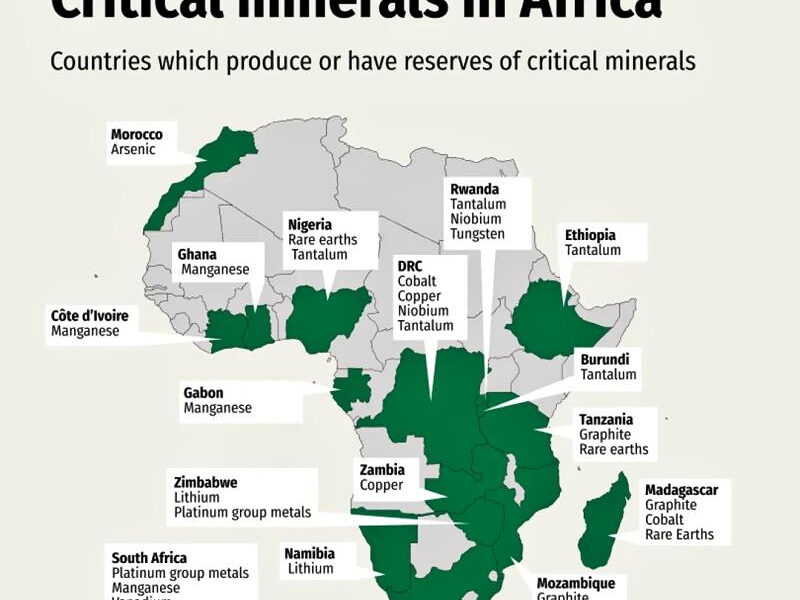
Take a closer look at a map of Africa’s critical minerals, and you will see an extraordinary mosaic of resources that underpin modern technology – from electric vehicles to smartphones and beyond.
At the heart of this mineral-rich landscape lies the Democratic Republic of the Congo (DR Congo), which stands out for its vast reserves of cobalt, copper, niobium, and tantalum. Notably, the DR Congo supplies more than 70 percent of the world’s cobalt – essential for lithium-ion batteries – making it a linchpin in the global shift toward clean energy.
On the opposite end of the continent, Morocco leads in arsenic production. While less commonly discussed, arsenic plays a vital role in manufacturing semiconductors and specialized alloys.
South Africa, meanwhile, is a powerhouse of platinum group metals (PGMs), which are crucial for catalytic converters in vehicles. It also holds major deposits of manganese, vanadium, and rare earth elements – all essential for steel production, infrastructure, and high-tech industries like wind turbines and advanced electronics.
Just across the border, Zambia remains a key supplier of copper – a foundational metal for electrical wiring and renewable energy systems.
In East Africa, countries such as Rwanda, Burundi, and Ethiopia contribute tantalum, a metal critical to ensuring the performance and reliability of electronic devices. Rwanda, in particular, also boasts significant reserves of niobium and tungsten – minerals used in high-strength steels and precision cutting tools.
Further east, Tanzania brings graphite and rare earths to the table, while Madagascar offers a rich mix of graphite, cobalt, and rare earth elements. Mozambique, too, is emerging as a growing force in the tantalum and graphite markets.
Southern and Eastern Africa: Emerging Lithium Hotspots
Looking southward, Zimbabwe and Namibia are positioning themselves as key players in the global lithium race. Zimbabwe has abundant lithium and platinum group metals, while Namibia’s lithium reserves could soon rival those of South America – long considered the epicenter of lithium production.
These resources lie at the core of the green energy transition, fueling everything from battery storage and electric vehicles to wind farms and solar power infrastructure.
West Africa: Manganese Powerhouses and Rare Earth Potential
West Africa is no exception. Ghana, Gabon, and Côte d’Ivoire (Ivory Coast) are among the top producers of manganese – an indispensable element in steelmaking, accounting for around 20 percent of global output. Meanwhile, Nigeria holds promising reserves of rare earths and tantalum.
According to the U.S. Geological Survey’s Mineral Commodity Survey World Data 2025, Africa is home to nearly half of the world’s known cobalt reserves, close to 60 percent of manganese, and substantial shares of platinum group metals and rare earth elements.
The potential here is immense – not just for reshaping global supply chains, but for transforming local economies. If managed sustainably and equitably, these resources could offer unprecedented opportunities for development and prosperity.
We often speak of Africa’s promise, but maps like this reveal a reality already unfolding – one where the continent is quietly redefining industries on a global scale.
The question now is how these vast mineral riches will translate into tangible benefits for local communities. And perhaps more importantly – what frameworks must be put in place to ensure that the rewards of Africa’s natural wealth are shared fairly between global markets and the people who call these resource-rich regions home?
Dishant Shah is a partner at Legion Exim, a company specializing in facilitating the export of high-quality engineering products directly sourced from manufacturers in India to Africa. His areas of expertise include new business development and business management.