Opinion
Africa’s Engineering Moment: Build for Productivity, Not Dependency


By Apollo Buregyeya
As the world marks World Engineering Day for Sustainable Development on March 4, 2026, Africa finds itself at a defining crossroads. The global order is fracturing – geopolitical instability, climate volatility, and economic fragmentation are reshaping every continent.
Yet Africa’s cities keep growing, its populations keep expanding, and its ambitions keep rising. The gravest threat to this momentum is not war, nor drought, nor debt alone. It is dependency.
In Africa, engineering is not a professional luxury or an academic abstraction. It is the backbone of commerce. It determines whether a smallholder farmer can reach a market, whether a factory can operate without a diesel generator humming in the background, whether a family can afford a home, and whether a road draws wealth inward to build industry – or funnels it outward to enrich someone else’s economy.
“Green Infrastructure” Must Mean Something Different Here
The global conversation around sustainable infrastructure has become dominated by the vocabulary of wealthy donor nations: carbon credits, net-zero pledges, and green bonds. Africa is under no obligation to adopt this framing wholesale.
When African engineers and policymakers speak of green infrastructure, they must define it on their own terms – in the language of economic survival rather than environmental performance.
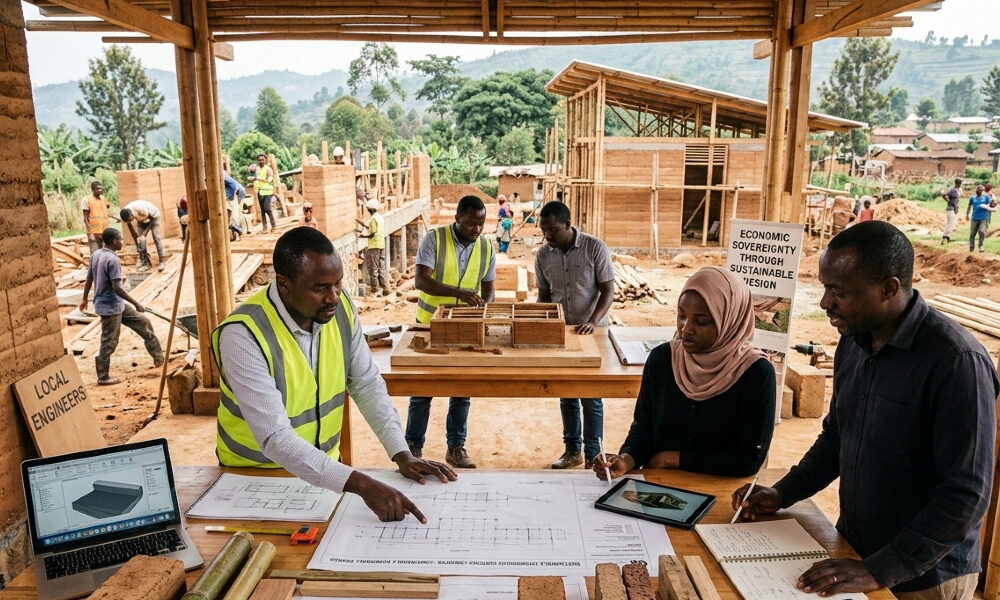
For Africa, green must mean lower energy costs. It must mean building with local materials, reducing import dependency, and extending the service life of critical assets.
It must mean designing systems that can be maintained within African supply chains, staffed by African technicians, and financed without surrendering fiscal sovereignty.
Green infrastructure must strengthen national balance sheets, not inflate national debt. It must expand housing ownership, not entrench exclusion.
This is not a rejection of global sustainability goals. It is a recognition that sustainability, at its most rigorous, is a discipline of necessity – not a performance staged for international donors.
Engineering Sovereignty Is an Economic Imperative
Africa’s infrastructure deficit is well documented. According to the African Development Bank, the continent faces an annual infrastructure financing gap estimated in the hundreds of billions of dollars.
But financing is only one dimension of the problem. The deeper issue is the design philosophy that governs what gets built, for whom, and under what conditions.
Too much of Africa’s infrastructure has been engineered elsewhere – conceived in foreign capitals, built with imported materials and equipment, and structured around repayment schedules that serve creditors more than citizens. The result is infrastructure that exists but does not compound: roads that carry commodities to ports without anchoring value-added manufacturing at the source; energy projects that electrify export industries while leaving households in darkness; housing developments priced for foreign investors rather than domestic earners.
The antidote is not hostility to outside investment. It is a clear-eyed insistence on engineering standards, procurement frameworks, and project structures that prioritize African commercial productivity.
Infrastructure built to serve African markets, African industries, and African households will, almost by definition, be more durable, more appropriate, and more sustainable than infrastructure designed to satisfy external metrics.
A Call to Africa’s Engineers, Policymakers, and Institutions
World Engineering Day is not merely a moment for celebration. It is an occasion for strategic clarity.
Africa’s engineers – in civil, structural, mechanical, electrical, environmental, and industrial disciplines – carry a responsibility that extends far beyond technical execution. They are architects of sovereignty.
The standards Africa adopts, the codes it enforces, the materials it specifies, and the supply chains it develops are all engineering decisions with profound economic and political consequences.
Every locally manufactured construction component that displaces an import is an act of industrial policy. Every infrastructure project designed for local maintenance rather than foreign contractors is an investment in long-term self-sufficiency.
The call, then, is straightforward: engineer Africa for productivity and sovereignty. Build infrastructure and standards that serve African commerce first.
When that work is done with rigor and ambition, sustainability will follow – not as a concession to outside pressure, but as the natural discipline of a continent building to last. The future Africa seeks will not be imported. It will be engineered at home.
Apollo Buregyeya, Ph.D., is a civil engineer and entrepreneur focused on developing sustainable African industries that leverage local mineral resources to improve living standards. He is the founder and CEO of Eco Concrete Ltd, a construction company specializing in innovative solutions tailored to the African environment. Committed to resource ownership and appropriate technology for value creation, he also teaches at Makerere University in Kampala, Uganda.