Opinion
Africa’s Electric Future Is Not About Climate – It Is About Economics
The real prize isn’t selling electric vehicles to Africa. It’s building everything that makes them move – and everything that moves alongside them.


By Dishant Shah
For much of the developed world, the electric vehicle revolution is framed as an environmental imperative: a moral reckoning with carbon emissions, a race against climate change. Africa sees things differently.
On a continent where over 600 million people still lack reliable access to electricity, where fuel import bills consume an outsized share of government budgets, and where the median age hovers below 20, the case for electric mobility is rooted not in ideology but in arithmetic.
This distinction matters enormously – for investors, for policymakers, and for the companies competing to define what the next great industrial story looks like.
The Economics Are Already Compelling
Africa’s urban transport landscape is structurally different from that of Europe or North America. Two-wheelers and three-wheelers dominate mobility in cities from Lagos to Nairobi, from Kampala to Dakar.
This is not a liability; it is an advantage. Electrifying a motorcycle fleet requires far less capital, less charging infrastructure, and less grid capacity than converting a car-centric market.
Electric motorcycles have already emerged as one of Africa’s fastest-growing EV segments, driven by operating costs that are a fraction of their gasoline equivalents and maintenance requirements that are dramatically simpler.
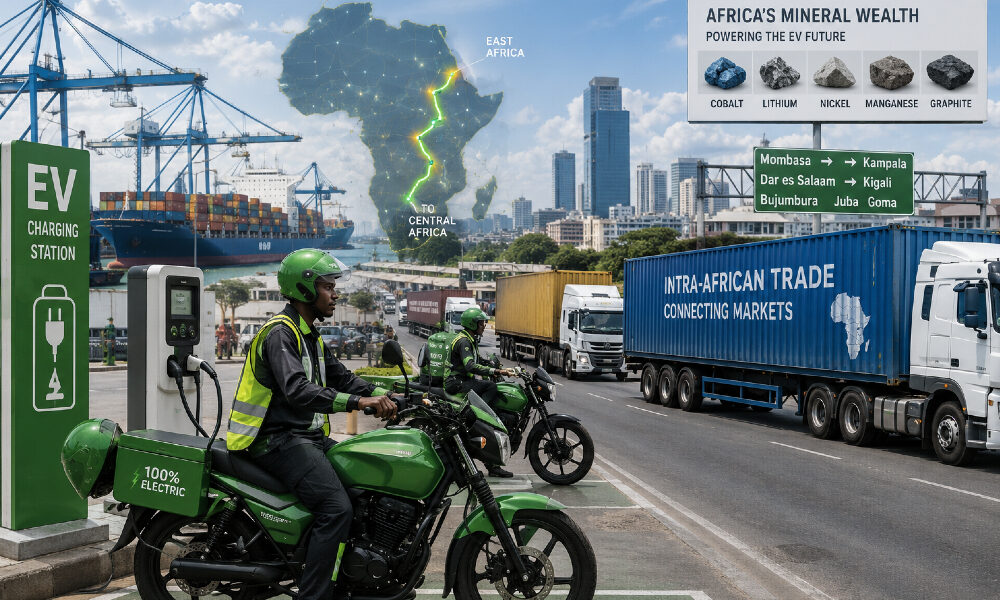
Meanwhile, the continent sits atop much of what the global EV industry needs most. Africa holds more than 70 percent of the world’s cobalt reserves – predominantly in the Democratic Republic of the Congo – along with substantial deposits of lithium, manganese, graphite, and nickel.
These are not incidental footnotes; they are the foundational materials of every battery in every electric vehicle sold anywhere on earth. The continent that supplies the raw inputs for the global energy transition has, until now, captured almost none of the value that transformation creates.
That calculus is beginning to shift. Kenya, Rwanda, South Africa, and Morocco are each, in their own ways, constructing EV ecosystems: offering fiscal incentives, investing in charging infrastructure, and encouraging local assembly.
Governments that once viewed energy security as a function of fuel import diversification are increasingly recognizing that domestic electric mobility offers a more durable path out of exposure to volatile oil markets.
The Bigger Opportunity: Building the Value Chain
Yet the companies likely to generate the most durable returns in Africa’s EV story will not be those simply importing finished vehicles and hoping for the best. The transformative opportunity lies upstream, downstream, and laterally – in mining and refining, in battery manufacturing, in renewable energy integration, in fleet management software, in the financing structures that make ownership accessible to first-time buyers, and in the local assembly capacity that creates thousands of jobs while reducing dependence on imported goods.
Africa is not merely an EV market. It is the raw material for an entirely new industrial ecosystem.
The distinction is the difference between a transaction and a transformation. Those who treat it as the former will compete on price and lose. Those who treat it as the latter may find themselves anchoring the continent’s next wave of economic development.
The Logistics Imperative
No discussion of African economic opportunity is complete without confronting the continent’s single greatest structural constraint: the cost and complexity of moving things. Transport costs in Africa routinely account for 30 to 40 percent of final product prices – multiples of the global average.
This is not simply a nuisance; it is a tax on every business, every consumer, and every aspiration to competitiveness.
Nowhere is this more acute than the corridor connecting East Africa’s ports to Central Africa’s consumers. The Port of Mombasa and the Port of Dar es Salaam serve as the primary gateways for a landlocked interior that includes Uganda, Rwanda, Burundi, South Sudan, and significant parts of the DR Congo – a combined market of more than 200 million people.
The roads, rail lines, inland waterways, warehousing facilities, customs services, and trucking fleets that serve these corridors represent multi-billion-dollar investment opportunities in their own right. They also represent the difference between a regional economy that works and one that does not.
The rise of the African Continental Free Trade Area adds urgency to this calculus. As intra-African trade volumes grow – which the AfCFTA is designed to accelerate – the inadequacy of existing logistics infrastructure will become an increasingly visible bottleneck.
The companies that build the solutions will not merely profit from trade; they will, in a meaningful sense, enable it. Businesses that solve the logistics puzzle between East Africa’s coastline and Central Africa’s hinterland may well become some of the continent’s most valuable enterprises over the next two decades.
A Convergent Thesis
Taken together, Africa’s EV opportunity and its logistics imperative are not separate stories. They are facets of the same underlying reality: a continent of 1.4 billion people – young, urbanizing, and rapidly formalizing – whose economic potential has been persistently constrained by infrastructure deficits that are now, finally, beginning to attract serious capital and serious competition.
The companies most likely to win are those that resist the temptation to approach Africa as a single, undifferentiated export market. The continent rewards those who think in systems: who understand that an electric motorcycle is also a logistics node, that a charging station is also a retail opportunity, that a mineral deposit is also a manufacturing anchor.
Africa’s EV moment is an economics story. But for those paying close enough attention, it may also be the investment story of the generation.
Dishant Shah is a partner at Legion Exim, a company specializing in facilitating the export of high-quality engineering products directly sourced from manufacturers in India to Africa. His areas of expertise include new business development and business management.