Opinion
Africa’s Education Crisis: The Model Problem
The continent isn’t failing to educate its young people. It’s educating them for a world that no longer exists.


By Kelly Mua Kingsly
By 2050, one in every four people on Earth will be African. More than 60 percent of the continent’s 1.5 billion inhabitants are already under 25, making Africa by far the youngest region on the planet. This should be an extraordinary economic advantage – a demographic dividend that other aging societies, from Japan to Germany, can only envy.
Instead, it risks becoming a demographic time bomb. The reason has less to do with how much Africa spends on education than with what that spending is designed to produce.
A System Built for a Different Century
Africa’s education systems were largely inherited from colonial administrations that needed clerks, translators, and civil servants – not engineers, scientists, or entrepreneurs. More than sixty years after independence, most of these systems remain structurally unchanged. They still reward memorization over problem-solving, certificates over competence, and conformity over creativity.
The results are stark. Roughly 70 percent of children in Sub-Saharan Africa cannot read and understand a simple sentence by age 10, according to World Bank estimates – a figure UNESCO and other agencies have flagged repeatedly as a foundational-learning emergency. Meanwhile, more than 20 million young Africans enter the labor market each year, yet the formal economy generates only about 3 million new jobs annually. The gap between what schools produce and what economies need is not a rounding error. It is a structural failure.
Government financing compounds the problem. UNESCO recommends that countries allocate 4–6 percent of GDP, or 15–20 percent of total public expenditure, to education. Many African governments fall short of both benchmarks. And even where public money flows in, families continue to shoulder the “hidden curriculum” of costs – uniforms, textbooks, transport, examination fees – that public budgets rarely capture but that determine, in practice, who gets to stay in school.
The Wrong Question
Policymakers, understandably, tend to frame this as a funding problem: spend more, build more schools, hire more teachers. But that framing obscures a more uncomfortable question. Are we financing the right kind of education in the first place?
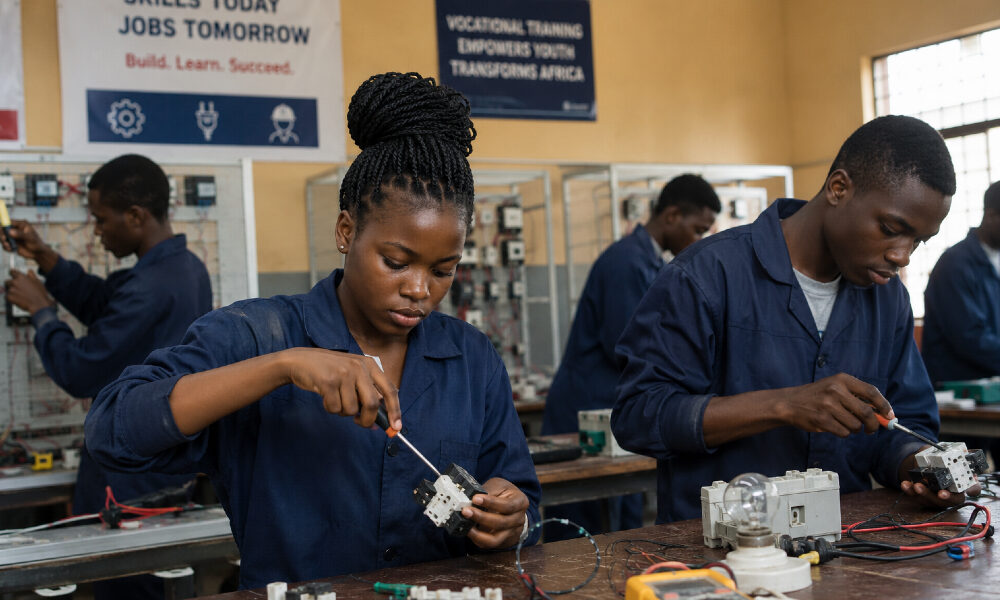
Consider technical and vocational education and training (TVET) – the pathway most directly linked to employable skills. Fewer than 10 percent of African learners are enrolled in TVET programs, even though these are precisely the skills that manufacturing, agribusiness, construction, and the digital economy are crying out for. Contrast this with the countries most often cited as post-war development success stories. Germany, Switzerland, South Korea, Singapore, and more recently China did not industrialize on the strength of university degrees alone. They built dual-track systems that fused classroom learning with real workplace apprenticeships, treating vocational training not as a fallback for weaker students but as a prestige pathway to skilled, well-paid work.
Africa has largely done the opposite. Vocational education carries social stigma, university enrollment is treated as the default marker of success, and the result is a growing population of credentialed but underemployed graduates chasing a shrinking pool of white-collar jobs.
From Certificates to Competencies
Simply scaling up the existing model – building more of the same schools, producing more of the same graduates – is not just ineffective. Given that Africa’s population is projected to reach 2.5 billion by 2050, it is financially unsustainable. Doing more of what isn’t working, at twice the scale, is not a strategy.
What Africa needs instead is a deliberate shift: from certificates to competencies, from memorization to innovation, from producing job seekers to producing job creators. Every graduate – whether from a university, a technical institute, or a community training program – should leave with a demonstrable skill, a recognized certification, and a clear pathway into either employment or entrepreneurship. Degrees may open doors. Skills build economies. The two are not the same thing, and African education policy has spent too long conflating them.
Africa’s Next Economic Revolution
None of this is an argument against education. It is an argument for a fundamentally different kind of education – one built for the economy Africa actually has, not the one its colonial-era institutions were designed to administer.
Africa does not need more graduates. It needs more builders, more innovators, more technicians, more entrepreneurs – people equipped not just to fill jobs, but to create them. Reorienting education systems around competency, industry linkage, and entrepreneurship is not a technical adjustment to be left to ministries of education. It is, in the fullest sense, Africa’s next economic revolution – and the window to get it right, while the demographic dividend still favors the continent, is narrowing every year.
Kelly Mua Kingsly brings extensive expertise in public finance and strategic leadership. He currently serves as the Head of Finance Operations at the Ministry of Finance of Cameroon, while also holding a dual role as Project Finance Manager at the Ministry of Economy, Planning, and Regional Development, and Censor at the Central Bank of Central African States (BEAC). He has previously served as Chairperson of the Board of the African Trade & Investment Development Insurance (ATIDI) and as a Director on the Board of Quantum Blockchain Capital. Driven by a strong passion for Africa’s economic transformation, he is deeply committed to advancing the continent’s path toward industrialization.