Opinion
Africa’s Digital Financial Revolution: How Infrastructure Is Rewriting Development


By Jastine Martine
The true measure of a continent’s economic potential lies not in what it has built, but in what it enables. Africa stands at an inflection point where digital payments, mobile finance, and interoperable systems will determine whether hundreds of millions join the formal economy or remain locked outside it.
The African Development Bank (AfDB) has made a consequential wager: that digital infrastructure represents the highest-return development investment Africa can make.
This is not incrementalism.
It is a fundamental reimagining of what development finance means.
The Arithmetic of Exclusion
Global financial inclusion has reached 79 percent of adults, up from 62 percent in 2014. Sub-Saharan Africa has seen account ownership surge from 34 percent to 58 percent over the same period. Progress, certainly. But 42 percent of adults – roughly 350 million people – remain outside the formal financial system.
The demographics of exclusion reveal a pattern: 55 percent are women, 52 percent come from the poorest households, and 62 percent have only primary education.
These figures represent more than statistical gaps. They are mothers unable to save securely for their children’s schooling, entrepreneurs denied credit to expand businesses, and farmers hemorrhaging money to intermediaries because digital payment options do not exist.
The economic cost compounds across lost productivity, trapped informal economies, constrained tax revenues, and denied autonomy.
Yet here lies the transformative insight reshaping development finance: solving this does not require bank branches in every village. It requires digital rails.
From Concrete to Code
The AfDB has financed Africa’s development since 1964, primarily through physical infrastructure – roads connecting markets, dams providing irrigation, power plants electrifying cities. These investments mattered then and matter still.
But around 2019, the Bank made a pivotal recognition: digital infrastructure is infrastructure, potentially delivering returns that rival or exceed traditional projects.
The Africa Digital Financial Inclusion Facility, launched in June 2019, set an audacious goal: extending financial inclusion to 332 million additional Africans by 2029. That figure represents nearly the entire population of the United States, and the timeframe is a single decade.
The facility operates across three strategic pillars: digital infrastructure including payment switches and real-time settlement systems, policy and regulation supporting central banks in creating enabling environments, and product innovation catalyzing financial services for underserved segments.
Gender considerations and capacity building are mainstreamed throughout.
Payment Infrastructure That Transcends Borders
Africa’s greatest barrier to digital payments has been fragmentation. National payment systems operate as isolated islands.
Cross-border transactions route expensively through correspondent banks in London or New York, consuming days and 5 percent to 15 percent of transaction value in fees.
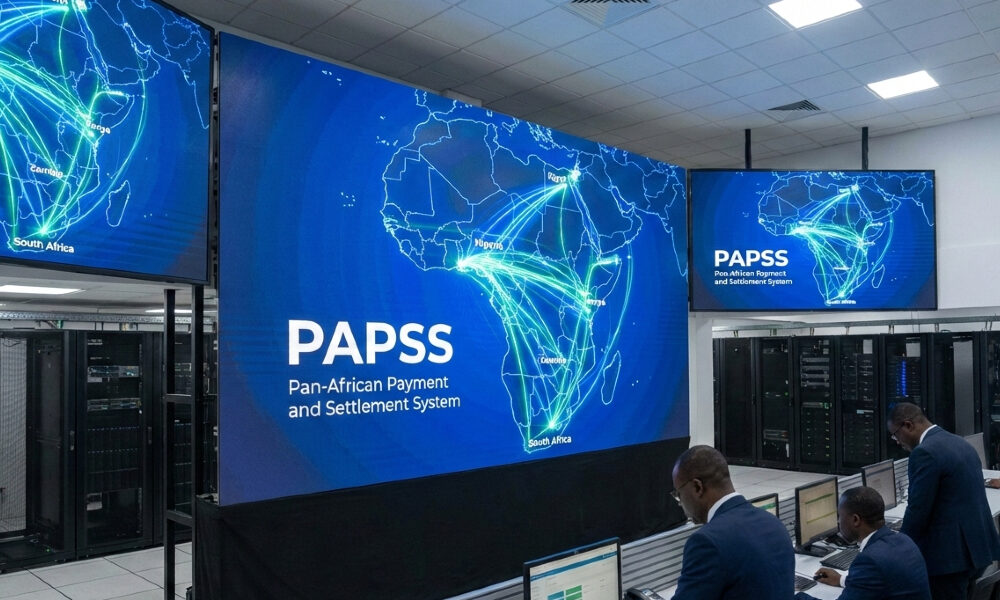
The Pan-African Payment and Settlement System (PAPSS), publicly launched in January 2022 by the African Union and African Export-Import Bank, changes this calculus fundamentally.
A Nigerian business paying a Kenyan supplier now transacts in naira; the supplier receives shillings within 120 seconds. The system handles settlement and currency conversion seamlessly.
As of late 2024, PAPSS encompasses 14 central banks and over 50 commercial banks. Egypt’s Central Bank joined in November 2024, positioning Cairo as headquarters and creating a strategic link between Africa and the Middle East.
More than 115 commercial banks had connected by May 2024, with an equal number in the pipeline.
The system aspires to save African businesses five billion dollars annually in transaction costs. That capital stays in African enterprises, compounding through reinvestment, job creation, and growth.
Identity as Infrastructure
Opening a bank account requires documentation – government-issued identification, proof of residence, Know Your Customer materials. Lacking these documents represents one of the most common barriers to financial inclusion.
The AfDB has invested strategically in digital identity systems, recognizing this bottleneck.
The Bank’s Board approved US$1.024 million for artificial intelligence-enabled complaint processing systems for national banks in Ghana and Rwanda and Zambia’s Competition and Consumer Protection Commission.
But the investment extends beyond complaint systems to comprehensive digital identity infrastructure enabling remote account opening, rural-friendly KYC processes, digital loan applications, and verifiable transaction histories that build creditworthiness.
Ghana’s digital identity system exemplifies the impact. By providing citizens with verifiable digital identities, it unlocked access to mobile money accounts, banking services, government programs, and credit – all digitally accessible.
The Unglamorous Work That Matters
Building superior payment technology means nothing if regulators shut it down or impose impossible compliance requirements. The AfDB has invested substantially in technical assistance to central banks and financial regulators across Africa.
This work involves policy documents, regulatory sandboxes, consumer protection frameworks, and cross-border harmonization efforts – unglamorous but essential.
The facility has supported progressive fintech regulations in Kenya, Rwanda, and Ghana, balancing innovation with consumer protection. It has helped establish regulatory sandboxes where fintechs test products without full licensing requirements and pushed for interoperability requirements forcing mobile money providers to work together.
The Gender Imperative
Women constitute 55 percent of the unbanked population. In some African regions, the gender gap in financial inclusion ranges from 7 percent in Southern Africa to 14 percent in North Africa.
This is not merely inequitable; it is economically catastrophic. When women lack financial access, families suffer across education, nutrition, and health outcomes, while economies forfeit half their productive potential.
The facility’s goal explicitly targets 332 million Africans, with 60 percent being women. This strategic focus manifests through women-focused digital financial products, female agent networks in rural areas, targeted financial literacy programs, and women entrepreneurs accessing working capital.
Results are emerging. In low and middle-income economies, women’s account ownership nearly doubled over the past decade, rising from 37 percent in 2011 to 73 percent in 2024.
Mobile money has proved transformative, particularly in Sub-Saharan Africa, successfully closing the gender gap in financial inclusion.
Catalytic Capital and Multiplier Effects
Smart development finance involves catalytic investment – deploying capital and expertise that unlocks five, ten, or twenty times more investment from others. The AfDB and Agence Française de Développement co-founded the facility in 2019 with the Gates Foundation and Luxembourg’s Ministry of Finance.
France’s Ministry for Economy, Finance and Industrial and Digital Sovereignty, the Women’s Enterprise Finance Initiative, and India’s Ministry of Finance joined in 2020, 2022, and 2023 respectively. In 2025, AFD committed an additional €3 million (US$3.51 million), bringing its total funding above €5 million (US$5.86 million).
The private sector amplification strategy demonstrates particular ingenuity. The Bank co-finances fintech companies to de-risk expansion into underserved markets, supports telecommunications companies building agent networks in rural areas, and partners with banks digitizing operations to reach new customers.
The multiplier effect operates predictably: AfDB invests US$10 million in catalytic capital, fintechs and telecommunications companies add US$50 million seeing reduced risk, that US$60 million reaches five million new users who begin transacting, saving, and borrowing, tax revenues increase, and economic growth accelerates.
Government-to-Person payments represent particularly high-impact territory.
When governments distribute social protection benefits, pensions, or agricultural subsidies via mobile money rather than cash, corruption and leakage decrease dramatically, beneficiaries receive funds faster and more reliably, administrative costs drop, and digital financial inclusion increases.
Rwanda has digitized most government payments through platforms like Irembo, with efficiency gains alone justifying investment before accounting for knock-on financial inclusion effects.
Measurable Transformation
PAPSS continues expanding, with Algeria becoming the 18th country of presence in August 2025 and Morocco the 17th in July 2025. Commercial banks are integrating rapidly.
In West Africa, institutions including Ecobank, Zenith, Standard Chartered, GCB, ABSA, Stanbic IBTC Bank, UBA, Access Bank, Sterling Bank, and CalBank have linked into the system.
Real businesses utilize it operationally. A Ghanaian textile exporter receives payment from a Kenyan buyer in local currencies within minutes.
An Ethiopian coffee trader pays Nigerian logistics companies instantly. Friction constraining intra-African trade is dissipating.
Mobile money supported by the Bank delivers measurable results. In 2024, 40 percent of adults in developing economies saved in a financial account, a 16 percentage point increase since 2021 – the fastest rise recorded in over a decade.
Sub-Saharan Africa saw particularly strong growth, with formal savings increasing 12 percentage points to reach 35 percent of adults. Formal savings translate directly to resilience against shocks, emergency funds, ability to invest in opportunities, and pathways out of poverty.
Small and medium enterprise lending has surged. In Sub-Saharan Africa, fintech lending targeting micro and small enterprises jumped from 13 percent to 88 percent of overall fintech funding between 2020 and 2023.
Small businesses previously unable to secure bank loans now access working capital based on mobile money transaction histories.
Country-level transformations are visible. Kenya boasts 90 percent account ownership, followed by Mauritius at 89 percent, South Africa and Ghana both at 81 percent.
Rwanda has leapfrogged into fintech leadership despite being landlocked and historically poor, through strategic investments in digital infrastructure, progressive regulations, and private sector partnerships.
Ghana’s digital identity system, supported by development finance including AfDB, has enabled millions previously excluded by documentation requirements to access financial services.
Persistent Barriers
Significant obstacles remain. In rural areas, 45 percent of unbanked agricultural payment recipients have mobile phones – meaning 55 percent do not.
Mobile phone penetration remains limited in rural Africa; smartphone penetration is lower still.
USSD captured 63.5 percent of total transaction volume in 2024 because unlike internet-dependent applications, it operates on 2G networks, ensuring functionality in remote and low-connectivity regions. This pragmatism comes with limitations. USSD interfaces are clunky and cannot support sophisticated financial products.
Internet connectivity remains patchy. Electricity access for charging devices is inconsistent. The last mile remains expensive and difficult.
The Bank’s response bundles digital finance investments with connectivity and energy investments, recognizing their interdependence. Regulatory fragmentation persists across 54 countries representing 54 different regulatory regimes.
Progress in harmonization has been gradual. Each country’s central bank operates with different priorities, risk tolerances, and political pressures. Achieving agreement on common standards resembles herding cats – if the cats spoke different languages and operated under mismatched colonial-era legal systems.
The Bank’s approach involves patient technical assistance, regional forums, and pilot programs proving that harmonization benefits all parties.
Trust and adoption barriers remain significant. Digital literacy gaps persist, particularly among older populations and in rural areas.
Barriers to financial inclusion include inability to prove identity (20 percent of the unbanked), distance from financial institutions (22 percent), and distrust of the financial system (16 percent). Fraud and scams have damaged trust, with people losing money to fake mobile money agents, phishing attacks, and fraudulent lending applications. Rebuilding trust requires time.
The Bank responds through consumer protection frameworks, financial literacy programs, and support for robust KYC and anti-fraud systems.
The sustainability question looms: will these systems be maintained after donor funding ends? Digital infrastructure requires ongoing investment in maintenance, security updates, and system improvements.
If countries cannot or will not fund this from their own resources, the foundation remains precarious.
The Bank’s response focuses on revenue-generating systems like PAPSS, which charges transaction fees, builds local capacity, and ensures governments understand that digital infrastructure is as essential as roads and electricity.
The Cascade Beyond Finance
Financial inclusion is not the end goal – it is the catalyst. When people access financial services, education improves as parents save for and pay school fees digitally, avoiding emergencies that pull children from class. Health outcomes improve when families save for medical emergencies and access health microinsurance, avoiding catastrophic expenses.
Women’s empowerment accelerates as economic independence translates to decision-making power, safety, and opportunity.
Businesses grow through access to working capital, ability to manage cash flow, and reduced transaction costs, meaning more enterprises survive and thrive. Tax revenues increase as the informal economy formalizes, creating sustainable tax bases for public services.
Intra-African trade expands when payments function seamlessly. PAPSS aims to support increased African trade under the African Continental Free Trade Area, which could create a US$3 trillion economic bloc – but only if payments work.
Resilience increases as digital savings, insurance, and credit create buffers against climate shocks, health crises, and economic downturns.
A Coordinated Path Forward
This transformation requires coordinated action across stakeholders. African governments must create enabling environments by accelerating digital identification rollout, creating regulatory sandboxes, digitizing government-to-person payments, investing in connectivity, and resisting temptations to over-regulate or protect incumbent interests at innovation’s expense.
Central banks hold the key. Progressive, risk-based regulation that enables innovation while protecting consumers represents the optimal balance.
Supporting PAPSS, pushing for interoperability, and building capacity in digital finance supervision are critical.
Fintechs and the private sector face their moment but must not waste it. Building for the underserved rather than easy segments, prioritizing interoperability over proprietary advantages, working with rather than around regulators, and building sustainably rather than extracting value matters fundamentally.
Development partners must coordinate. The AfDB leads, but fragmentation serves no one.
Aligning behind national digital finance strategies, supporting the facility, filling gaps rather than duplicating efforts, and exercising patience as ecosystems mature are essential.
Investors must recognize that returns exist but require different thinking. Infrastructure may lack glamour but remains essential.
Patient capital wins. Companies building foundational financial infrastructure will create enormous value over decades.
The New Development Paradigm
We are witnessing the most significant development finance shift in 50 years. For decades, development meant building physical infrastructure – roads, dams, schools, hospitals.
All important, all necessary. But digital financial infrastructure may deliver higher returns in GDP growth, poverty reduction, women’s empowerment, and human dignity than anything built before.
As Alex Mubiru, the Bank’s Director General for East Africa, observes: “Inclusive finance is not just about access, it is about empowerment, resilience and opportunity for every African, regardless of circumstance.”
This vision imagines a continent where a smallholder farmer has the same financial service access as a Manhattan CEO, where a woman entrepreneur in a rural village can access working capital as easily as a Silicon Valley startup founder, where borders do not block payments between neighbors.
The technology exists. Partnerships are forming. Investments are being made.
The frontier the African Development Bank pushes toward is one worth reaching – and the path there runs through digital rails connecting 350 million people to economic possibility.
Jastine Martine is a Business Analyst and Resident Technologist at HEBO Consult in Dar es Salaam, Tanzania. He specializes in process optimization and digital transformation, converting complex business challenges into clear, data-driven solutions. Jastine is passionate about advancing Capital Markets and Investment Finance across Africa.